
CITI 5 Research with Prisoners Practice Test
$69.00
- Buy to unlock unlimited access to all Quiz questions and Answers in this Quiz.
- After purchase you can print a PDF of the whole quiz at any point. The PDF will contain the questions and the correct answers.
About this Exam
The CITI Program (Collaborative Institutional Training
Initiative) provides comprehensive, high-quality, peer-reviewed educational
content for the research community. This specific module, CITI 5: Research with
Prisoners, is designed for researchers, institutional review board (IRB)
members, and staff involved in studies that include, or may include, prisoners
as a research population. It is tailored to provide a deep understanding of the
unique ethical considerations and stringent federal regulations governing
research involving this exceptionally vulnerable group, balancing the need for
potentially beneficial research with the protection against exploitation.
Ready to test your knowledge?
Buy Now to Access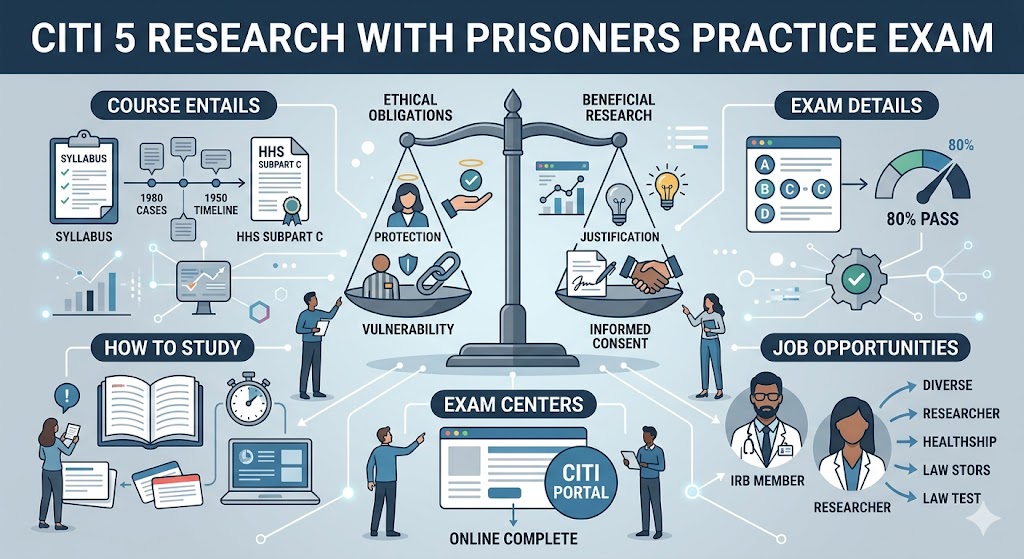
Additional Information
What the Course Entails and Exam Details
The course focuses on the complex ethical and regulatory
framework governing research with incarcerated individuals. The core topics
covered in the module and associated exams include:
- Historical
Context and Vulnerability: Understanding the historical exploitation
of prisoners in research and the subsequent development of ethical
standards.
- Defining
"Prisoner": Navigating the specific regulatory definitions
of who constitutes a prisoner under different jurisdictions and research
contexts.
- Subpart
C Regulations: Detailed exploration of the additional protections for
prisoners outlined in the U.S. Department of Health and Human Services
(HHS) regulations (Subpart C), including special review procedures.
- Minimal
Risk & Justification: Clearly distinguishing between minimal risk
for the general population and the heightened standard for prisoners, and
understanding how to strongly justify the inclusion of prisoners in
research.
- Informed
Consent: Mastering the critical challenges of obtaining voluntary,
non-coercive informed consent in an environment where autonomy is
inherently restricted.
- Balancing
Benefits and Harms: Techniques for critically assessing whether the
potential benefits of the research to the prisoner population or the
individual participant truly outweigh the risks, while avoiding undue
influence.
What to Expect in
the Final Exam
The CITI modules, including "Research with
Prisoners," typically culminate in multiple-choice and/or true-false
quizzes testing your comprehension of the material presented in the required
reading. Here is what to anticipate:
- Format:
The exam will consist entirely of objective questions. No essay writing or
practical components are required.
- Passing
Score Requirements: CITI institutions often set their own passing
thresholds for each module, but a score of 80% or higher is very common.
You must achieve the institution-specified minimum to earn a completion
certificate.
- Time
Limits: Generally, CITI exams do not have a time limit, allowing you
to move through the questions at your own pace and revisit the learning
materials as needed.
- Specific
Rules: This is typically an open-material exam. You are encouraged to
review the provided texts while completing the quizzes. However, the exact
rules can vary slightly by institution, so confirm with your affiliated
organization. You usually have multiple attempts to pass each quiz.
How to Study and Exam Centers
Effectively preparing for and completing your CITI modules
requires a structured approach. Here are actionable strategies:
- Active
Engagement with Material: Dedicate sufficient time to read each
required text thoroughly. Do not rush through the content solely to get to
the quiz. Take detailed notes, summarize key ethical concepts, and
physically write down the differences in regulations (e.g., minimal risk vs.
significant risk for prisoners).
- Create
Ethical Scenarios: Based on the readings, actively construct your own
hypothetical research scenarios involving prisoners. Ask yourself if the
proposed research would be ethical, what specific steps you would need to
take, and which regulations would apply.
- Use
CITI Practice Tests: Actively seek out and utilize authorized CITI
practice materials and quizzes (such as those associated with the title
"CITI 5 Research with Prisoners Practice Test") to test your
knowledge gaps before attempting the actual module quizzes. This will
familiarize you with the question style and key areas of focus.
- How
and Where to Take the Exam: The entire CITI Program, including all
modules and exams, is completed completely online via the CITI portal
website. You do not need to visit a physical testing center, a Pearson VUE
facility, or an authorized school to take the test. Access is managed
entirely through your affiliated institution's subscription to the CITI
Program.
Job Opportunities
from the Course
Successfully completing the CITI 5 Research with Prisoners
module and associated exams validates your expertise in complex research ethics
and regulatory compliance. This certification is a critical credential for
numerous career paths, including:
- Institutional
Review Board (IRB) Member or Administrator
- Clinical
Research Coordinator / Grant Manager (especially in prison healthcare or
social science settings)
- Research
Scientist / Principal Investigator (conducting studies on criminal
justice, rehabilitation, or prison populations)
- Ethics
Consultant or Compliance Officer
- Grants
and Contracts Specialist (overseeing grants involving vulnerable
populations)
- Public
Health Professional or Epidemiologist studying unique health issues within
correctional facilities.
We provide the comprehensive article and optimized title
above, ensuring appropriate spacing for your review and use. To further enhance
your preparation, we have also developed an interactive tool that allows you to
explore these complex concepts through realistic ethical scenarios.
The "CITI 5 Research with Prisoners Practice Exam"
centers on delicate ethical judgments within a strictly regulated framework.
Navigating these complexities—balancing potential research benefits against the
inherent vulnerabilities of incarcerated populations—can be challenging. To
deepen your understanding beyond standard text, we designed the interactive
tool below. By adjusting different research parameters, you can simulate
ethical decision-making scenarios, seeing the direct regulatory and ethical implications
of various research designs involving prisoners. This hands-on exploration
provides a different level of engagement and critical thinking than static
material alone.
Frequently Asked Questions
Reviews
5.0
Based on 0 reviews
Leave a Review
No reviews yet. Be the first to review!