
CITI Human Subjects Research Certification Practice Test
$69.00
- Buy to unlock unlimited access to all Quiz questions and Answers in this Quiz.
- After purchase you can print a PDF of the whole quiz at any point. The PDF will contain the questions and the correct answers.
About this Exam
The CITI Human Subjects Research (HSR) certification is a
vital ethical cornerstone for anyone conducting research involving human
participants.
This comprehensive training ensures researchers are
deeply familiar with the historical context and ethical principles guiding
responsible conduct in studies.
It is specifically designed for principal investigators,
research staff, students, Institutional Review Board (IRB) members, and anyone
seeking a solid foundation in research ethics.
Mastering this content signifies your commitment to
protecting the rights and welfare of research subjects, a fundamental
requirement in academic and clinical environments.
Ready to test your knowledge?
Buy Now to Access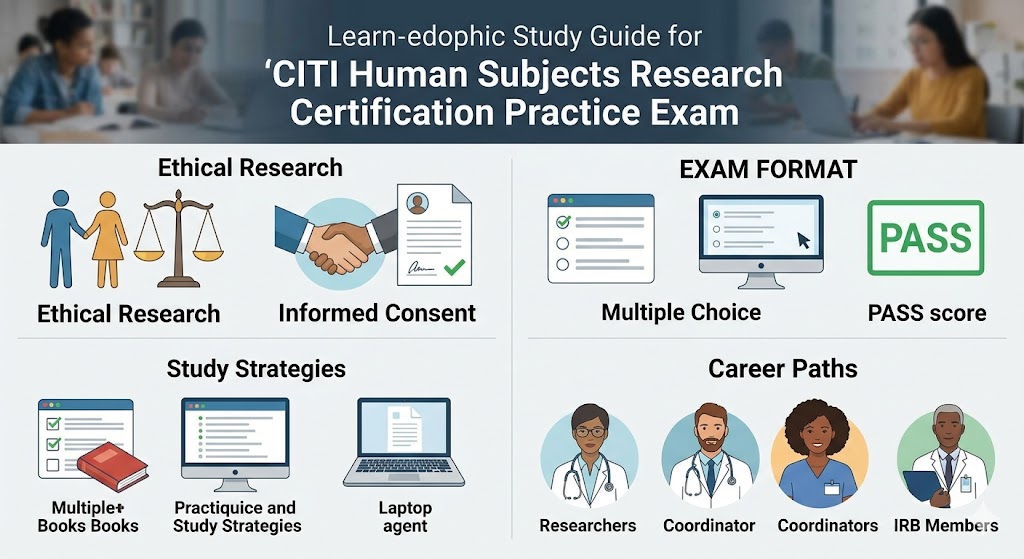
Additional Information
What the Course Entails
The CITI HSR course provides a deep dive into the
regulatory framework and ethical guidelines governing research with humans.
You will explore the history of ethical lapses that led
to current regulations, including the Nuremberg Code and the Belmont Report.
Core topics include understanding the role and function
of IRBs, obtaining informed consent, and protecting vulnerable populations.
The syllabus covers essential areas such as privacy and
confidentiality, assessing risks and benefits, and navigating international
research ethics.
By completing this course, you will acquire practical
skills in designing and conducting ethically sound research studies that
respect participant autonomy and well-being.
What to Expect in the Final Exam
The final assessment for the CITI HSR course is typically
a series of multiple-choice quizzes integrated throughout the online modules,
rather than one single proctored exam at the very end.
There are usually multiple quizzes, with each quiz
corresponding to a specific training module, testing your understanding of that
specific content area.
A minimum cumulative score, often around 80?ross all
modules, is generally required to pass the certification overall, though
specific institutional requirements may vary.
Quizzes are typically untimed, allowing you to carefully
review the material and questions, and you can often retake individual module
quizzes to improve your score if needed.
The format is straightforward multiple-choice, focusing
purely on applied understanding of the ethical principles and regulations
covered in the modules.
How to Study and
Exam Centers
Effective study involves actively reading each module,
taking detailed notes on key concepts, regulations, and case studies presented.
Utilizing practice exams specifically for CITI HSR can be
immensely beneficial, helping you familiarize yourself with question types and
identify knowledge gaps before attempting the official quizzes.
Focus on understanding the application of ethical
principles rather than just memorizing facts, as questions often present
scenarios.
You do not need to visit a physical testing center like
Pearson VUE; the entire CITI program, including all modules and quizzes, is
completed online through the CITI Program portal.
Once your institution or organization provides access,
you can securely log in and complete the training at your own pace, from any
location with internet access.
Job Opportunities
Successfully obtaining your CITI HSR certification is
highly beneficial and often mandatory for a wide range of professional roles in
research.
Common job titles that frequently require or
significantly value this certification include:
Principal Investigator or Co-Investigator
Clinical Research Coordinator or Associate (CRC/CRA)
Research Assistant or Coordinator
IRB Administrator or Member
Grant Writer or Manager
Ethicist or Research Ethics Consultant
Data Manager or Analyst
Academic or Clinical Researcher
Regulatory Affairs Specialist in research-focused
organizations
Frequently Asked Questions
Reviews
5.0
Based on 0 reviews
Leave a Review
No reviews yet. Be the first to review!