
Ciulla Clinical Chemistry Practice Test
$69.00
- Buy to unlock unlimited access to all Quiz questions and Answers in this Quiz.
- After purchase you can print a PDF of the whole quiz at any point. The PDF will contain the questions and the correct answers.
About this Exam
The Ciulla Clinical Chemistry Practice Test is an advanced preparatory resource specifically engineered for individuals aiming to achieve certification as Medical Laboratory Scientists (MLS) or Medical Laboratory Technicians (MLT).
This practice exam is patterned after the comprehensive methodology established by Linda Ciulla, a recognized authority in Medical Laboratory Science review.
It is designed for students enrolled in accredited MLS/MLT programs, as well as working professionals seeking comprehensive review before attempting their primary certification exams, such as those administered by the ASCP Board of Certification (BOC) or American Medical Technologists (AMT).
The primary goal of this resource is to consolidate complex knowledge and simulate the rigor of the actual clinical chemistry certification segment.
Ready to test your knowledge?
Buy Now to Access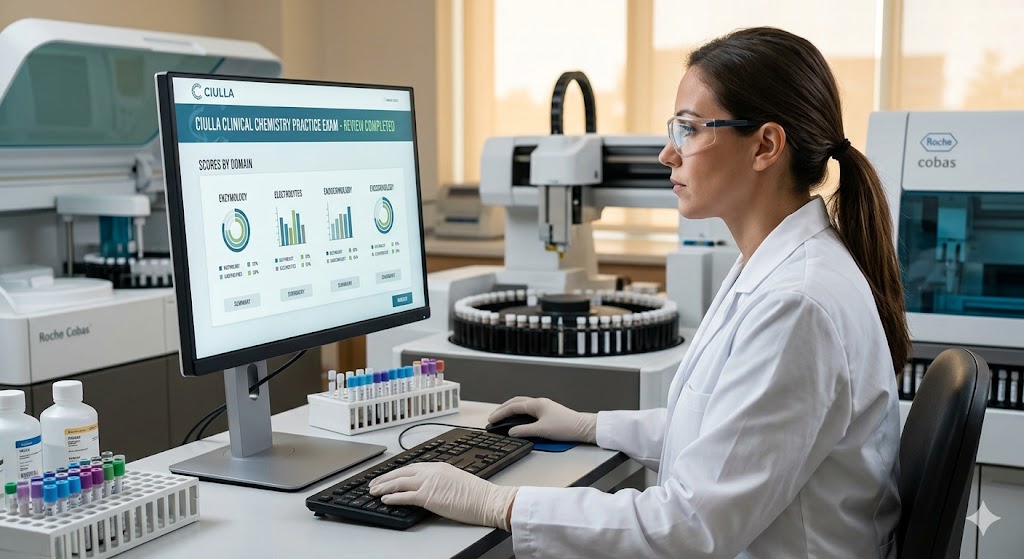
Additional Information
What the Course Entails and Exam Details
As a practice and review resource, this tool does not deliver a formal "course" with new lectures, but rather synthesizes critical clinical chemistry knowledge into a challenging examination format.
The exam content is comprehensively structured to cover the full spectrum of a modern clinical chemistry laboratory’s menu.
Prospective examinees must demonstrate proficiency across several core areas, which are generally divided into both testing knowledge and practical calculation skills.
The key areas covered include:
Laboratory Principles and Safety: Instrumentation, quality control, analytical techniques (spectrophotometry, chromatography, electrophoresis), and laboratory mathematics.
Analytes and Metabolic Pathways: The pathophysiology, measurement, and clinical significance of carbohydrates (glucose management), lipids and lipoproteins, proteins, and non-protein nitrogenous compounds.
Enzymology: Clinical significance of major diagnostic enzymes (e.g., CK, LDH, AST, ALT, ALP, Amylase, Lipase) and their isoenzymes.
Organ System Function: Comprehensive assessment of cardiac markers, liver function tests, renal function (including clearance calculations), and pancreatic assessment.
Endocrinology: The feedback mechanisms, function, and dysfunction of the thyroid, parathyroid, adrenal, and reproductive endocrine axes.
Electrolytes, Blood Gases, and Acid-Base Balance: Mastery of the Henderson-Hasselbalch equation and the interpretation of arterial blood gases.
Therapeutic Drug Monitoring (TDM) and Toxicology: The pharmacokinetics of common drugs and the detection of drugs of abuse.
What to Expect in the Final Exam
When utilizing the Ciulla Clinical Chemistry Practice Test, you should expect a simulation that mirrors the format and difficulty level of the official certification boards.
The "final exam" within this practice context is typically structured as follows:
Format: The exam consists of multiple-choice questions (MCQs). These are designed not just for recall, but to test critical thinking through clinical case scenarios and data interpretation.
Adaptive vs. Linear: While the main ASCP BOC exam is Computer Adaptive Testing (CAT), the Ciulla practice test usually functions in a linear format (a fixed set of questions) to ensure comprehensive topic coverage.
Time Limit: The practice exam will have a total time limit, often simulating the 2.5 to 3 hours allotted for the full multi-discipline board exam, though this practice test only focuses on the Chemistry discipline.
Content Weighting: The question distribution across the sub-topics is designed to match the specific content area percentages published by the main certification agencies.
How to Study and Exam Centers
Effective preparation using the Ciulla Clinical Chemistry Practice Test requires an active, structured study strategy rather than passive reading.
Follow this actionable method:
Baseline Assessment: Take one complete practice test without prior review. This establishes your baseline score and immediately highlights your weakest subject areas (e.g., endocrinology or acid-base balance).
Use the Explanations: Do not just look at the correct answer key. The value of this practice test lies in the detailed explanations provided for every choice (both correct and incorrect). Read these thoroughly to understand the underlying physiological principles and analytical logic.
Cross-Reference with Textbooks: When you miss a question or feel uncertain, return to your primary MLS textbooks (such as Bishop, Sunheimer, or Tietz) and Linda Ciulla's "Success! in Clinical Laboratory Science" review book. Do not rely solely on the practice questions.
Practice Calculations: Master the required formulas (e.g., Creatinine Clearance, LDL calculation, Anion Gap, Osmole Gap, Molarity/Normality). You must be able to perform these accurately and quickly under timed conditions.
Regarding Exam Centers: It is crucial to understand that the Ciulla Clinical Chemistry Practice Test is a study tool that you take on your own. It does not license you. To become certified, you must register for and take the official BOC or AMT exam. These official, proctored exams are administered only at secure, authorized testing facilities, most commonly Pearson VUE professional testing centers, located worldwide.
Job Opportunities from the Course
While completing a practice test does not unlock jobs itself, achieving the MLT or MLS certification that it helps you prepare for opens access to a robust career path.
A medical laboratory professional specialized in clinical chemistry is essential in all healthcare environments.
Success in this exam allows you to pursue specific job titles and career paths, including:
Medical Laboratory Scientist (MLS)
Medical Laboratory Technician (MLT)
Clinical Chemistry Specialist (Sc(ASCP))
Laboratory Supervisor (Chemistry Department)
Laboratory Quality Control Coordinator
Point-of-Care Testing (POCT) Coordinator
Toxicologist (in forensic or clinical settings)
Research and Development Scientist (Diagnostic Industry)
Field Service Engineer (for automated analyzers)
Frequently Asked Questions
Reviews
5.0
Based on 0 reviews
Leave a Review
No reviews yet. Be the first to review!