
Civics History and Government Naturalization Practice Test
$69.00
- Buy to unlock unlimited access to all Quiz questions and Answers in this Quiz.
- After purchase you can print a PDF of the whole quiz at any point. The PDF will contain the questions and the correct answers.
About this Exam
Preparing for the naturalization test is a crucial step in the journey to becoming a United States citizen.
This study guide focuses specifically on the Civics component, which evaluates an applicant's knowledge of U.S. history, government principles, and citizen rights and responsibilities.
The exam is designed for lawful permanent residents (Green Card holders) who have met all other eligibility requirements to apply for naturalization.
It serves as a foundational assessment to ensure new citizens possess the civic knowledge necessary to participate fully in American society.
Ready to test your knowledge?
Buy Now to Access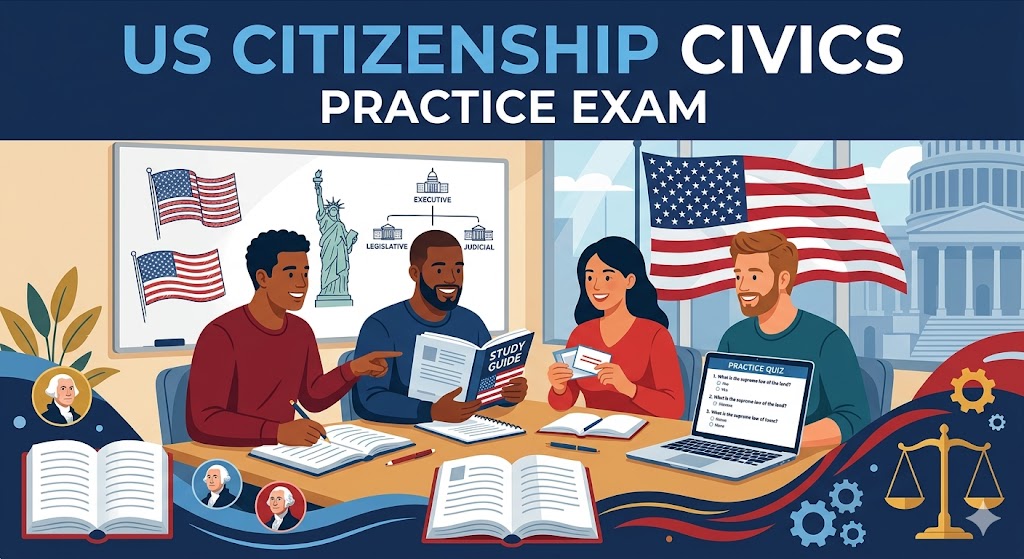
Additional Information
What the Course Entails and Exam Details
The official material for the test requires focused study on a standardized list of 100 civics questions provided by United States Citizenship and Immigration Services (USCIS).
The material is categorized into three primary areas: American Government, American History, and Integrated Civics.
Within these areas, applicants must study sub-topics such as the principles of American democracy, the structure of the system of government (Legislative, Executive, Judicial branches), and the rights and responsibilities of citizens.
Furthermore, the exam covers crucial historical periods including the colonial era and independence, the 1800s, and recent American history, along with general geography and national symbols.
What to Expect in the Final Exam
The final Civics exam is unique because it is conducted orally by a USCIS officer during your naturalization interview, rather than as a multiple-choice paper or computer test.
The officer will ask you up to 10 questions from the official list of 100 possible civics questions.
To pass this component of the naturalization test, you must answer at least 6 out of the 10 questions correctly.
While the civics portion is part of the overall interview, it is generally completed within a relatively short timeframe by well-prepared applicants.
It is critical to remember that, unless you meet specific age or disability exemptions, this test is administered in English to simultaneously demonstrate your English language proficiency.
How to Study and Exam Centers
Preparation is the cornerstone of success for the naturalization exam, and we recommend beginning your study with the official resources.
The primary study method should be the list of 100 possible civics questions and their answers, available directly from the USCIS website.
Effective study strategies include creating flashcards to help memorize historical facts, key figures, and government principles, as well as utilizing official USCIS audio guides.
You can also find multiple practice exams online that pull questions randomly from the official pool to help simulate the testing environment and boost your confidence.
Many community centers and immigration support groups offer free citizenship classes which provide structured learning, English practice, and peer support.
You will not schedule this test at a commercial test center; the exam takes place at the official USCIS Field Office where your naturalization interview is scheduled after your N-400 application has been accepted.
Job Opportunities from the Course
While the knowledge gained from this study guide itself does not guarantee specific job titles, the ultimate outcome—United States citizenship—unlocks numerous career and educational opportunities.
Possessing this civic knowledge is a requirement to become a citizen, and citizenship is a prerequisite for a wide array of career paths in the United States.
Upon becoming a citizen, individuals can apply for most federal government jobs within the United States Civil Service.
Citizenship opens doors to sensitive career fields that require a security clearance, which is often a fundamental requirement for many roles in defense, intelligence, and high-level technology contracting.
Citizens can seek election to public office, ranging from municipal positions up to state and federal legislatures.
Citizens have the unique opportunity to work for federal law enforcement agencies such as the FBI, CIA, and border security.
Furthermore, citizenship allows for easier global travel with a U.S. passport, which can facilitate careers involving extensive international business or diplomacy.
Becoming a citizen also grants the vital right to vote in all federal elections, a foundational civic duty and opportunity.
Frequently Asked Questions
Reviews
5.0
Based on 0 reviews
Leave a Review
No reviews yet. Be the first to review!