
Civil Engineering Professional Engineer Practice Exam
$69.00
- Buy to unlock unlimited access to all Quiz questions and Answers in this Quiz.
- After purchase you can print a PDF of the whole quiz at any point. The PDF will contain the questions and the correct answers.
About this Exam
The Civil Engineering Professional Engineer Practice Exam is an essential tool designed to prepare candidates for the official NCEES Principles and Practice of Engineering (PE) Civil exam. This comprehensive practice assessment is tailored for engineers who have already obtained a foundational engineering degree and accumulated the necessary professional experience, typically four years.
Our practice exam offers a realistic simulation of the actual test environment, ensuring you can assess your knowledge, improve your time management skills, and build the confidence required to succeed. By utilizing this resource, you can pinpoint specific areas needing further review, effectively narrowing your study focus and maximizing your chances of passing the official exam on your first attempt.
Ready to test your knowledge?
Buy Now to Access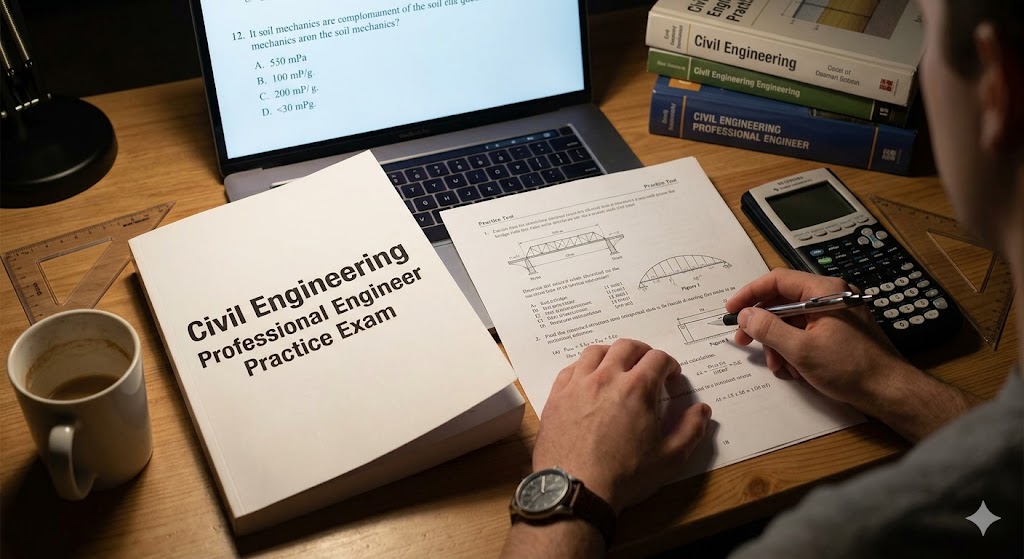
Additional Information
What the Course Entails and Exam Details
This practice exam covers the comprehensive syllabus required for the PE Civil exam, focusing on both breadth and depth topics across the five major civil engineering disciplines.
The material ensures thorough preparation in the following core areas:
Construction: Including project planning, estimating, scheduling, and material testing.
Geotechnical: Covering soil mechanics, foundations, and earth structures.
Structural: Focusing on analysis of structures, design mechanics, and code applications.
Transportation: Including geometric design, traffic analysis, and pavement design.
Water Resources and Environmental: Covering hydraulics, hydrology, and water/wastewater treatment.
The practice exam is designed to mirror the current NCEES exam specifications, providing up-to-date questions that test fundamental engineering principles and practical application skills.
What to Expect in the Final Exam
The actual NCEES PE Civil exam is a formidable 8-hour, computer-based test (CBT) consisting of 80 questions. The exam is divided into two 4-hour sessions: a breadth session in the morning and a depth session in the afternoon, focusing on your chosen area of specialization.
Key exam details include:
Format: Multiple-choice questions, along with alternative item types (AITs) such as drag-and-drop, point-and-click, and fill-in-the-blank.
Time Limit: 8 hours of total testing time, with a generic 50-minute scheduled break.
Reference Materials: The exam is closed-book; however, a digital version of the NCEES PE Civil Reference Handbook is provided on screen.
Passing Score: The NCEES does not publish a fixed passing score; results are based on a scaled score that accounts for exam difficulty.
How to Study and Exam Centers
Effective preparation for the PE Civil exam requires a disciplined approach combining theoretical review with extensive problem-solving practice.
Study Strategies:
Master the Handbook: Become intimately familiar with the NCEES PE Civil Reference Handbook, as this will be your primary resource during the test.
Structured Review: Utilize dedicated review courses or comprehensive study guides to refresh your knowledge across all breadth topics.
Simulated Practice: Take multiple full-length, timed practice exams to build stamina and improve pacing.
Focus on Depth: Dedicate substantial study time to your selected afternoon depth module.
Exam Centers:
The official NCEES PE Civil exam is administered year-round at authorized Pearson VUE test centers throughout the United States and internationally. Candidates must register through their MyNCEES account and schedule their exam appointment directly with Pearson VUE.
Job Opportunities from the Course
Obtaining your Professional Engineer (PE) license is a significant career milestone that validates your expertise and commitment to the engineering profession. This credential unlocks numerous advanced career paths and high-level job opportunities.
A PE license is highly valued across many sectors and can lead to the following positions:
Senior Civil Engineer
Project Manager (Engineering)
Principal Engineer
Structural Engineer
Geotechnical Engineer
Transportation Engineer
Water Resources Engineer
City/Municipal Engineer
Engineering Consultant
Director of Public Works
Structural Department Manager
Licensed Professional Engineers often enjoy higher salaries, greater job security, and the authority to sign and seal engineering drawings, which is essential for many high-responsibility projects.
Frequently Asked Questions
Reviews
5.0
Based on 0 reviews
Leave a Review
No reviews yet. Be the first to review!