
Civil Service Supervisor Practice Exam
$69.00
- Buy to unlock unlimited access to all Quiz questions and Answers in this Quiz.
- After purchase you can print a PDF of the whole quiz at any point. The PDF will contain the questions and the correct answers.
About this Exam
The Civil Service Supervisor examination is a crucial assessment utilized by state, local, and federal government agencies to evaluate a candidate’s readiness for leadership and administrative roles. This exam is specifically designed for public sector employees seeking promotion to supervisory positions or for external candidates applying directly for management-level government jobs. It serves as an objective filtering process, ensuring that those selected possess the necessary knowledge and behavioral skills to effectively manage personnel, budgets, and public resources in compliance with civil service laws and ethics. Passing this exam demonstrates not only job-specific expertise but also the critical thinking and decision-making capabilities essential for strong public leadership.
Ready to test your knowledge?
Buy Now to Access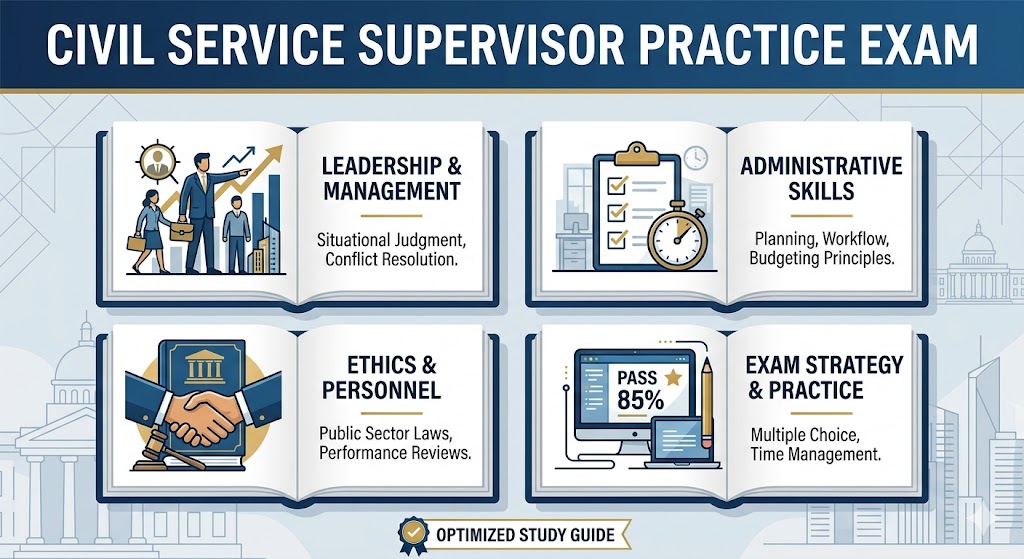
Additional Information
What the Course Entails and Exam Details
This examination does not generally follow a single, unified "course" curriculum but rather evaluates core competency areas essential for modern supervision within a public administration framework. Preparation requires understanding four primary domains. First is Leadership and Interpersonal Skills, which covers motivating diverse teams, resolving workplace conflicts, and delegating authority effectively. Second is Administrative Supervision and Planning, focusing on standard operating procedures, setting performance objectives, and managing workflows. Third is Personnel Management and Employee Relations, which assesses understanding of performance evaluations, progressive discipline, grievance procedures, and anti-discrimination laws (such as EEO/ADA). Finally, many exams include a critical assessment of Written Communication, ensuring supervisors can generate clear, professional reports and correspondence crucial for organizational transparency and efficiency.
What to Expect in the Final Exam
While the exact structure of the examination varies significantly depending on the specific government jurisdiction (city, county, state, or federal), most Civil Service Supervisor exams share common characteristics. The primary format is usually a computerized multiple-choice test. These questions frequently utilize situational judgment scenarios, presenting candidates with realistic workplace dilemmas and asking them to select the most effective management response. Depending on the level of the position, some exams may also include an oral board interview or a writing sample exercise. The passing score requirements are determined by the specific civil service commission, often ranging from 70% to 80%, but it is vital to check the specific job announcement, as the score may be used to rank candidates on an eligibility list. Strict time limits are enforced, often ranging from two to four hours depending on the complexity and volume of the questions.
How to Study and Exam Centers
Effective preparation is the single most important factor for success on this competitive exam. A vital first step is reviewing the specific "Job Description" or "Knowledge, Skills, and Abilities" (KSAs) listed in the official announcement for the supervisory role, as these are exactly what the exam will test. Focus your study efforts on areas you feel least confident about. It is highly recommended to use the practice exam provided to familiarize yourself with the structure and wording of civil service questions, particularly the situational judgment scenarios. Developing time management skills during practice will ensure you can complete the actual test within the tight deadlines. The method for taking the exam also depends on the specific jurisdiction. Most computerized testing centers are now managed by major proctoring services, but some city or county commissions still manage their own physical testing locations, such as local government buildings or authorized schools. Candidates must closely follow the instructions on their exam notice regarding scheduling, required identification, and prohibited items, as strict civil service protocols always apply.
Job Opportunities from the Course
Successfully passing the Civil Service Supervisor exam can unlock a wide range of stable, rewarding, and upwardly mobile career paths in the public sector. While job titles can vary greatly across different departments, these are representative of the roles that utilize this qualification:
Administrative Supervisor
Office Manager (Public Administration)
Field Operations Team Leader (e.g., Public Works or Sanitation)
Unit Supervisor (e.g., Social Services or DMV)
Administrative Analyst (Senior Level)
Division Manager (Department of Transportation or Recreation)
Supervisory Program Specialist
Operations Manager (City Planning)
Compliance Supervisor (Environmental Health)
Public Information Officer (Management Grade)
Frequently Asked Questions
Reviews
5.0
Based on 0 reviews
Leave a Review
No reviews yet. Be the first to review!