
Class 5 Boiler Practice Exam
$69.00
- Buy to unlock unlimited access to all Quiz questions and Answers in this Quiz.
- After purchase you can print a PDF of the whole quiz at any point. The PDF will contain the questions and the correct answers.
About this Exam
The Class 5 Boiler Operator certification is a fundamental credential for individuals seeking to enter the field of power engineering and facility maintenance.
This certification validates that an individual possesses the essential knowledge and skills required to safely operate and maintain small high-pressure boilers and various types of low-pressure boiler systems.
It is designed for entry-level operators, maintenance technicians, and building superintendents who are responsible for the safe and efficient functioning of heating plants in commercial buildings, industrial facilities, and residential complexes.
Earning this license is often the first step toward a rewarding career in stationary engineering.
Ready to test your knowledge?
Buy Now to Access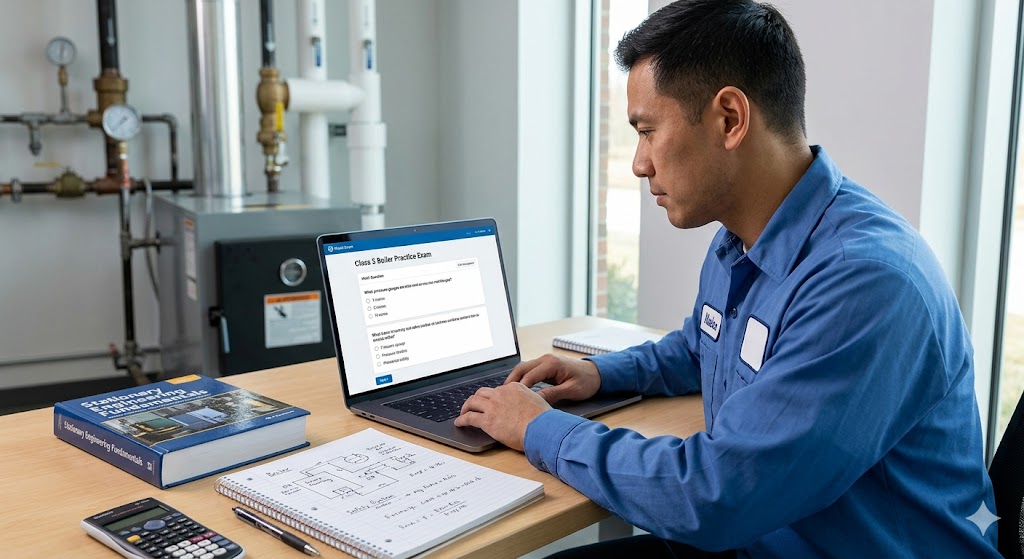
Additional Information
What the Course Entails and Exam Details
To prepare for the exam, candidates typically undergo training that covers the core principles of boiler operation, safety protocols, and regulatory requirements.
The specific syllabus may vary slightly by jurisdiction, but generally includes foundational knowledge in thermodynamics and heat transfer.
You will study boiler designs, including firetube and watertube configurations, and learn about essential boiler fittings and controls such as safety valves, water columns, and pressure gauges.
The curriculum places significant emphasis on feedwater treatment, combustion fundamentals, fuel systems, and draft control.
Furthermore, students are trained in standard operating procedures, including start-up and shut-down sequences, routine maintenance tasks, and emergency response protocols to ensure workplace safety.
What to Expect in the Final Exam
The final exam is designed to rigorously test your understanding of the training material and your ability to apply that knowledge to real-world scenarios.
Typically, the Class 5 exam is a proctored, written test consisting of multiple-choice questions.
Depending on the specific jurisdiction or examining body, there may be between 50 and 100 questions.
Candidates are usually allotted a specific time limit to complete the exam, often ranging from two to three hours.
While specific passing scores vary by region, a score of 65% to 75% is generally required to achieve certification.
The exam focuses heavily on safety regulations, operating procedures, and troubleshooting common boiler issues, requiring a thorough understanding of the material rather than simple memorization.
How to Study and Exam Centers
Effective preparation is key to passing the Class 5 Boiler Practice Exam on your first attempt.
Begin by thoroughly reviewing the official course materials, study guides, and relevant boiler codes and regulations utilized in your jurisdiction.
Utilizing a comprehensive "Class 5 Boiler Practice Exam" is highly recommended; taking timed practice tests helps familiarize you with the question format, identifies areas where you need further study, and improves your time management skills.
Forming study groups can also be beneficial for discussing complex topics and sharing insights.
When you are ready to take the final exam, scheduling is usually managed through local regulatory authorities, safety councils, or authorized technical colleges.
In many regions, exams are administered at specific government testing centers or through proctored online portals, while some jurisdictions utilize third-party testing services like Pearson VUE.
Be sure to check with your local licensing board for specific location options and registration requirements.
Job Opportunities from the Course
Obtaining your Class 5 Boiler Operator certification opens the door to numerous entry-level positions in facility management and industrial operations.
This credential is highly valued by employers who require skilled personnel to oversee their heating and power systems.
Graduates and certified individuals can pursue various career paths, including:
Boiler Operator
Junior Power Engineer
Facility Maintenance Technician
Building Superintendent
Heating Plant Operator
Maintenance Mechanic
Assistant Stationary Engineer
Operations Technician in manufacturing plants, hospitals, schools, and commercial high-rises.
Frequently Asked Questions
Reviews
5.0
Based on 0 reviews
Leave a Review
No reviews yet. Be the first to review!