
Clery Certification Practice Exam
$69.00
- Buy to unlock unlimited access to all Quiz questions and Answers in this Quiz.
- After purchase you can print a PDF of the whole quiz at any point. The PDF will contain the questions and the correct answers.
About this Exam
The Clery Act is a crucial federal mandate ensuring transparency in campus safety policies and crime statistics at higher education institutions across the United States. A Clery Certification validates a professional's comprehensive expertise in navigating these complex legal requirements. This credential is vital for professionals tasked with maintaining safe, compliant educational environments. It is ideally designed for campus police, security personnel, compliance officers, university administrators, and legal counsel working within higher education. Achieving certification demonstrates a rigorous commitment to student safety and institutional integrity.
Ready to test your knowledge?
Buy Now to Access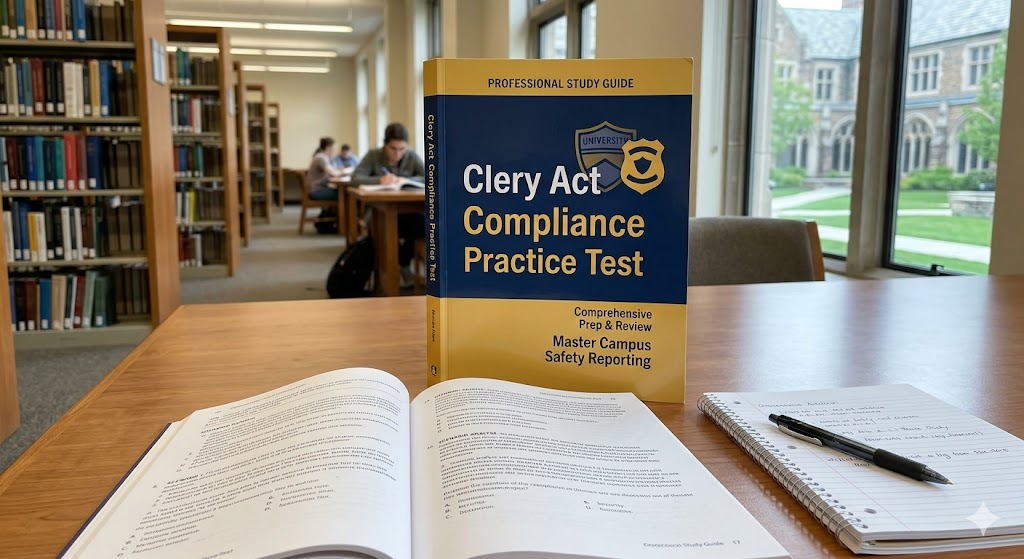
Additional Information
What the Course Entails and Exam Details
Candidates must master the intricate components of the Jeanne Clery Disclosure of Campus Security Policy and Campus Crime Statistics Act. Key areas of study include defining "Clery geography" and accurately identifying Campus Security Authorities (CSAs). You will learn how to classify crimes according to federal UCR/NIBRS definitions and compile accurate statistics for the Annual Security Report (ASR). The course also covers mandatory protocols for issuing Timely Warnings and Emergency Notifications to the campus community. Furthermore, it addresses critical compliance regarding VAWA (Violence Against Women Act) offenses, hate crime reporting, and maintaining a public daily crime log.
What to Expect in the Final Exam
The final exam is designed to test practical application, not just rote memorization. Expect a computer-based test composed primarily of multiple-choice and scenario-based questions. Many questions will present a realistic campus incident and require you to correctly determine if it is a Clery-reportable crime, where it occurred geography-wise, and what reporting actions are required. While exact details vary by the specific certifying body, the exam is generally timed, offering around 90 to 120 minutes for completion. A passing score is typically high, often requiring 70% to 80% correct answers to demonstrate true proficiency.
How to Study and Exam Centers
Effective preparation begins with a thorough reading of the official "The Handbook for Campus Safety and Security Reporting" provided by the U.S. Department of Education. Create detailed flashcards for specific crime definitions, geographical classifications, and mandatory reporting timelines. Utilize official practice exams repeatedly to familiarize yourself with the question formatting and to manage your time pressure effectively. Focus heavily on practice scenarios, as these test your true understanding of how the act applies to real-world situations. These exams are usually administered online through the specific certifying organization’s secure portal. Upon registration for a recognized training course, you will receive secure access links to take the exam remotely at your convenience.
Job Opportunities from the Course
Achieving this certification significantly enhances your career prospects and earning potential in higher education administration and public safety. It distinguishes you as a dedicated compliance specialist in a high-stakes legal area that institutions take very seriously.
This credential opens doors to specific specialized roles, including:
Clery Act Compliance Officer
Director of Public Safety or Campus Police Chief
Title IX Coordinator or Investigator
Vice President of Student Affairs
University Risk Manager
Campus Safety Data Analyst
Higher Education Legal Consultant
Frequently Asked Questions
Reviews
5.0
Based on 0 reviews
Leave a Review
No reviews yet. Be the first to review!