
Clinical Biomechanics Practice Test
$69.00
- Buy to unlock unlimited access to all Quiz questions and Answers in this Quiz.
- After purchase you can print a PDF of the whole quiz at any point. The PDF will contain the questions and the correct answers.
About this Exam
The Clinical Biomechanics certification exam serves as a premier validation of knowledge for professionals dedicated to analyzing human movement from a mechanical and physiological perspective. This specialized exam is designed for physical therapists, occupational therapists, kinesiologists, athletic trainers, and movement specialists who seek to apply advanced mechanical principles to patient assessment, injury prevention, and rehabilitation strategies. Earning this credential confirms an individual's expertise in understanding the forces acting on the human body and how these forces influence musculoskeletal function and dysfunction. It is a vital step for practitioners aiming to enhance their diagnostic accuracy and develop more effective, evidence-based treatment plans for diverse patient populations.
Ready to test your knowledge?
Buy Now to Access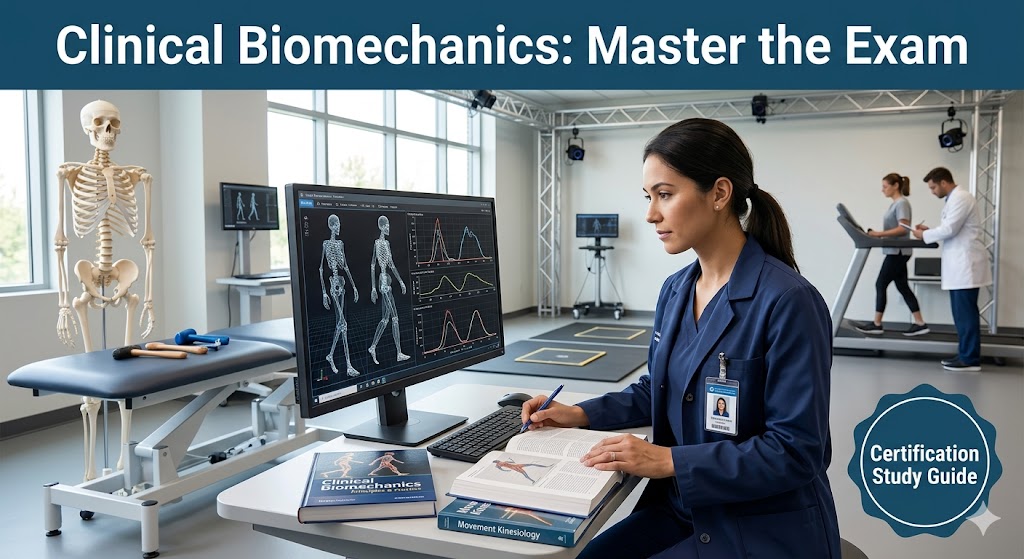
Additional Information
What the Course Entails and Exam Details
The course and exam content are designed to provide a thorough understanding of human movement science applied in clinical settings. The comprehensive syllabus covers several foundational and advanced topics.
Kinematics and kinetics form the core of the biomechanical analysis principles you must master.
You will delve into joint mechanics, examining the specific forces and ranges of motion for the spine, upper extremities, and lower extremities.
A significant portion of the course focuses on muscle physiology and the mechanics of muscle contraction as they relate to human movement.
The analysis of pathological movement patterns, particularly gait analysis, is central to clinical application and heavily featured in the material.
Injury mechanics, understanding how excessive or repetitive forces cause trauma, is another critical area of study.
Additional topics include postural analysis, the biomechanics of specific activities (such as running or lifting), and the application of orthotic and prosthetic devices from a mechanical perspective.
Ergonomics and workplace assessment methods are also integral components of the modern clinical biomechanics curriculum.
What to Expect in the Final Exam
The final Clinical Biomechanics certification exam is a rigorous assessment of both your theoretical understanding and your ability to apply biomechanical concepts to practical, clinical scenarios.
Candidates should expect a computerized examination that typically consists of approximately 100 to 150 multiple-choice questions.
These questions often present detailed case studies, requiring you to interpret patient data, motion analysis results, or imaging and then determine the most appropriate biomechanical diagnosis or intervention.
The testing window generally allows between two and three hours for completion, with no scheduled breaks.
The specific passing score varies by the certifying body but often requires achieving 70% to 75% of the total available points.
The exam is typically closed-book, and strict proctoring procedures are enforced, whether taken at a testing center or via an online proctoring service.
Immediate, preliminary scoring is sometimes provided, but official results are typically sent after a final review period.
How to Study and Exam Centers
Effective preparation for the Clinical Biomechanics exam demands a structured, multi-faceted study strategy that balances theory with practical application.
Begin your preparation by reviewing foundational textbooks that focus specifically on clinical biomechanics, kinesiology, and joint anatomy.
Create a detailed study schedule that dedicates specific, concentrated blocks of time to each major content area outlined in the exam syllabus.
Utilize high-quality practice exams, such as the Clinical Biomechanics Practice Test, as your primary tool for simulation and assessment.
Use these practice tests not only to gauge your readiness but to identify specific areas where your knowledge is weak, focusing your revision efforts accordingly.
Forming study groups with peers can provide diverse perspectives and enhance problem-solving skills, particularly when discussing complex clinical case studies.
Focus heavily on practical gait and movement analysis drills; practicing biomechanical assessments with volunteer "patients" is invaluable for reinforcing these skills.
The exam is typically administered through professional certification boards or associations in the fields of sports medicine, physical therapy, or kinesiology.
Testing methods include secure online proctoring portals, allowing you to take the exam from a private location.
Alternatively, the exam may be offered at physical, authorized testing centers, such as those managed by Pearson VUE, or within specified university labs and professional development facilities.
Job Opportunities from the Course
Earning a Clinical Biomechanics certification unlocks diverse and specialized career opportunities across healthcare and research fields.
Clinical Biomechanist in hospitals or specialized clinics
Gait Laboratory Coordinator/Analyst
Movement Analysis Specialist in sports performance centers
Orthopedic Rehabilitation Consultant
Research Biomechanist in university or private research labs
Sports Performance and Injury Prevention Analyst
Prosthetics and Orthotics Designer (when combined with appropriate professional degrees)
Ergonomic Consultant for corporate health and safety programs
University Lecturer or Clinical Instructor in movement science programs
Frequently Asked Questions
Reviews
5.0
Based on 0 reviews
Leave a Review
No reviews yet. Be the first to review!