
Clinical Chemistry Numericals Practice Test
$69.00
- Buy to unlock unlimited access to all Quiz questions and Answers in this Quiz.
- After purchase you can print a PDF of the whole quiz at any point. The PDF will contain the questions and the correct answers.
About this Exam
Welcome to your essential resource for mastering the mathematical foundations of the clinical laboratory. This Clinical Chemistry Numericals Practice Test is meticulously designed to help Medical Laboratory Scientists (MLS), Technicians (MLT), and students sharpen the calculation skills required in a modern diagnostic setting. Accurate numerical analysis is crucial for interpreting patient results and ensuring quality control. This practice exam provides a realistic simulation of the types of calculation-based questions you will encounter on professional certification exams and in daily laboratory practice.
Ready to test your knowledge?
Buy Now to Access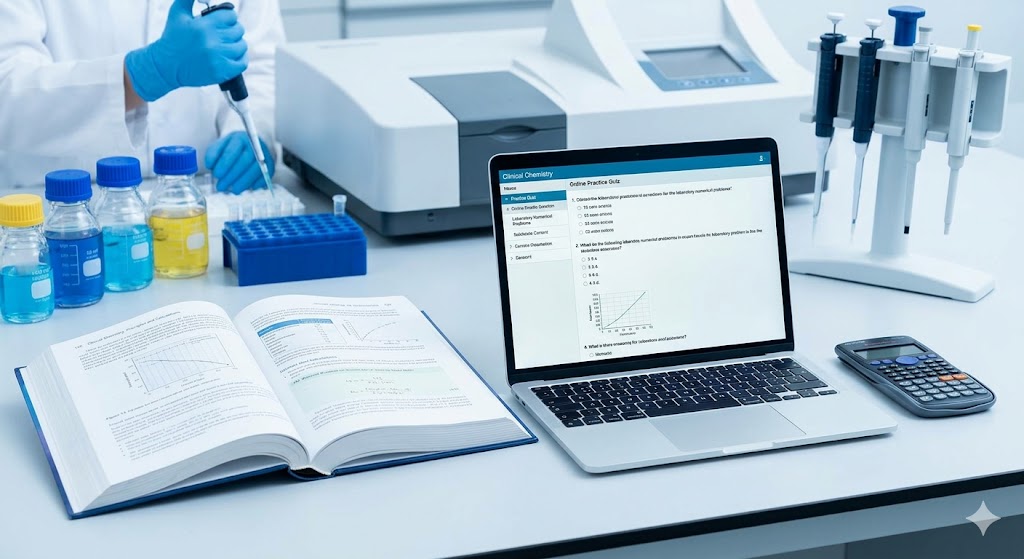
Additional Information
What the Course Entails and Exam Details
This comprehensive practice test covers the full spectrum of calculations performed in a clinical chemistry department. You will be tested on your ability to accurately solve problems related to:
Molarity, normality, and molality calculations.
Percent solutions and dilutions (including serial dilutions).
Beers Law and spectrophotometry applications.
Enzyme activity calculations.
Acid-base balance and Henderson-Hasselbalch equations.
Quality control statistics (mean, standard deviation, coefficient of variation).
Renal function calculations (e.g., creatinine clearance).
Anion gap and osmolality determinations.
Unit conversions (SI to conventional units and vice-versa).
Mastering these areas ensures you possess the competence and confidence required for accurate laboratory reporting.
What to Expect in the Final Exam
While this is a practice exam, it is structured to simulate the rigor of professional certification bodies like the ASCP Board of Certification (BOC) or AMT. A typical final examination covering clinical chemistry numericals will be computer-based and primarily consist of multiple-choice questions focusing heavily on problem-solving.
Expect a timed environment, requiring you to work efficiently under pressure. The passing score varies by the specific certification body but generally requires a solid understanding of the core concepts rather than just memorization of formulas. Precision is key; many questions will require careful calculation and attention to units.
How to Study and Exam Centers
Effectively preparing for numerical-based exams requires a strategic approach.
Review Formulas Consistently: Create flashcards for essential clinical chemistry formulas and review them daily until retrieval is automatic.
Practice, Practice, Practice: The best way to improve is by solving as many different types of problems as possible. Use this practice test multiple times to build speed and accuracy.
Understand the 'Why': Don't just memorize formulas; understand the underlying principles behind each calculation (e.g., why you dilute a sample, what spectrophotometry measures).
Focus on Unit Conversions: Many errors stem from incorrect unit conversions. Dedicate specific study time to mastering conversions between different systems of measurement.
As this is a self-paced practice resource, you can access this material anywhere with an internet connection. For the official certification exams (like the ASCP BOC), you will need to schedule your test at an authorized computer-based testing center, such as Pearson VUE. These centers are located globally and offer secure, proctored environments.
Job Opportunities from the Course
Achieving proficiency in clinical chemistry numericals is a critical step toward certification and advancement in the medical laboratory field. Mastering these skills unlocks numerous rewarding career paths, including:
Medical Laboratory Scientist (MLS)
Medical Laboratory Technician (MLT)
Clinical Chemistry Specialist
Laboratory Supervisor/Manager
Quality Control Coordinator
Point-of-Care Testing Coordinator
Research Associate in Clinical Diagnostics
Technical Support Specialist for Laboratory Instrumentation
Frequently Asked Questions
Reviews
5.0
Based on 0 reviews
Leave a Review
No reviews yet. Be the first to review!