
Clinical Connections Practice Test
$69.00
- Buy to unlock unlimited access to all Quiz questions and Answers in this Quiz.
- After purchase you can print a PDF of the whole quiz at any point. The PDF will contain the questions and the correct answers.
About this Exam
The Clinical Connections designation is a pivotal milestone for healthcare students transitioning from theoretical classroom knowledge to hands-on clinical practice. This certification is designed to validate a candidate’s ability to synthesize core medical knowledge and apply it within dynamic, real-world patient scenarios.
It is primarily targeted at medical students approaching their clerkships, nursing students entering advanced clinical rotations, and allied health professionals seeking to demonstrate readiness for autonomous practice. By assessing critical thinking rather than rote memorization, the Clinical Connections Exam ensures that candidates are prepared to provide safe, effective, and compassionate patient care.
Ready to test your knowledge?
Buy Now to Access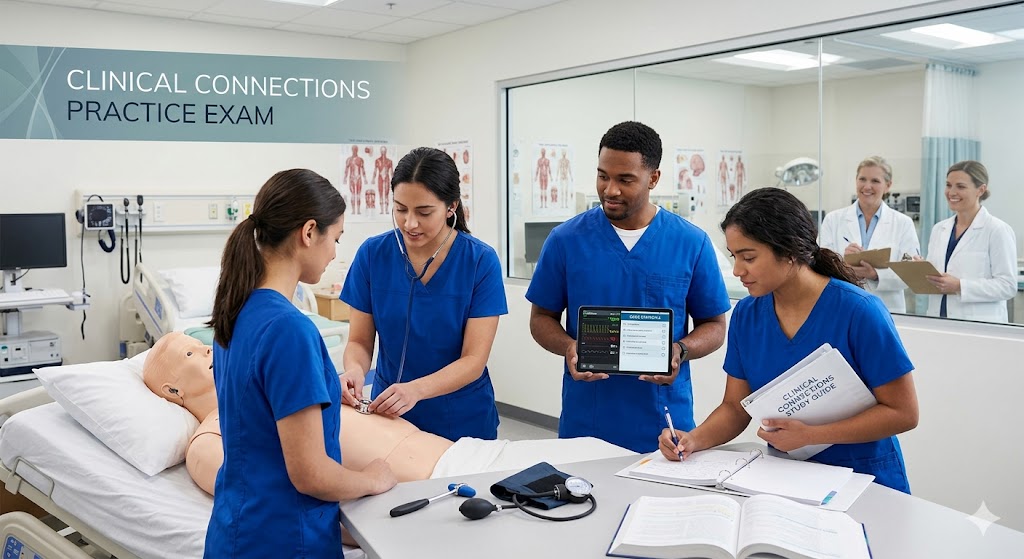
Additional Information
What the Course Entails and Exam Details
To succeed on the Clinical Connections Exam, candidates must master the art of "connecting" disparate pieces of clinical information. The preparatory course and the exam itself cover several core competency domains.
First, candidates must demonstrate proficiency in comprehensive Patient Assessment. This includes obtaining a focused history and performing accurate, systematic physical examinations.
Second, the curriculum emphasizes Clinical Reasoning and Differential Diagnosis. Students are tested on their ability to interpret lab results, diagnostic imaging, and vital signs to formulate a prioritized list of potential diagnoses.
Third, candidates must master Plan Formulation and Documentation. This involves creating evidence-based treatment plans and documenting them clearly using standard medical formats, such as SOAP notes.
Finally, a significant portion of the details focus on Communication and Professionalism. This includes demonstrating empathy, cultural competence, and the ability to work effectively within an interprofessional healthcare team.
What to Expect in the Final Exam
The Final Clinical Connections Exam is a rigorous assessment, often delivered in a hybrid format to test both knowledge and application. While specific details can vary slightly by the administering institution, candidates should prepare for the following general structure.
The knowledge component is typically delivered via Multiple-Choice Questions (MCQs). These are rarely simple recall questions; they are almost exclusively case-based scenario questions that require you to analyze a patient vignette before selecting the best management step.
The practical component often utilizes Objective Structured Clinical Examinations (OSCEs). In this format, you will move through various timed stations. At each station, you will interact with a Standardized Patient (an actor) or a high-fidelity manikin to perform specific tasks, such as history taking, focused physical exams, or delivering difficult news.
Passing Score and Time Limits: Because this exam is often used as a competency benchmark within specific academic or hospital programs, the passing score is determined by the local examining board (often set around 70-80% for the MCQ portion, with "Pass" grades required for all critical OSCE safety checks). You will be strictly timed for both portions, with OSCE stations often lasting between 10 and 20 minutes each.
How to Study and Exam Centers
Preparation for the Clinical Connections Practice Test requires a balance of study and active practice.
Actionable Study Strategies:
Utilize Case-Based Review: Do not just read textbooks. Study from case files and question banks that force you to synthesize information and make management decisions.
Form Study Groups for OSCEs: This is critical. Practice history taking and physical exams on your peers. Take turns acting as the patient, the clinician, and the examiner using a checklist to provide constructive feedback.
Practice Documentation: After every practice patient encounter, write a full SOAP note. Time yourself to ensure you can be comprehensive yet concise under pressure.
Focus on High-Yield Topics: Review standard treatment guidelines for common chronic conditions (e.g., hypertension, diabetes) and acute presentations (e.g., chest pain, shortness of breath).
Exam Centers and Registration:
Because the Clinical Connections Exam is often tied to specific academic progression, it is rarely offered at generic public testing centers like Pearson VUE. Instead, the exam is typically administered directly through your university’s simulation center, your hospital’s medical education department, or authorized medical schools.
Candidates usually register through their internal student portal or clinical coordinator. Be sure to check with your specific program for the approved list of authorized testing locations and upcoming exam dates.
Job Opportunities from the Course
Passing the Clinical Connections Exam is a critical verification of clinical readiness. While it is rarely a standalone commercial certification, it is a necessary gateway that unlocks the clinical rotations required to earn your final degree. Completing this step brings you significantly closer to the following career paths.
Doctor of Medicine (MD/DO): Moves students into core clerkships and residency.
Registered Nurse (RN) - Advanced Placement: Required for entry into specialized acute care or critical care rotations.
Physician Assistant (PA-C): Final gateway before entering clinical rotation phase.
Nurse Practitioner (NP): Validates assessment skills required for advanced practice clinical hours.
Physical Therapist (DPT): Ensures readiness for clinical internships and patient management.
Occupational Therapist (OTR): Unlocks the fieldwork required for final certification.
Respiratory Therapist (CRT/RRT): Demonstrates competency needed for hospital-based clinical training.
Frequently Asked Questions
Reviews
5.0
Based on 0 reviews
Leave a Review
No reviews yet. Be the first to review!