
Coast Guard Hyperbaric Medicine Practice Test
$69.00
- Buy to unlock unlimited access to all Quiz questions and Answers in this Quiz.
- After purchase you can print a PDF of the whole quiz at any point. The PDF will contain the questions and the correct answers.
About this Exam
The Coast Guard Hyperbaric Medicine certification is an advanced qualification tailored for specialized personnel operating in high-pressure environments. Primarily designed for Coast Guard Divers, Medical Officers, and Health Services Technicians (HS), this certification validates the specialized knowledge required to operate hyperbaric chambers, treat diving accidents, and administer hyperbaric oxygen therapy (HBOT). This training ensures that critical personnel are equipped to handle complex barotrauma, decompression sickness, and operational medical emergencies, maintaining mission readiness in the most demanding maritime conditions.
Ready to test your knowledge?
Buy Now to Access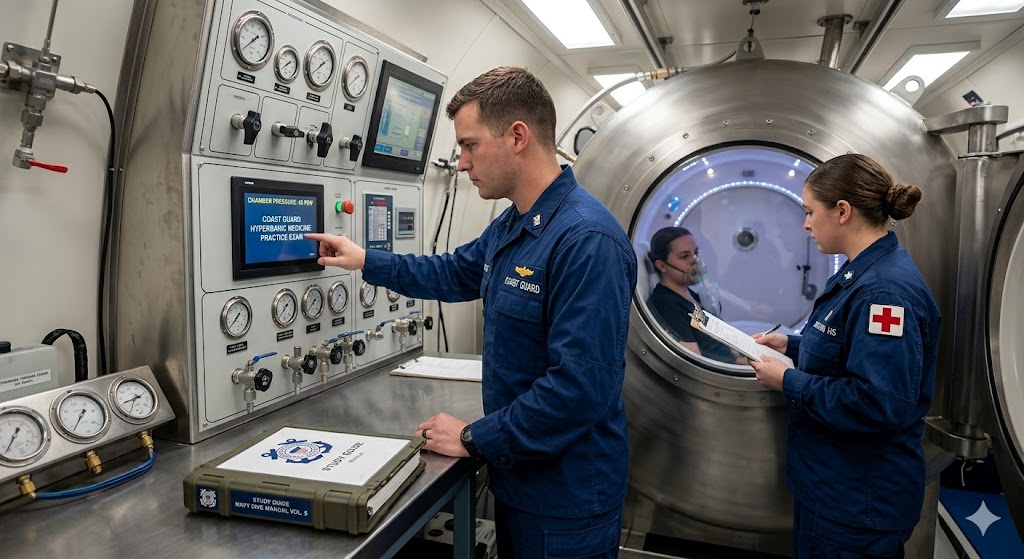
Additional Information
What the Course Entails and Exam Details
The core curriculum of this program bridges the gap between physics, physiology, and emergency medical response. Students undergo rigorous training that equips them with a deep understanding of the following areas:
Hyperbaric Physics: The laws of physics governing gases under pressure, including Boyle’s, Dalton’s, Henry’s, and Charles’s laws, and their application to diving and chamber operations.
Diving Physiology: The human body’s physiological response to increased ambient pressure, gas toxicities (oxygen, nitrogen, carbon dioxide), and the mechanisms of decompression sickness and arterial gas embolism.
Chamber Operations: Technical proficiency in operating multiplace and/or monoplace hyperbaric chambers, including pressurization, ventilation, and emergency procedures.
US Navy Decompression Tables: Expert mastery of the official decompression and recompression treatment tables used to manage dive profiles and treat dysbaric injuries.
Hyperbaric Medicine: Indications and contraindications for hyperbaric oxygen therapy (HBOT) in both diving and clinical settings, such as carbon monoxide poisoning, gas gangrene, and selected non-healing wounds.
Safety and Regulations: Stringent adherence to safety protocols, including fire prevention, equipment maintenance, and operational standards set by the Coast Guard and recognized bodies like the NBDHMT (National Board of Diving and Hyperbaric Medical Technology).
What to Expect in the Final Exam
The Coast Guard Hyperbaric Medicine Final Exam is a demanding assessment that tests both your theoretical knowledge and your ability to apply it under pressure. While specific formats may vary slightly depending on the training facility (e.g., Naval Diving and Salvage Training Center), you can generally expect the following:
Exam Format: The final examination is primarily multiple-choice. It often consists of 100 to 120 questions. Some versions may also include true/false questions or a practical scenario component where you must demonstrate chamber operation or treatment table selection.
Time Limit: Candidates are typically allotted a strict time limit, such as 2 hours for the written portion.
Passing Score: The required passing score is high, reflecting the safety-critical nature of the work. Candidates usually must achieve a minimum score of 70% to 80%.
Rules: The exam is typically closed-book. You will need to bring authorized identification.
How to Study and Exam Centers
Preparation is the absolute key to success on this challenging exam. Use these actionable strategies to optimize your study time:
Master the Navy Dive Manual: The US Navy Diving Manual is your foundational text. Create detailed outlines of Chapter 2 (Physics), Chapter 3 (Physiology), and Chapter 20 (Diagnosis and Treatment of Decompression Sickness and Arterial Gas Embolism).
Use Practice Exams Strategically: Incorporate the Coast Guard Hyperbaric Medicine Practice Exam into your study routine early and often. Take initial practice tests to identify your weak points, then use subsequent tests to simulate the timed exam environment. Do not memorize answers; understand the rationale behind the correct choice.
Practice with Decompression Tables: Do not just read the tables; practice solving complex diving scenarios. Know exactly which treatment table to use for various symptoms and profiles.
Create Flashcards: Flashcards are excellent for memorizing the laws of physics, gas toxicity levels, and critical safety procedures.
Group Study: Study with fellow candidates to discuss complex concepts, peer-review recompression scenarios, and keep each other motivated.
Exam Centers: The final certification exam is administered through authorized military and government training facilities, most notably the Naval Diving and Salvage Training Center (NDSTC) in Panama City, Florida, where many Coast Guard personnel receive their diving and hyperbaric training. Upon completion of the required coursework and passing the internal exam, personnel may also be eligible to sit for civilian board certifications, such as the Diving Medical Technician (DMT) or Certified Hyperbaric Technologist (CHT), offered via the National Board of Diving and Hyperbaric Medical Technology (NBDHMT), which utilizes Pearson VUE testing centers worldwide.
Job Opportunities from the Course
Earning your Coast Guard Hyperbaric Medicine certification unlocks specialized career paths both within the military and in the civilian sector. This certification signals to employers that you possess a unique, elite skillset in operational medicine and high-risk technical operations.
Career Paths and Job Titles:
Coast Guard Diver (DV): Specializing in search and rescue, salvage, and underwater inspection.
Coast Guard Health Services Technician (HS): Serving as a specialized medical first responder on dive teams or in chambers.
Chamber Operator / Supervisor: Responsible for the safe execution of recompression treatments.
Diving Medical Technician (DMT): (Civilian equivalent via NBDHMT) Working on commercial dive teams, in hyperbaric clinics, or in medical research.
Certified Hyperbaric Technologist (CHT): (Civilian equivalent via NBDHMT) Operating clinical hyperbaric chambers in hospitals and medical centers to provide HBOT.
Hyperbaric Safety Officer: Overseeing safety protocols in clinical or commercial hyperbaric environments.
Commercial Diver: Utilizing specialized medicine knowledge for deep-sea operations.
Best of luck with your studies. This certification represents a standard of excellence, and with dedicated preparation using this Coast Guard Hyperbaric Medicine Practice Exam guide, you are well on your way to achieving it.
Frequently Asked Questions
Reviews
5.0
Based on 0 reviews
Leave a Review
No reviews yet. Be the first to review!