
Coast Guard Practice Exam
$69.00
- Buy to unlock unlimited access to all Quiz questions and Answers in this Quiz.
- After purchase you can print a PDF of the whole quiz at any point. The PDF will contain the questions and the correct answers.
About this Exam
The Coast Guard Merchant Mariner Credential (MMC) is the essential license required for any individual seeking to work professionally on commercial vessels in the United States. This certification is issued by the U.S. Coast Guard National Maritime Center (NMC) and serves as proof of your qualification, training, and experience to serve in various capacities afloat. The exams are designed for aspiring captains, deck officers, marine engineers, and specialized ratings who need to demonstrate regulatory knowledge and technical proficiency. Whether you are aiming to operate a small charter boat or serve as an officer on a large oceangoing cargoship, passing these exams is the critical regulatory milestone in your maritime career path.
Ready to test your knowledge?
Buy Now to Access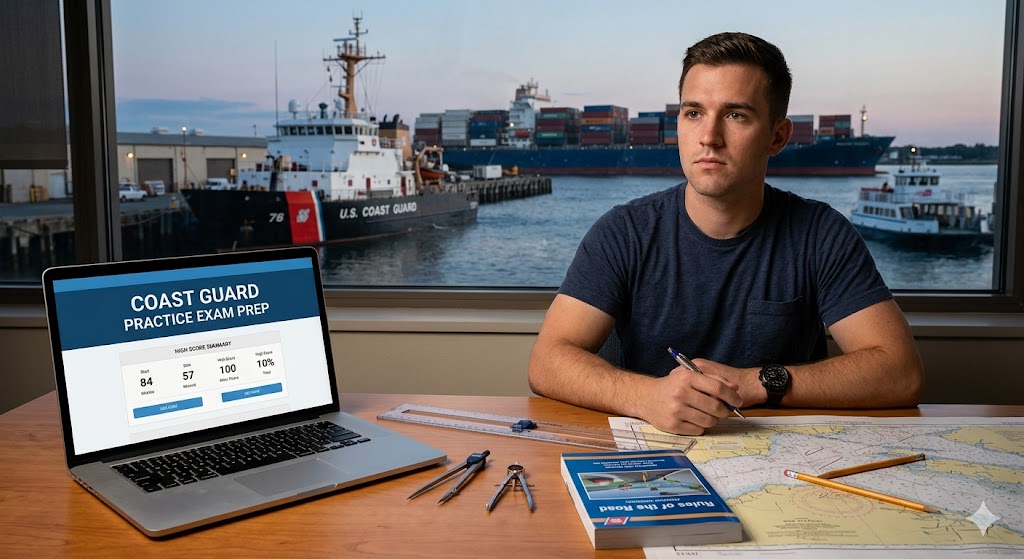
Additional Information
What the Course Entails and Exam Details
The scope of the Coast Guard exams is broad, reflecting the complexity and responsibility of maritime operations. The core topics are split into two main departments: Deck and Engine.
For Deck Officers (such as Master, Mate, or OUPV "Six-Pack"): The syllabus encompasses several critical modules. Navigation General and Navigation Problems (Charting) require mastering chart plotting, calculating tides and currents, and understanding navigational aids. Rules of the Road is a mandatory module covering International and Inland Navigation Rules (COLREGS) which must be passed with a higher score than other sections due to its vital role in collision avoidance. Deck General/Safety includes stability calculations, firefighting, lifesaving equipment, and regulatory requirements (46 CFR).
For Engineering Officers: The curriculum focuses on Marine Engineering, including main propulsion systems (diesel, steam, gas turbine), electrical engineering, auxiliary machinery (pumps, refrigeration), and safety protocols specific to the engine room.
Regardless of the department, the focus is always on understanding the Code of Federal Regulations (CFR), international conventions (like STCW), and the practical application of seamanship or engineering principles to ensure safe vessel operation.
What to Expect in the Final Exam
The final examinations are rigorous, proctored assessments. The format is almost exclusively multiple-choice, though you may need to perform mathematical calculations and charting work that you must transfer to the answer sheet. The number of modules you must take depends entirely on the specific level and scope of the credential you are seeking. For example, a candidate for an OUPV license may take four modules, while a candidate for a Third Mate Unlimited license may take eight or more modules over several days.
Passing score requirements vary by module. For most technical and general safety subjects, a score of 70% is required. However, the Rules of the Road section requires a minimum passing score of 90%, reflecting the zero-tolerance necessity of collision prevention knowledge.
Time limits are strictly enforced for each module, generally ranging from two to four hours depending on the difficulty and number of questions (often 20 to 70 questions per section). You must pass all required modules within a set period to earn the credential. Failing a module requires a waiting period before retesting that specific section.
How to Study and Exam Centers
Actionable Study Strategies:
We recommend beginning your preparation at least three to six months before your intended exam date. Utilize the official USCG Sample Exam questions available on the National Maritime Center website; these are the best indicator of the type of phrasing and complexity you will encounter. We highly advise enrolling in a Coast Guard-approved training course offered by a reputable maritime school. Many of these schools offer proctored "in-lieu-of" exams, which the USCG accepts as passing the regulatory requirement. Focus heavily on mastering the Navigation Problems and Rules of the Road sections. Use flashcards for Rules, light configurations, and sound signals.
Where to Take the Exam:
You have two main paths for taking the official written exams. First, you can schedule your exams directly with the Coast Guard at one of the 17 Regional Examination Centers (RECs) located in major port cities throughout the U.S. (e.g., Miami, New Orleans, Seattle, New York). The exams at RECs are provided at no cost, but you must arrange your own schedule.
Alternatively, many students choose to take a Coast Guard-approved course at a private maritime training academy or authorized school. In this scenario, you will take the proctored final exam directly at the school upon completion of the coursework. This "in-lieu-of" path often streamlines the process, merging training and testing into one comprehensive program. Some basic certification courses are available online, but they still require an in-person, proctored final exam component at an authorized location.
Job Opportunities from the Course
A Merchant Mariner Credential opens the door to a diverse and rewarding career on the water. Here are specific job titles and career paths available once you pass your exams:
Charter Boat Captain (fishing, sailing, sightseeing)
Water Taxi or Ferry Operator
Merchant Marine Officer (Third Mate / Third Assistant Engineer) on cargo ships, tankers, or cruise lines
Tugboat or Towboat Captain/Mate
Offshore Supply Vessel (OSV) Crew or Officer
Commercial Fisherman
Port Captain or Marine Superintendent (shore-based)
Yacht Captain or Professional Crewmember
U.S. Army Corps of Engineers Vessel Operator
Frequently Asked Questions
Reviews
5.0
Based on 0 reviews
Leave a Review
No reviews yet. Be the first to review!