
Cockpit Instrumentation Practice Exam
$69.00
- Buy to unlock unlimited access to all Quiz questions and Answers in this Quiz.
- After purchase you can print a PDF of the whole quiz at any point. The PDF will contain the questions and the correct answers.
About this Exam
The cockpit of a modern aircraft is a masterpiece of engineering, designed to provide pilots with the exact data needed to fly safely in all conditions. This comprehensive study guide and the accompanying Cockpit Instrumentation Practice Exam are designed for aspiring aviators, avionics technicians, and anyone pursuing specialized certifications in aviation electronics. This resource targets students preparing for ratings such as the Instrument Rating (IFR), the Commercial Pilot License knowledge tests, or technician certifications that require a profound understanding of how flight instruments work, interact, and occasionally fail.
Our goal is to give you the confidence to interpret these systems instantly under pressure. Understanding these systems is the cornerstone of aeronautical decision-making and situational awareness. Whether you are navigating precisely through clouds or troubleshooting a malfunction from the technician’s perspective, mastery of these systems is non-negotiable.
Ready to test your knowledge?
Buy Now to Access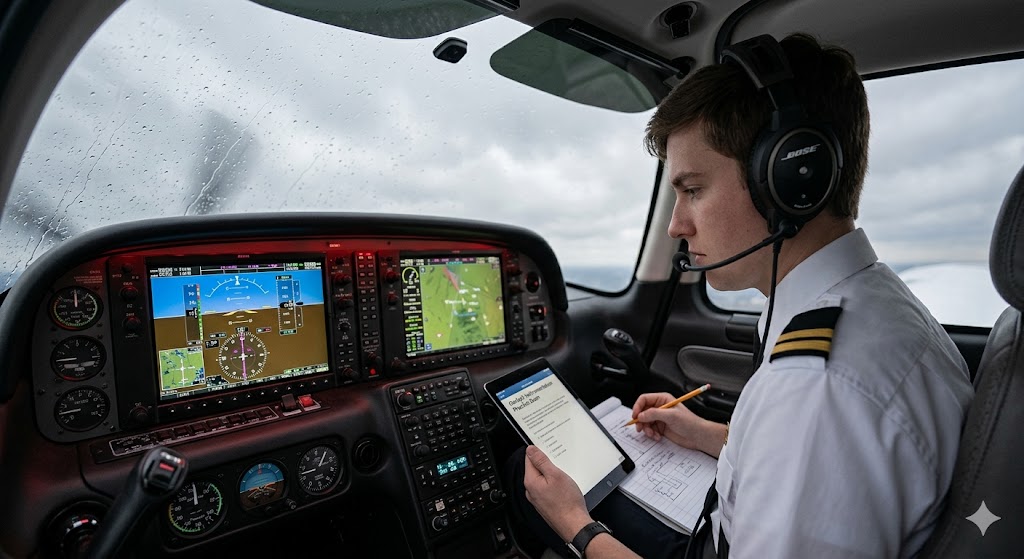
Additional Information
What the Course Entails and Exam Details
This examination covers the complete spectrum of cockpit instruments, transitioning from traditional analog "steam gauges" to advanced electronic flight information systems (EFIS). It provides a rigorous assessment of both theory and practical application.
The core syllabus encompasses the following crucial areas:
Pitot-Static Systems: Deep understanding of the pitot tube, static ports, and the instruments they serve: the Airspeed Indicator (ASI), Altimeter (ALT), and Vertical Speed Indicator (VSI). You must master the associated blockage scenarios (pitot vs. static) and their indications.
Gyroscopic Systems: Comprehensive knowledge of gyroscopic principles (rigidity in space and precession) and the instruments dependent on vacuum or electrical systems: the Attitude Indicator (AI), Heading Indicator (HI), and Turn Coordinator. You must understand common errors, such as gimbal lock and gyroscopic drift.
Electronic Flight Information Systems (EFIS): Mastery of modern "glass cockpits," including Primary Flight Displays (PFDs) and Multi-Function Displays (MFDs). You must understand the integration of Air Data Computers (ADC) and Attitude and Heading Reference Systems (AHRS).
Navigation Systems Interface: Understanding how to interpret and interact with navigation displays using inputs from VOR, ILS, GPS, and DME. This includes mastering HSI (Horizontal Situation Indicator) interpretation.
Engine & System Monitoring: Knowledge of key parameters required for safe operation, including manifold pressure, tachometer (RPM), fuel flow, oil temperature/pressure, and electrical system monitoring.
What to Expect in the Final Exam
You must prepare for a rigorous, formal testing environment. While the exact details can vary depending on your specific regulatory authority (such as the FAA, EASA, or national equivalent) or technician certification body (like NCATT), the standard final exam for this knowledge level follows a predictable format.
Generally, you can expect the following structure:
Format: The primary test is a computer-based, multiple-choice examination. Some questions require analyzing complex cockpit diagrams, comparing two sets of instrument readings, or diagnosing a failure state based on multiple gauge readings.
Time Limit: You will typically have a strictly enforced time limit, often averaging 1 to 1.5 minutes per question. Standard aviation knowledge tests often allow between 120 and 150 minutes to complete the exam.
Passing Score: The threshold for success is high. Regulatory authorities generally require a score of 70% to 75% or higher to pass. Technician certifications sometimes require even higher thresholds.
Aids: You are strictly forbidden from bringing unauthorized memory aids. You will generally be permitted only basic tools like a calculator and a visual aid supplement (figure book) provided by the testing center.
Question Structure: Expect questions framed as practical "what-if" scenarios. For example: "If the static port is completely blocked in a climb, what indication will the altimeter show?"
How to Study and Exam Centers
Preparation must move beyond passive reading. You need an active strategy that simulates the pressure of the testing center. Our recommended study methodology includes:
Active Visualization: Do not just memorize descriptions; diagram the systems. Trace the airflow from the pitot tube to the pressure-sensitive diaphragm in the ASI.
Flight Simulation: Use desktop flight simulators to practice the "cross-check" (your scan pattern). Inadvertently fail an instrument during a simulator flight and practice recovering from the resulting situational disorientation.
Scenario-Based Practice Exams: Repeatedly take practice exams that generate explanations for incorrect answers. Focus on the why of the error, rather than the raw score. Practice until you can explain the mechanics behind every answer.
Regulatory Handbooks: For pilot ratings, prioritize the official FAA Pilot’s Handbook of Aeronautical Knowledge (PHAK) and the Instrument Flying Handbook. These are the gold standards for knowledge requirements.
Testing Locations: Where you take your final exam depends on your path. For pilot certifications in the United States, you must schedule your test at an official FAA Knowledge Testing Center, which are usually located at airport FBOs (Fixed Base Operators) or flight schools. For technician certifications, tests are often administered at certified technical colleges or authorized schools. These exams require pre-registration through portals like PSI (for FAA tests).
Job Opportunities from the Course
A strong score on your instrumentation examination is a prerequisite for unlocking the most lucrative and rewarding careers in aviation. This specific knowledge base directly qualifies you for roles that demand high technical proficiency.
These certifications pave the way to the following career paths:
Commercial Pilot: Whether you fly for regional airlines, major carriers, or cargo operations, an Instrument Rating (which requires passing this knowledge area) is mandatory.
Certified Flight Instructor - Instrument (CFII): Specializing in teaching others how to fly in low-visibility conditions.
Corporate and Charter Pilot: Flying private jets for businesses, which operates almost exclusively under IFR (Instrument Flight Rules).
Avionics Technician: The specialists responsible for installing, maintaining, and troubleshooting the very systems you just studied. This knowledge is essential for diagnosing complex interface errors in modern aircraft.
Aircraft Maintenance Engineer (AME): A technician authorized to approve maintenance and certify the airworthiness of aircraft systems.
Flight Test Instrumentation Engineer: For those on the engineering side, designing and calibrating the sensors used on prototype aircraft during development.
Frequently Asked Questions
Reviews
5.0
Based on 0 reviews
Leave a Review
No reviews yet. Be the first to review!