
Collateral Duty Safety Course Practice Exam
$69.00
- Buy to unlock unlimited access to all Quiz questions and Answers in this Quiz.
- After purchase you can print a PDF of the whole quiz at any point. The PDF will contain the questions and the correct answers.
About this Exam
The Collateral Duty Safety Course (CDSC) is a crucial training program designed for individuals within federal agencies and the military who are assigned safety and health responsibilities as a secondary, or collateral, duty rather than their primary occupation.
This certification is designed for personnel who are the 'eyes and ears' on the ground, ensuring that workplace environments remain compliant with crucial safety regulations. These individuals assist full-time safety officers by recognizing basic hazards, conducting inspections, and facilitating abatement efforts. It is an essential step for those looking to ensure the well-being of their teams while enhancing their professional profile within government or DoD structures.
Ready to test your knowledge?
Buy Now to Access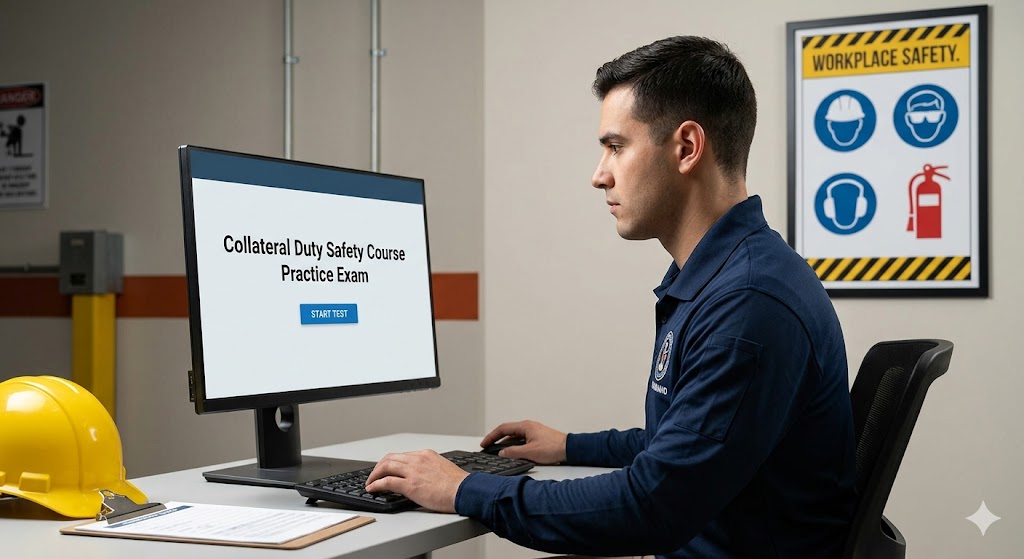
Additional Information
What the Course Entails and Exam Details
The CDSC provides a thorough grounding in standard safety principles, regulatory compliance, and practical hazard recognition. The syllabus is often rooted in the Occupational Safety and Health Act (OSH Act), specific Federal Executive Orders, and agency-specific regulations.
The core areas generally covered in the course material include:
Regulatory Framework: Understanding the OSH Act, Executive Order 12196, and 29 CFR 1960 (Basic Program Elements for Federal Employees).
General Industry Standards: Familiarization with 29 CFR 1910, covering crucial topics like Walking-Working Surfaces, Exit Routes, and Emergency Action Plans.
Hazard Recognition: Learning to identify common workplace dangers, including electrical hazards, fire hazards, and improper chemical handling.
Safety Programs: Understanding core safety initiatives such as Personal Protective Equipment (PPE), Lockout/Tagout, and Hazard Communication (HazCom).
Inspections and Abatement: Mastering the procedures for conducting effective workplace inspections and documenting methods for mitigating identified hazards.
What to Expect in the Final Exam
While exact formats can differ slightly depending on the issuing branch or agency (e.g., Navy eLearning vs. an OSHA Training Institute), students should prepare for a rigorous digital assessment.
Format: The exam typically consists of multiple-choice and true/false questions designed to test both regulatory knowledge and practical application scenarios.
Passing Score: Most agencies require a score of 70% or higher to receive certification.
Time Limit: You are typically allotted between 60 to 90 minutes to complete the exam.
Rules: Many of these exams are not standard open-book tests. You will be expected to know key regulations and safety principles from memory or understand how to quickly navigate official digital reference materials if provided within the testing environment.
How to Study and Exam Centers
Preparation is the key to mastering the CDSC practice exam and the final certification. You are encouraged to move beyond simple reading and engage in active studying.
Master the CFR: Do not just read the regulations; learn to navigate them. You should know exactly where to find standards for PPE, HazCom, and Fire Protection within the 1910 standards.
Use Active Recall: Create flashcards for key terms, regulatory standard numbers (e.g., 1910.1200 for HazCom), and specific abatement procedures.
Practice Scenario Mapping: When studying a standard, visualize your actual workplace and mentally map how that standard applies to the equipment and procedures you see every day.
Take Multiple Practice Exams: Use resources like this guide and other reputable practice tests to familiarize yourself with the phrasing and focus of actual exam questions.
Regarding Exam Centers, this course and its final exam are typically administered through internal government or military online learning management systems (LMS). For military personnel, this often means accessing the course via portals like Navy eLearning. For civilian federal employees, training may be hosted through agency-specific learning portals or authorized OSHA Training Institute (OTI) Education Centers. Your command or agency Safety Officer will direct you to the correct official portal for your final assessment.
Job Opportunities from the Course
Earning your Collateral Duty Safety Course certification is a significant resume enhancer. It does not just show you can pass a test; it demonstrates leadership, commitment to team welfare, and a functional understanding of regulatory compliance.
While rarely a primary job title on its own in the civilian world, this certification makes you eligible for safety-focused roles within your current organization and opens doors to several career paths, including:
Collateral Duty Safety Officer (CDSO): This designated role within your command or agency unit, improving your advancement opportunities.
Workplace Safety Coordinator: A vital function in many industrial and administrative settings.
Facility Manager Safety Liaison: Helping to manage the safety compliance of large buildings and complexes.
Quality Assurance Specialist (Safety): Integrating safety standards into regular quality audits.
Primary Safety Specialist/Technician: This certification serves as a foundational step toward pivoting into a full-time career in Occupational Health and Safety (OSH).
Frequently Asked Questions
Reviews
5.0
Based on 0 reviews
Leave a Review
No reviews yet. Be the first to review!