
College Math CLEP Prep Practice Exam
$69.00
- Buy to unlock unlimited access to all Quiz questions and Answers in this Quiz.
- After purchase you can print a PDF of the whole quiz at any point. The PDF will contain the questions and the correct answers.
About this Exam
The College Mathematics CLEP exam offers students a streamlined path to earning college credit for knowledge they have already acquired outside the traditional classroom setting. This exam is specifically designed to cover material typically taught in a standard college-level mathematics course for nonmathematics majors and majors in fields that do not require knowledge of advanced mathematics. It is an ideal solution for adult learners, home-schooled students, transferring students, or any motivated individual looking to save thousands of dollars in tuition and months of classroom time by demonstrating their mathematical proficiency upfront.
Ready to test your knowledge?
Buy Now to Access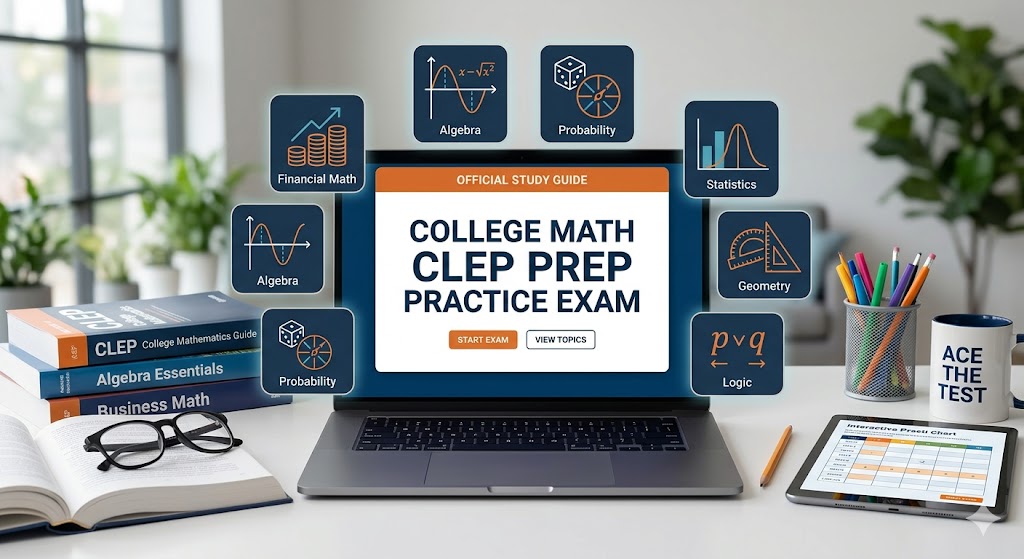
Additional Information
What the Course Entails and Exam Details
This comprehensive exam assesses your proficiency across six main mathematical domains. The "course" you must self-study entails mastering these essential concepts:
Financial Mathematics (approx. 20-25%): Simple and compound interest, annuities, loans, and managing budgets.
Algebra and Functions (approx. 20-25%): Properties of functions and their graphs, equations and inequalities, representation and modeling.
Counting and Probability (approx. 10-12%): Basic probability theory, permutations, combinations, and counting principles.
Data Analysis and Statistics (approx. 10-12%): Graphical and numerical summaries of univariate data, bivariate data, linear models, and correlation.
Geometry and Measurement (approx. 10-12%): Plane geometry, transformations and symmetry, measurement concepts like length, area, and volume.
Numbers and Logic (approx. 15-20%): Properties and operations of integers and rational numbers, logical operations, and sets.
The final exam is administered on a computer and contains approximately 60 multiple-choice questions to be answered within 90 minutes. Please note that some questions may be pretest questions that are not scored.
What to Expect in the Final Exam
You should expect a rigorous, time-limited testing scenario that requires both conceptual understanding and quick problem-solving skills. All questions are multiple-choice, though the exact format may include variations like matching or drop-down selections on screen. The exam does not use a raw score (number correct); instead, your raw score is converted to a "scaled score" ranging from 20 to 80. A score of 50 is the recommended credit-granting threshold by the American Council on Education (ACE), which typically corresponds to a grade of 'C' in a corresponding course. However, individual colleges and universities set their own CLEP credit policies, so you must verify the required score at your target institution.
Importantly, there is no penalty for guessing. Your score is based solely on the number of questions answered correctly. You should make an educated guess on every single question to maximize your chances. A scientific or graphing calculator will not be permitted; instead, an on-screen scientific calculator will be provided within the testing interface for specific questions.
How to Study and Exam Centers
Effective preparation is the key to passing. First, take a diagnostic practice test to identify your weakest areas among the six core topics. Develop a structured study plan that focuses on these gap areas using reputable resources, such as official CLEP study guides, textbooks recommended by the College Board, and interactive online prep courses. Create flashcards for definitions and key formulas, and practice problem-solving daily to improve your speed and accuracy.
Finally, register to take the exam. You will register and pay for your exam through the "My CLEP" student portal on the official College Board website. Once you have a registration ticket, you can schedule your appointment. The College Math CLEP is offered year-round. You can take the exam at more than 2,000 authorized CLEP test centers located at colleges, universities, and military bases globally. Alternatively, if you meet the equipment and technical requirements, you may elect to take the exam remotely proctored at home via the College Board’s approved vendor.
Job Opportunities from the Course
Earning credit through the College Math CLEP exam does not directly provide a job certification. However, it demonstrates foundational quantitative skills essential for many degree programs, and it accelerates your progress toward a college degree. Many entry-level positions require a bachelor's degree or proof of basic mathematical competency. Successfully passing this exam can unlock paths toward the following career opportunities that require analytical and mathematical skills:
Actuarial Assistant: Analyzing data for risk management in insurance and finance.
Data Analyst (Entry-Level): Cleaning, processing, and analyzing datasets for business decision-making.
Financial Services Representative: Handling basic client accounts, interest calculations, and financial planning support.
Junior Computer Programmer: Utilizing logical reasoning and algorithmic thinking derived from algebraic principles.
Market Research Assistant: Assisting in the gathering and statistical analysis of market data.
Math Teacher (K-12): This credit fulfills foundational requirements for teaching licensure pathways.
Quality Control Technician: Applying statistical sampling techniques to monitor manufacturing quality.
Research Assistant: Supporting academic or corporate research through data entry and fundamental analysis.
By passing this test, you validate the quantitative proficiency employers and higher education institutions value, moving you one step closer to your graduation and career goals.# College Math CLEP Prep Practice Exam
Frequently Asked Questions
Reviews
5.0
Based on 0 reviews
Leave a Review
No reviews yet. Be the first to review!