
College of Nurses of Ontario (CNO) Jurisprudence Practice Exam
$69.00
- Buy to unlock unlimited access to all Quiz questions and Answers in this Quiz.
- After purchase you can print a PDF of the whole quiz at any point. The PDF will contain the questions and the correct answers.
About this Exam
The College of Nurses of Ontario (CNO) Jurisprudence Practice Exam is a crucial requirement for anyone seeking registration as a nurse in Ontario, Canada. It is specifically designed to assess an applicant’s knowledge and understanding of the laws, regulations, and ethical standards that govern the nursing profession within the province.
This mandatory exam ensures that all practicing nurses possess the necessary legal and ethical framework to provide safe, competent, and ethical care to the public. Whether you are a new graduate from an Ontario nursing program or an internationally educated nurse, passing this exam is a mandatory step toward obtaining your General or Extended Class registration.
Ready to test your knowledge?
Buy Now to Access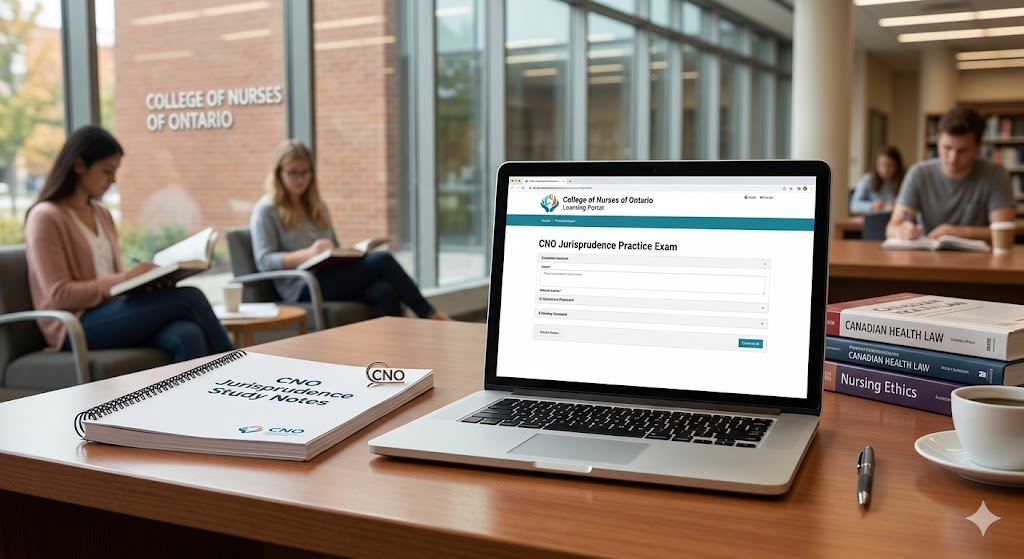
Additional Information
What the Course Entails and Exam Details
This examination does not require completion of a specific "course" but rather is a comprehensive assessment based on professional nursing standards and Ontario legislation. Applicants are responsible for self-studying the relevant content areas. The exam details the following core components:
Nursing Legislation: A deep dive into the Nursing Act, 1991, and the Regulated Health Professions Act, 1991 (RHPA), which define the scope of practice, controlled acts, and regulatory framework for Ontario nurses.
CNO Professional Standards: Complete knowledge of the CNO’s foundational documents, including the Code of Conduct, Professional Standards, Revised 2002, and Ethics standards.
Controlled Acts and Delegation: Understanding which procedures nurses are authorized to perform and the legal requirements for delegating tasks to un-regulated care providers.
Privacy and Confidentiality: Mastering the requirements of the Personal Health Information Protection Act, 2004 (PHIPA) regarding the collection, use, and disclosure of client information.
Consent: Thorough understanding of the Health Care Consent Act, 1991, and the legal principles surrounding informed consent for treatment.
Professional Misconduct and Fitness to Practice: Understanding the definitions of misconduct, incapacity, and incompetence, and the CNO's role in public protection.
What to Expect in the Final Exam
The CNO Jurisprudence Exam is an online, open-book examination.
Format: The exam consists of multiple-choice questions. These questions are often case-based, requiring you to apply your knowledge of legislation and standards to realistic nursing scenarios.
Time Limit: Applicants are generally allotted approximately 150 minutes (2.5 hours) to complete the exam.
Open-Book Policy: As an open-book exam, you are permitted to access external resources during the test, such as the CNO website, specific laws, and CNO practice standards. This format emphasizes your ability to find, interpret, and apply the correct information efficiently, rather than relying solely on memorization.
Passing Score: The pass mark is predetermined by the CNO and is based on demonstrating minimum competence. Your results will be provided as a simple pass or fail, typically available immediately upon completion.
Attempts: Applicants are allowed multiple attempts to pass the exam, though subsequent attempts may require a waiting period and additional fees.
How to Study and Exam Centers
Because the exam is open-book, effective studying focuses on familiarization and navigation rather than rote memorization.
Create a Master Resource Directory: Organise digital or physical copies of all essential CNO practice standards, guidelines, and relevant Ontario legislation (the Nursing Act, RHPA, PHIPA, Health Care Consent Act).
Use the CNO Jurisprudence Resources: The CNO provides specific study resources, including a Jurisprudence Handbook for Nurses, which serves as an excellent foundational text.
Practice with Scenarios: When reviewing standards, ask yourself: "How does this apply to a real patient situation?" Practice linking specific regulations to nursing actions.
Understand 'Find' Functions: If using digital resources, ensure you know how to quickly search keywords within PDF documents or legislation websites to locate relevant clauses during the exam.
Exam Centers: There are no physical testing centers for the CNO Jurisprudence Exam. The entire process is conducted online. You can take the exam from any location with a secure and stable internet connection. You will access the examination portal directly through your CNO maintain-your-membership (or applicant) portal account once you are eligible.
Job Opportunities from the Course
Passing the CNO Jurisprudence Exam is a mandatory component of obtaining licensure. It is not a certification that itself unlocks a niche job; rather, it is a vital key that unlocks the entire nursing profession in Ontario. Successfully navigating this exam enables you to work as a:
Registered Nurse (RN)
Registered Practical Nurse (RPN)
Nurse Practitioner (NP) (upon completing additional Extended Class requirements)
Once licensed, you can pursue diverse career paths in hospital settings (ICU, ER, Oncology), community health, long-term care facilities, public health agencies, corporate nursing, research, and educational roles across Ontario.
Frequently Asked Questions
Reviews
5.0
Based on 0 reviews
Leave a Review
No reviews yet. Be the first to review!