
College Success Skills Practice test
$69.00
- Buy to unlock unlimited access to all Quiz questions and Answers in this Quiz.
- After purchase you can print a PDF of the whole quiz at any point. The PDF will contain the questions and the correct answers.
About this Exam
Navigating the demands of higher education can be challenging, even for the most dedicated students. Success often hinges on more than just raw academic ability; it requires a set of specific, learned skills. The College Success Skills assessment (and our dedicated practice test) is designed precisely to measure a student’s readiness and aptitude in these essential areas. This evaluation typically includes assessments of time management, effective study techniques, critical thinking, communication, and information literacy. While some institutions may use an assessment like this for developmental placement, its primary purpose is diagnostic: to identify a student's strengths and weaknesses and provide guidance on areas for improvement, ensuring they have the foundational tools for academic achievement. This is an invaluable resource for incoming freshmen, transfer students, or anyone looking to refine their approach to higher education learning. Mastering these skills not only leads to better grades but also reduces stress and boosts overall student confidence and retention. By utilising our practice exam, you are actively investing in your academic preparedness.
Ready to test your knowledge?
Buy Now to Access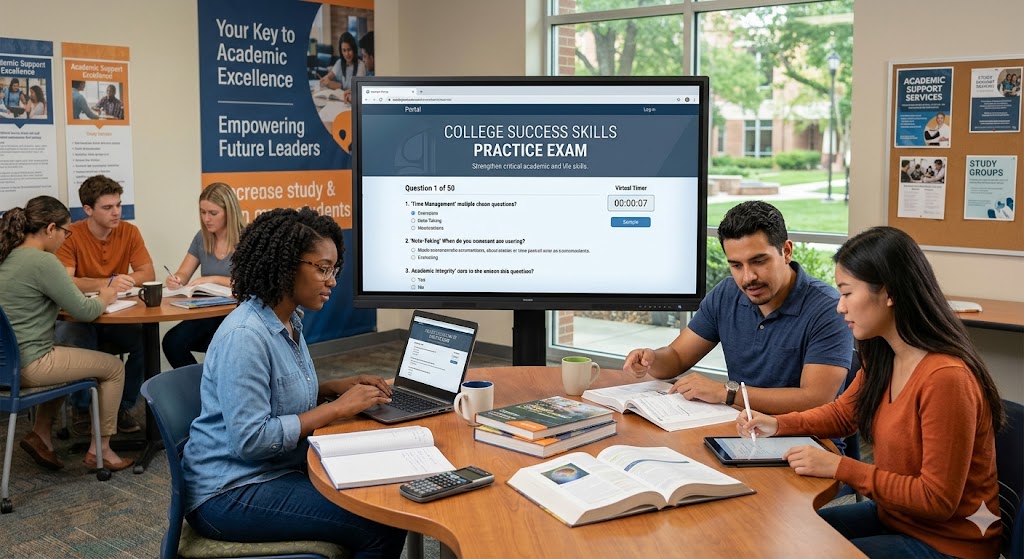
Additional Information
What the Course Entails and Exam Details
Preparation for a College Success Skills exam, and the practice test we offer, covers a wide range of topics essential for collegiate achievement. The core domains you will typically explore and practice include:
Time Management & Organisation: Strategies for creating effective schedules, prioritizing tasks, combating procrastination, and maintaining a balanced life as a student.
Study Skills & Learning Strategies: Evidence-based techniques for effective note-taking (e.g., Cornell method, mind mapping), active reading (e.g., SQ3R), information retention, and varied learning style adaptation.
Test-Taking Strategies: Comprehensive approaches for preparing for exams, managing test anxiety, understanding different question formats (multiple choice, essay, etc.), and employing effective strategies during the test itself.
Critical Thinking & Problem Solving: Developing the ability to analyse information, evaluate arguments, think creatively, make sound decisions, and apply problem-solving frameworks to academic challenges.
Communication Skills: Techniques for effective written and oral communication, active listening, collaborating in groups, and professional interaction with peers and professors.
Information & Digital Literacy: Strategies for identifying information needs, locating relevant resources (library, online databases), evaluating the credibility of sources, using information ethically, and utilizing common academic technologies.
Goal Setting & Motivation: Understanding the importance of setting SMART goals (Specific, Measurable, Achievable, Relevant, Time-bound), building resilience, maintaining motivation, and accessing student support services.
Our practice exam reflects these crucial domains. While the specific number of questions and time limits may vary depending on the particular real exam or practice platform, our comprehensive practice exam is typically designed with:
Format: Primarily multiple-choice questions, interspersed with relevant scenarios or short scenarios testing application of skills.
Number of Questions: Our current College Success Skills Practice Test contains approximately 50-70 questions designed to broadly assess all key areas.
Time Limit: We recommend simulating a real-world testing environment and completing the practice exam within a designated time limit (e.g., 60-90 minutes).
What to Expect in the Final Exam
While the exact structure can differ slightly by institution or specific test provider, here is what you can generally expect from a College Success Skills exam, and what our practice test aims to simulate:
Comprehensive Assessment: Expect questions and scenarios covering all the domains outlined in Section 2, demanding both conceptual understanding and practical application.
Varied Question Formats: Most real exams will feature a significant number of multiple-choice questions to test knowledge across many topics efficiently. Some might also incorporate:
Scenario-based Questions: Presenting a situation (e.g., "A student has three assignments due on the same day. What should they do?") to assess application of organizational or problem-solving skills.
Matching or True/False Questions: For factual knowledge checking.
Short Answer or Reflective Writing: A less common but possible element, particularly in coursework finales, where you might be asked to describe your own study plan or analyze a specific challenge.
Time-Consuming but Manageable: The exam is typically designed to be completed within a specific timeframe (often 1-2 hours for the full assessment). It is not excessively long, but requires focus and efficient time management from the test-taker.
Passing Score: Requirements can vary. Some exams might not have a formal "passing score" but use performance to make placement recommendations. Where a passing grade is defined, it is often in the range of 70-80%.
Rules & Integrity: Real exams, whether online proctored or in-person, will have strict academic integrity rules. This includes restrictions on external resources, collaboration, and potential penalties for misconduct. Our practice exam is for your own benefit, so we encourage you to simulate these rules for authentic preparation.
How to Study and Exam Centers
Effective preparation for the College Success Skills exam, leveraging our practice test, involves a combination of consistent effort and strategic study:
Engage in Consistent Practice: Utilize our College Success Skills Practice Test multiple times. The immediate feedback provided can help you identify areas for review.
Treat Practice as a Simulation: For the best results, take the practice exam in a single sitting, under timed conditions, in a quiet environment free from distractions. This builds stamina and helps you manage time effectively.
Review and Reflect: After each practice test attempt, carefully review both correct and incorrect answers. For the incorrect ones, truly understand why the correct answer is better and review the related concepts in depth.
Study Core Concepts Actively: Don't just read about study techniques or time management – practice them. Create a weekly schedule, practice different note-taking methods with actual lectures or articles, and actively apply critical thinking to everyday situations or academic readings.
Seek Out Additional Resources: Use online study guides, academic articles, college student handbooks, and reputable educational videos to deepen your understanding of the essential success skills.
Clarify Doubts: If you are part of a program or have access to advisors, don't hesitate to ask for clarification or additional guidance on challenging topics.
Regarding Exam Centers: Our College Success Skills Practice Test is an online tool, accessible directly from our platform for your convenience. However, if you are preparing for a real College Success Skills exam administered by an institution, you will typically take it through one of these channels:
Institution’s Testing Center: Many colleges and universities administer their own assessments on campus, often as part of orientation or placement testing.
Online Proctoring Services: Due to convenience and broader accessibility, some real exams might be proctored online via authorized services (e.g., ProctorU, Honorlock), where your environment is monitored remotely during the test.
Specific Assessment Platforms: Some exams may be administered through third-party platforms linked by the institution.
Job Opportunities from the Course
While the College Success Skills course and its associated assessments (which our practice test helps you prepare for) do not typically provide a direct certification for specific jobs in themselves, they are crucial catalysts for academic achievement and personal development. The skills you cultivate are essential for success in higher education, which is the primary pathway to numerous careers and professions. By demonstrating and mastering these skills through your studies and assessments, you significantly enhance your long-term employability and career advancement opportunities. Achieving a degree, bolstered by these foundational abilities, unlocks doors to diverse job titles, including:
Corporate Trainer: Utilizing exceptional communication, presentation, and instructional skills cultivated through successful academic work.
Human Resources Specialist: Employing strong organizational, communication, and interpersonal skills developed through collaborative academic projects and presentation experiences.
Academic Advisor or Counselor: Drawing upon deep understanding of student success strategies to guide and support future college students.
Project Manager: Applying rigorous organizational, time management, communication, and problem-solving abilities honed in managing academic workloads.
Public Relations Specialist: Leveraging strong written and oral communication, critical thinking, and information literacy skills for effective communication and messaging.
Data Analyst: Utilizing robust analytical, critical thinking, and information literacy skills developed through complex coursework and research.
Educator (Teacher/Professor): Demonstrating the communication, pedagogical understanding, and critical thinking that often begin with successful mastery of learning skills.
Entrepreneur: Applying critical thinking, problem-solving, resilience, and excellent organizational skills to build and manage a business.
Research Associate: Employing advanced research, critical analysis, and information evaluation skills essential for varied academic and industry projects.
Content Writer or Editor: Utilizing strong writing and analytical skills further refined through rigorous academic writing assignments.
The mastery of College Success Skills is an investment in your entire future academic and professional trajectory. Start preparing effectively today by using our comprehensive College Success Skills Practice Test.
Frequently Asked Questions
Reviews
5.0
Based on 0 reviews
Leave a Review
No reviews yet. Be the first to review!