
Collision Repair Practice Exam
$69.00
- Buy to unlock unlimited access to all Quiz questions and Answers in this Quiz.
- After purchase you can print a PDF of the whole quiz at any point. The PDF will contain the questions and the correct answers.
About this Exam
Embarking on a career in collision repair requires more than just mechanical aptitude; it demands specialized knowledge in metallurgy, plastic repair, and advanced refinishing techniques. A comprehensive collision repair practice exam is the most effective tool for measuring your readiness for official industry certifications, such as the Automotive Service Excellence (ASE) B-Series exams or specific state licensing requirements.
This study guide and practice exam are designed for aspiring automotive body technicians, painters, structural repair specialists, and collision estimators. It serves as a crucial benchmark, allowing you to identify knowledge gaps before investing time and money into the final certification exam. By validating your understanding of complex repair procedures and safety protocols, you gain the confidence needed to succeed in this dynamic field.
Ready to test your knowledge?
Buy Now to Access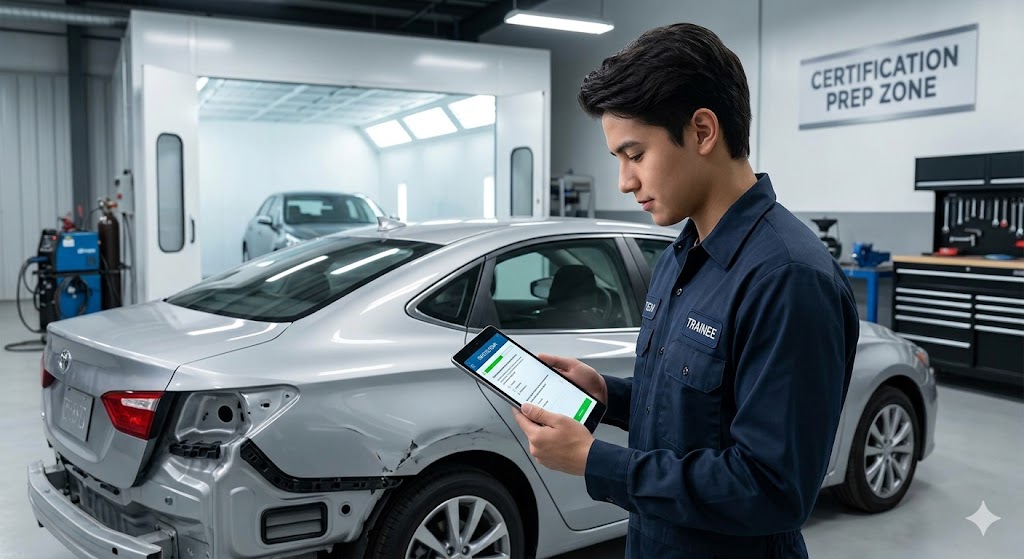
Additional Information
What the Course Entails and Exam Details
To master the collision repair domain, candidates must have a holistic understanding of a vehicle’s structure, appearance, and mechanical systems. The curriculum covered by this practice exam mirrors the standards set by industry leaders, ensuring you are tested on real-world scenarios. The core topics generally include:
Non-Structural Analysis and Damage Repair: This covers the basics of metal straightening, filling, plastic repair, and the replacement of bolt-on components like fenders, doors, and hoods.
Structural Analysis and Damage Repair: A critical section focusing on unibody and frame straightening, measuring systems, cutting and welding structural steel or aluminum, and adhering to strict OEM repair procedures.
Painting and Refinishing: Testing knowledge on surface preparation, sanding, primer application, color matching, spray gun operation, and understanding paint defects and their remedies.
Mechanical and Electrical Components: Understanding how accidents affect steering, suspension, electrical systems, safety restraints (SRS), and air conditioning, and how to safely repair or replace them.
Damage Analysis and Estimating: The business side of repair, testing the ability to accurately assess vehicle damage, calculate parts and labor costs, and write detailed estimates that are accepted by insurance companies.
What to Expect in the Final Exam
While individual certification bodies differ, the final official exam is typically a challenging assessment focused heavily on applying knowledge rather than simple recall. Most exams are computerized and administered in a timed environment.
You can usually expect between 50 and 75 multiple-choice questions per test section (e.g., one test for Painting, one for Structural). The time limit is often approximately 90 minutes per section. The passing score varies but is generally around 70%. Many questions are situational, presenting a "Technician A says X; Technician B says Y" scenario, requiring you to determine who is correct based on industry standards. In some advanced certifications, practical, hands-on demonstrations of skill (such as welding a test plaque or painting a panel) may be required in addition to the written test.
How to Study and Exam Centers
Effective studying requires a blend of theory and practical understanding. Because collision repair technology changes rapidly, rely on current study materials.
We recommend reviewing official task lists provided by the certifying body (such as ASE’s task list) to understand the exact competencies being tested. Use detailed study guides that explain the why behind repair procedures, not just the how. Take multiple practice exams to simulate the pressure of the timed environment and improve your test-taking speed. Visual learning is crucial in this trade; utilize manufacturer training videos or accredited educational channels to observe complex structural repairs or painting techniques.
When you are ready for the final, official certification, you will typically register through the certifying organization's portal. Examinations are generally held at authorized, secure testing centers, such as Pearson VUE or Prometric locations, which have strict identification and anti-cheating protocols. Occasionally, specialized training schools or community colleges are authorized to administer the tests.
Job Opportunities from the Course
Earning a collision repair certification unlocks numerous career paths within the automotive industry. Certification is often preferred by employers because it validates your skills and commitment to the trade. Common job titles and career paths available to certified professionals include:
Collision Repair Technician (Generalist)
Automotive Refinisher / Painter
Structural Repair Specialist
Non-Structural Repair Technician
Aluminum Repair Technician
Collision Damage Estimator / Appraiser
Automotive Body Shop Production Manager
Insurance Physical Damage Claims Appraiser
Automotive Detailer (often an entry-level path
Frequently Asked Questions
Reviews
5.0
Based on 0 reviews
Leave a Review
No reviews yet. Be the first to review!