
Colorado Security Officer Jurisprudence Practice Exam
$69.00
- Buy to unlock unlimited access to all Quiz questions and Answers in this Quiz.
- After purchase you can print a PDF of the whole quiz at any point. The PDF will contain the questions and the correct answers.
About this Exam
The Colorado Security Officer Jurisprudence Practice Exam is a crucial step for individuals aspiring to work as licensed security officers within the state. This exam is designed to test your knowledge of the specific laws, regulations, and ethical standards that govern the private security industry in Colorado. It ensures that all security professionals understand their legal authority, limitations, and the responsibilities they hold while protecting people and property. Whether you are new to the field or an experienced officer moving to Colorado, this practice exam is an essential resource to prepare you for the official licensing test and for a successful, legally compliant career.
Ready to test your knowledge?
Buy Now to Access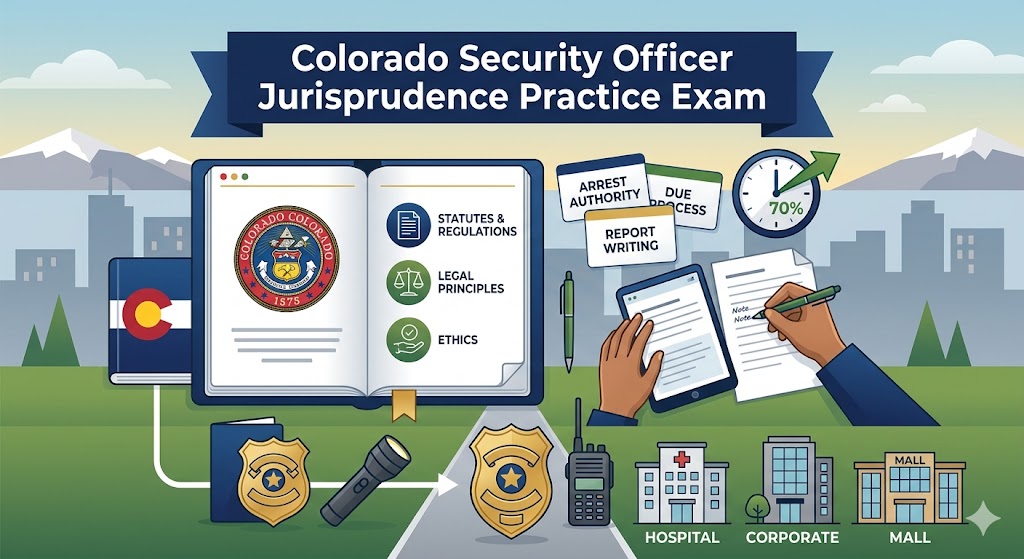
Additional Information
What the Course Entails and Exam Details
This guide focuses on the "jurisprudence" or legal aspects of being a security officer in Colorado. A jurisprudence practice exam typically covers the following core topics:
Colorado State Laws: Relevant sections of the Colorado Revised Statutes (C.R.S.) that apply to private security, including laws on arrest by private persons, use of force, and citizen's arrest.
Regulatory Requirements: Understanding the rules and regulations set by the Colorado Division of Professions and Occupations (DPO) and any specific local licensing authorities (e.g., Denver, Colorado Springs).
Search and Seizure: The legal limitations on security officers regarding searching individuals or property and seizing evidence.
Use of Force: Detailed knowledge of the legal justification and levels of force that are permissible in different situations.
Liability: Understanding personal and employer liability for actions taken while on duty.
Ethics and Professional Conduct: The expected standards of integrity, honesty, and professional behavior for all security personnel.
Report Writing: Best practices for creating accurate and legally sound incident reports.
What to Expect in the Final Exam
The actual final exam for your licensing will be a formal assessment. Here’s a typical format you can expect:
Format: The exam is most commonly a multiple-choice test, though some formats might include true/false questions. It is a written test, not a physical or practical one.
Number of Questions: The number of questions can vary but is often between 50 and 100.
Time Limit: You will typically be given a specific time limit to complete the exam, such as 1 to 2 hours.
Passing Score: The required passing score is determined by the specific licensing body but is often 70% or higher.
Allowed Materials: Most licensing exams are "closed-book," meaning you cannot use any reference materials or notes during the test.
Identification: You will need to present valid, government-issued photo identification (like a driver's license) at the testing center.
How to Study and Exam Centers
Preparation is key to succeeding on the Colorado Security Officer Jurisprudence Practice Exam.
Effective Study Strategies:
Review Official Resources: Obtain the most recent version of the relevant Colorado Revised Statutes and licensing board regulations. This is your primary source material.
Take Practice Tests: Regularly taking practice exams (like this one) is the best way to familiarize yourself with the question style, identify your weak areas, and build your confidence.
Focus on 'Use of Force' and 'Arrest Authority': These are critical topics that are almost guaranteed to be heavily represented in the exam.
Study Key Terms: Create flashcards for important legal terms and definitions specific to private security in Colorado.
Simulate Exam Conditions: When taking practice tests, time yourself and try to recreate the quiet, distraction-free environment of a real testing center.
How and Where to Take the Official Exam:
The process for taking the official licensing exam depends on which jurisdiction you are applying to.
Online Portals: Many regulatory bodies now offer the option to register for and even take the exam online through their official government portals or authorized third-party testing services.
Pearson VUE: Pearson VUE is a common partner for professional licensing exams and may have testing centers across Colorado where you can schedule and sit for the test.
Local Physical Testing Centers: Some local police departments or specific authorized schools that provide security officer training may also serve as testing sites. Check the specific licensing requirements for the city or county where you intend to work.
Job Opportunities from the Course
Passing the jurisprudence exam is a mandatory step toward achieving your Colorado Security Officer License. This certification unlocks a wide array of career paths in the bustling private security sector throughout the state. Possible job roles include:
Unarmed Security Officer
Armed Security Officer (requires additional training and certification)
Corporate Security Officer
Retail Loss Prevention Specialist
Hospital and Healthcare Security Officer
Event Security Staff
Residential Security (HOAs, Apartment Complexes)
Mobile Patrol Officer
Government Contract Security Officer
Frequently Asked Questions
Reviews
5.0
Based on 0 reviews
Leave a Review
No reviews yet. Be the first to review!