
Colorado Surplus Lines Practice Exam
$69.00
- Buy to unlock unlimited access to all Quiz questions and Answers in this Quiz.
- After purchase you can print a PDF of the whole quiz at any point. The PDF will contain the questions and the correct answers.
About this Exam
The Colorado Surplus Lines certification is a specialized license authority required for insurance producers who intend to place insurance policies with non-admitted insurers within the state.
Non-admitted insurers are companies that are not licensed to transact business directly in Colorado but are permitted to provide coverage when the admitted market (licensed companies) is unable or unwilling to accept the risk.
This authority is designed for experienced, currently licensed Property and Casualty (P&C) producers who wish to operate in the wholesale or specialized risk market, allowing them to legally assist clients with unique, high-capacity, or hard-to-place risks.
Ready to test your knowledge?
Buy Now to Access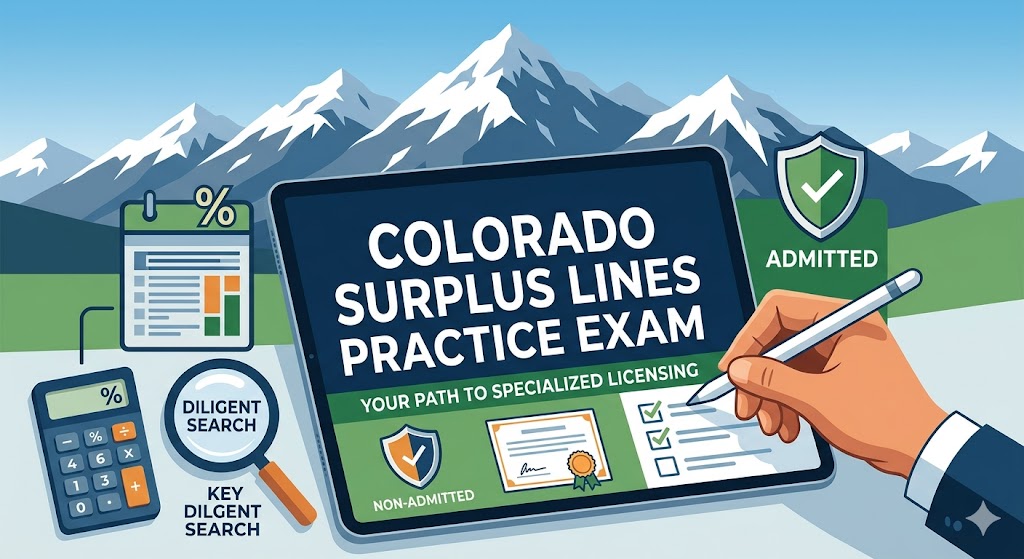
Additional Information
What the Course Entails and Exam Details
Preparing for the Colorado Surplus Lines exam requires focused study on specific Colorado state insurance statutes and regulations rather than general insurance principles.
The core of your study must revolve around Article V of the Colorado Insurance Code and Colorado Regulation 2-4-1.
The essential syllabus covered by a comprehensive prep course and the exam includes:
Key Definitions: Understanding the distinction between Admitted, Non-Admitted (Unauthorized), Foreign, and Alien insurers.
Eligibility and Qualifications: The prerequisites a producer must meet to obtain the surplus lines authority.
Diligent Search Requirement: The crucial regulation demanding a producer first make an exhaustive effort to find coverage within the admitted market, including obtaining necessary declinations.
Surplus Lines Taxes and Fees: Detailed knowledge of how premium taxes are calculated, who is responsible for paying them, and required reporting deadlines.
Affidavits and Recordkeeping: Requirements for filing affidavits of diligent search and strict mandates for maintaining accurate transaction records.
Prohibited Acts and Penalties: A clear understanding of what constitutes illegal placement and the specific administrative and financial penalties for violations.
Regulatory Authority: The powers and duties of the Colorado Division of Insurance concerning surplus lines operations.
What to Expect in the Final Exam
The Colorado Surplus Lines exam is a focused, computerized test administered by the state's third-party testing provider, currently Pearson VUE.
Because this exam is an add-on authority to an existing Property and Casualty license, it is significantly shorter than a full license exam.
Format: The exam consists entirely of multiple-choice questions.
Question Count: There are approximately 30 scored questions, though some pre-test questions (which do not affect your score) might be included.
Time Limit: Candidates are generally allotted 60 minutes (1 hour) to complete the test.
Passing Score: You must achieve a scaled score of 70% or higher to pass.
On the day of the exam, you must present two valid forms of government-issued identification at the testing center. The exam is closed-book, and no outside study materials are permitted.
How to Study and Exam Centers
Effective preparation is the key to passing the Colorado Surplus Lines exam. Focus your study efforts on state-specific regulatory knowledge.
Study Strategies:
Read the Statutes Directly: While difficult, reviewing Colorado Insurance Code Article V and Regulation 2-4-1 is the most direct way to understand the law's intent.
Use a Practice Exam: Utilize a reputable Colorado Surplus Lines Practice Exam. This is the most effective tool for familiarizing yourself with the phrasing of regulatory questions and highlighting gaps in your knowledge.
Flashcards for Definitions: Create flashcards for critical terms and the specific requirements for taxes and diligent search filings.
Exam Centers:
To take the actual final exam, you must register through the Pearson VUE online portal or by phone.
Pearson VUE offers the exam at numerous physical professional testing centers located throughout Colorado (such as in Denver, Colorado Springs, and Grand Junction).
Alternatively, remote online proctoring is available, allowing you to take the exam from your home or office computer while being monitored live by a proctor via webcam.
Job Opportunities from the Course
Earning the Colorado Surplus Lines authority is a significant career differentiator. It unlocks specialized roles within the insurance industry that are often more lucrative and complex than standard retail brokerage.
This authority is necessary for the following job titles and career paths:
Surplus Lines Broker
Wholesale Insurance Broker
Managing General Agent (MGA)
Surplus Lines Compliance Analyst
Excess and Surplus (E&S) Underwriter
Commercial Lines Specialist (focusing on high-risk industries)
Frequently Asked Questions
Reviews
5.0
Based on 0 reviews
Leave a Review
No reviews yet. Be the first to review!