
COLREGs Rules of the Road Practice Test
$69.00
- Buy to unlock unlimited access to all Quiz questions and Answers in this Quiz.
- After purchase you can print a PDF of the whole quiz at any point. The PDF will contain the questions and the correct answers.
About this Exam
The COLREGs Rules of the Road Practice Exam is a vital
preparatory tool designed for mariners seeking professional licensure or
certification. COLREGs stands for the International Regulations for Preventing
Collisions at Sea. This exam is essential for anyone who intends to command or
serve as a watch officer on a vessel, ranging from commercial ships and fishing
vessels to private yachts. It is specifically designed to assess a mariner's
thorough understanding of the mandatory rules governing safe navigation and
interaction between vessels. Passing the official version of this exam, such as
the United States Coast Guard (USCG) "Rules of the Road" component,
is a critical step in obtaining deck officer credentials. It ensures that those
in charge of a vessel are equipped to make split-second safety decisions to
prevent maritime disasters.
Ready to test your knowledge?
Buy Now to Access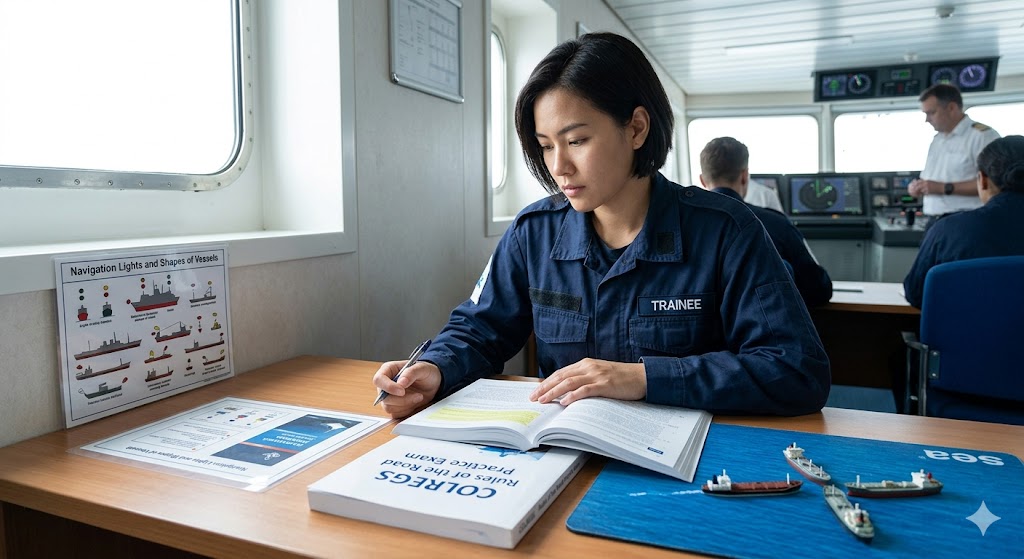
Additional Information
What the Course
Entails and Exam Details
This practice resource comprehensively covers all aspects
of the established International and Inland Navigation Rules. The curriculum
modeled in the practice exam focuses heavily on the steering and sailing rules
that define how vessels must navigate when in sight of one another, including
overtaking, head-on, and crossing situations. Students must master the
distinction between the International Rules and the corresponding Inland Rules
applicable in specific domestic waters.
Additionally, the exam details encompass crucial areas
such as the proper use of sound and light signals for both maneuvering and
warning. Candidates will be tested on their ability to identify vessel types,
sizes, and operational statuses through the interpretation of mandatory
navigation lights and day shapes. Finally, the syllabus covers crucial
responsibilities related to maintaining a proper look-out, proceeding at a safe
speed, and taking positive, timely action to avoid collision.
What to Expect in
the Final Exam
You should prepare for a demanding, multiple-choice
examination. The official USCG Rules of the Road exam component, for example,
typically consists of 50 questions. Unlike other licensing modules that allow a
70% passing score, the Rules of the Road exam requires a minimum passing grade
of 90%. This high bar is set because any misunderstanding of these rules can
immediately result in a catastrophic collision at sea.
Candidates are generally given a strict time limit, such
as 3.5 hours, to complete this section. The questions often use diagrams of
vessels showing specific light or shape configurations to test real-world
visual identification skills. No outside materials, such as the COLREGs
handbook itself, are permitted during the official proctored exam, demanding
that the information be fully memorized and understood.
How to Study and
Exam Centers
Effective study strategies must prioritize deep
understanding over rote memorization. We highly recommend starting by
thoroughly reading the full text of the rules, highlighting the key words that
define a mariner's duty in specific situations. Utilize flashcards extensively
for learning light and shape configurations and the meanings of sound signals.
Reciting the rules out loud—sometimes called the "walk and talk"
method—can dramatically improve recall. Practice drawing vessel scenarios and the
corresponding required lighting and maneuvering actions.
Regarding taking the official exam, the USCG administers
these tests through Regional Examination Centers (RECs) located nationwide.
Additionally, many mariners utilize USCG-approved courses offered by authorized
schools or online portals. Schools like Mariners Learning System or Explorer's
Guide Maritime Academy are approved to offer both the curriculum and the final
proctored exam. Taking the exam through an approved course can sometimes offer
a more flexible path to certification than scheduling directly with an REC.
Job Opportunities
from the Course
Mastering the COLREGs is the fundamental prerequisite for
almost every deck officer position in the maritime industry. While this
practice test does not confer licensure itself, it is the barrier you must pass
to unlock a wide array of professional paths.
Certified professionals with this knowledge are qualified
for numerous stable and rewarding job opportunities, including:
- Captain
or Master of commercial vessels
- Mate
(First, Second, Third) on merchant ships or cruise liners
- Officer
in Charge of a Navigational Watch (OICNW)
- Tugboat
Captain or Mate
- Commercial
Fishing Vessel Captain
- Marine
Pilot (Harbor Pilot)
- Harbor
Master
- Yachtmaster
for private or charter yachts
- Vessel
Traffic Service (VTS) Operator
- Marine
Surveyor
Image Based on Title
Optimized Title:
COLREGs Rules of the Road Practice Exam
Article:
1. Description
The COLREGs Rules of the Road Practice Exam is a vital
preparatory tool designed for mariners seeking professional licensure or
certification. COLREGs stands for the International Regulations for Preventing
Collisions at Sea. This exam is essential for anyone who intends to command or
serve as a watch officer on a vessel, ranging from commercial ships and fishing
vessels to private yachts. It is specifically designed to assess a mariner's
thorough understanding of the mandatory rules governing safe navigation and
interaction between vessels. Passing the official version of this exam, such as
the United States Coast Guard (USCG) "Rules of the Road" component,
is a critical step in obtaining deck officer credentials. It ensures that those
in charge of a vessel are equipped to make split-second safety decisions to
prevent maritime disasters.
2. What the Course Entails and Exam Details
This practice resource comprehensively covers all aspects
of the established International and Inland Navigation Rules. The curriculum
modeled in the practice exam focuses heavily on the steering and sailing rules
that define how vessels must navigate when in sight of one another, including
overtaking, head-on, and crossing situations. Students must master the
distinction between the International Rules and the corresponding Inland Rules
applicable in specific domestic waters.
Additionally, the exam details encompass crucial areas
such as the proper use of sound and light signals for both maneuvering and
warning. Candidates will be tested on their ability to identify vessel types,
sizes, and operational statuses through the interpretation of mandatory
navigation lights and day shapes. Finally, the syllabus covers crucial
responsibilities related to maintaining a proper look-out, proceeding at a safe
speed, and taking positive, timely action to avoid collision.
3. What to Expect in the Final Exam
You should prepare for a demanding, multiple-choice
examination. The official USCG Rules of the Road exam component, for example,
typically consists of 50 questions. Unlike other licensing modules that allow a
70% passing score, the Rules of the Road exam requires a minimum passing grade
of 90%. This high bar is set because any misunderstanding of these rules can
immediately result in a catastrophic collision at sea.
Candidates are generally given a strict time limit, such
as 3.5 hours, to complete this section. The questions often use diagrams of
vessels showing specific light or shape configurations to test real-world
visual identification skills. No outside materials, such as the COLREGs
handbook itself, are permitted during the official proctored exam, demanding
that the information be fully memorized and understood.
4. How to Study and Exam Centers
Effective study strategies must prioritize deep
understanding over rote memorization. We highly recommend starting by
thoroughly reading the full text of the rules, highlighting the key words that
define a mariner's duty in specific situations. Utilize flashcards extensively
for learning light and shape configurations and the meanings of sound signals.
Reciting the rules out loud—sometimes called the "walk and talk"
method—can dramatically improve recall. Practice drawing vessel scenarios and the
corresponding required lighting and maneuvering actions.
Regarding taking the official exam, the USCG administers
these tests through Regional Examination Centers (RECs) located nationwide.
Additionally, many mariners utilize USCG-approved courses offered by authorized
schools or online portals. Schools like Mariners Learning System or Explorer's
Guide Maritime Academy are approved to offer both the curriculum and the final
proctored exam. Taking the exam through an approved course can sometimes offer
a more flexible path to certification than scheduling directly with an REC.
5. Job Opportunities from the Course
Mastering the COLREGs is the fundamental prerequisite for
almost every deck officer position in the maritime industry. While this
practice test does not confer licensure itself, it is the barrier you must pass
to unlock a wide array of professional paths.
Certified professionals with this knowledge are qualified
for numerous stable and rewarding job opportunities, including:
- Captain
or Master of commercial vessels
- Mate
(First, Second, Third) on merchant ships or cruise liners
- Officer
in Charge of a Navigational Watch (OICNW)
- Tugboat
Captain or Mate
- Commercial
Fishing Vessel Captain
- Marine
Pilot (Harbor Pilot)
- Harbor
Master
- Yachtmaster
for private or charter yachts
- Vessel
Traffic Service (VTS) Operator
- Marine
Surveyor
Frequently Asked Questions
Reviews
5.0
Based on 0 reviews
Leave a Review
No reviews yet. Be the first to review!