
Combat Information Center (CIC) and Navigation Practice Test
$69.00
- Buy to unlock unlimited access to all Quiz questions and Answers in this Quiz.
- After purchase you can print a PDF of the whole quiz at any point. The PDF will contain the questions and the correct answers.
About this Exam
The Combat Information Center (CIC) and Navigation certification exam represents a critical milestone for naval personnel and advanced maritime professionals seeking to validate their expertise in shipboard operations and safe passage. This rigorous assessment is specifically designed for Operations Specialists, Quartermasters, prospective Officer of the Deck (OOD) candidates, and maritime officers who require a deep understanding of tactical environments and navigational safety.
Earning this certification proves to command leadership that you possess the necessary cognitive skills to synthesize complex sensor data, maintain situational awareness in high-pressure scenarios, and execute precise navigational plotting under varied conditions. It is a benchmark of operational readiness and professional competence required for advancement in naval warfare and professional maritime career paths.
Ready to test your knowledge?
Buy Now to Access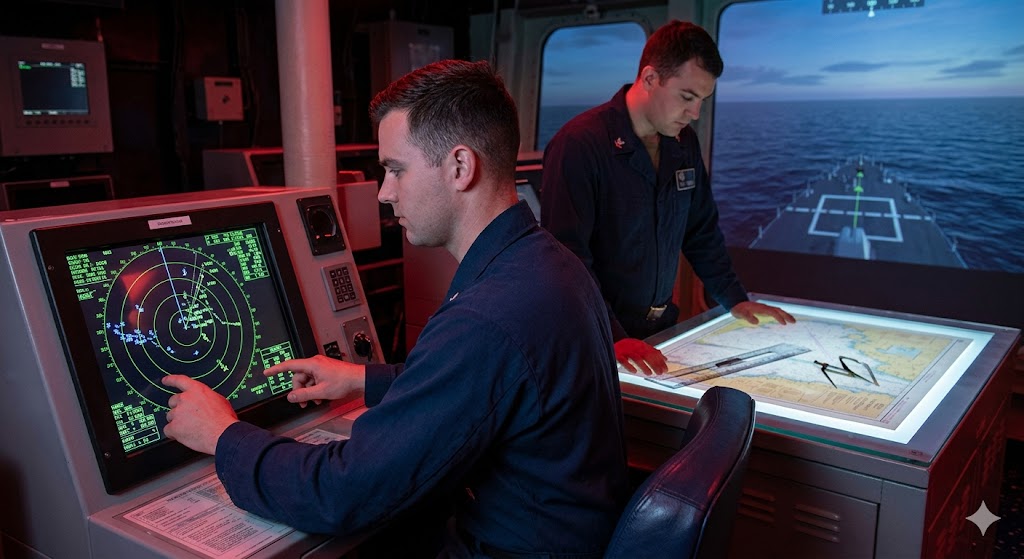
Additional Information
What the Course Entails and Exam Details
This comprehensive assessment covers two distinct yet heavily integrated pillars of maritime operation.
The Combat Information Center section focuses on the collection, processing, display, evaluation, and dissemination of tactical information. Candidates must demonstrate proficiency in radar operation and interpretation, plotting relative motion, understanding maneuvering boards (MoBoards), managing communication circuits, and supporting warfare area operations (such as Surface, Air, or Undersea warfare).
The Navigation section validates the core competencies required to safely pilot a vessel. This includes master over terrestrial navigation, nautical chart work, determining ship position via visual and electronic fixes, understanding tides and currents, implementing navigation Rules of the Road (COLREGs), and utilization of modern voyage management systems (VMS).
Combined, these areas ensure that a certified individual can function effectively as a critical component of a ship's bridge and CIC team.
What to Expect in the Final Exam
The Combat Information Center (CIC) and Navigation final exam is a comprehensive assessment that demands both theoretical knowledge and practical application.
The exam format is typically a closed-book, timed examination administered either via a computer-based testing system or as a proctor-led written test, depending on the specific certifying body or command. Candidates should expect a standard format of multiple-choice questions designed to test knowledge retrieval.
Additionally, a significant portion of the exam involves practical problem-solving. This includes plotting scenarios where candidates must use maneuvering boards to determine closest point of approach (CPA) or course to steer to intercept, as well as navigational chart problems requiring the calculation of set and drift or fixing a position using visual bearings. A passing score is usually set high, often at 80% or above, reflecting the critical safety and operational nature of the subject matter.
How to Study and Exam Centers
Preparation for this exam requires a balanced approach of rote memorization and hands-on practice.
To succeed, you should heavily utilize official navy training manuals (NAVEDTRA) related to Operations Specialist and Quartermaster rates, Bowditch (The American Practical Navigator), and the official Navigation Rules of the Road handbook.
Do not merely read the material; practice is essential. Dedicate time to solving complex maneuvering board problems and working through physical chart plotting exercises. Utilize practice exams to assess your knowledge gaps and normalize the pressure of the timed testing environment.
Regarding testing centers, the administration of this exam depends on your specific service branch or organization. For naval personnel, these exams are typically administered on-base at designated Navy College Offices, Training Commands (like Surface Warfare Schools Command), or authorized Learning Centers via secure military testing portals. For civilian mariners seeking equivalent endorsements, testing is conducted at authorized maritime academies or USCG Regional Examination Centers (RECs).
Job Opportunities from the Course
Mastery of CIC operations and navigation opens diverse career paths within both the military and civilian maritime sectors.
Military Career Paths (Navy / Coast Guard):
Operations Specialist (OS) - Advanced Ratings
Quartermaster (QM) - Advanced Ratings
Officer of the Deck (OOD) Qualification
Combat Information Center Officer (CICO)
Navigator
Civilian/Merchant Marine Career Paths:
Merchant Marine Deck Officer (Third Mate and above)
Harbor Pilot (Apprentice)
Vessel Traffic Service (VTS) Operator
Marine Surveyor
Offshore Supply Vessel Operations
Frequently Asked Questions
Reviews
5.0
Based on 0 reviews
Leave a Review
No reviews yet. Be the first to review!