
Combat Life Saver Practice Test
$69.00
- Buy to unlock unlimited access to all Quiz questions and Answers in this Quiz.
- After purchase you can print a PDF of the whole quiz at any point. The PDF will contain the questions and the correct answers.
About this Exam
The Combat Life Saver (CLS) certification is a vital medical qualification designed for non-medical military personnel. It serves as a critical bridge between the basic buddy aid taught to all service members and the advanced lifesaving interventions provided by specialized Combat Medics (68W) or Special Forces Medical Sergeants. The course is designed to empower soldiers with the skills and confidence necessary to provide immediate, life-saving care on the battlefield under high-stress conditions before professional medical assets can arrive. Passing the Combat Life Saver exam is essential for personnel deploying into combat environments, ensuring they can treat leading causes of preventable battlefield death.
Ready to test your knowledge?
Buy Now to Access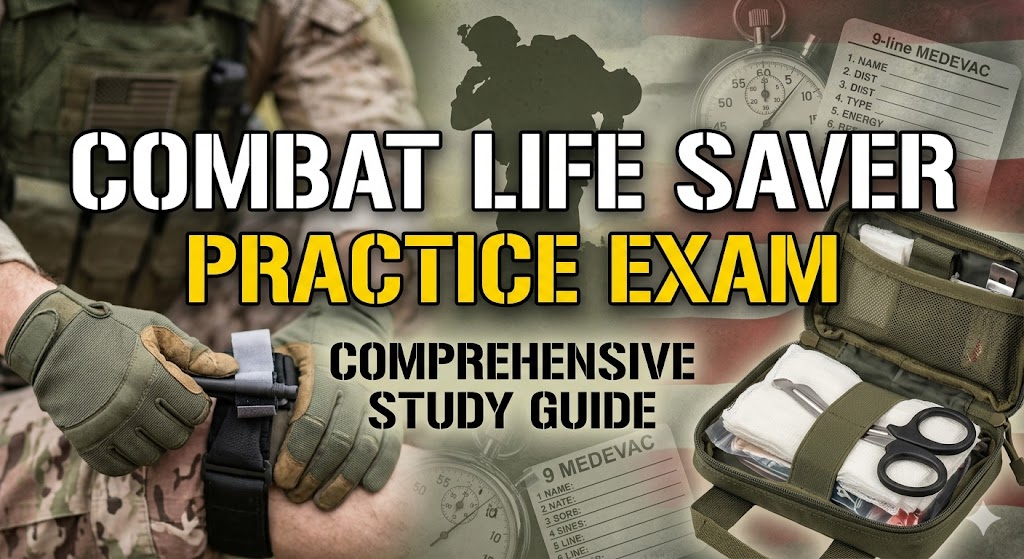
Additional Information
What the Course Entails and Exam Details
The Combat Life Saver course focuses heavily on the principles of Tactical Combat Casualty Care (TCCC). Students are rigorously trained to recognize, prioritize, and treat life-threatening injuries based on the MARCH algorithm: Massive Hemorrhage, Airway, Respiration, Circulation, and Hypothermia/Head injury. Core skills covered in the syllabus include the proper application of deliberate and hasty tourniquets, the use of hemostatic dressings for wound packing, advanced airway management techniques like the insertion of nasopharyngeal airways (NPAs), and treating sucking chest wounds with occlusive dressings or chest seals. Students also learn how to prepare casualties for evacuation, including tactical communication using the Nine-Line MEDEVAC Request.
What to Expect in the Final Exam
The CLS certification final exam consists of two comprehensive, mandatory components: a written test and a practical hands-on evaluation. Students must receive a "GO" on both sections to earn their certification.
The Written Exam generally covers between 40 and 50 multiple-choice questions focusing on TCCC theory, injury recognition, treatment priorities, and the MARCH algorithm. The minimum passing score is typically 80%.
The Practical Evaluation is a scenario-based test performed under time pressure. Instructors assess the student’s ability to perform critical interventions correctly. Some tasks, such as applying a tourniquet to an extremity hemorrhage, are evaluated on a Pass/Fail (Go/No-Go) basis and often require a 100?curacy rate within the time limit to receive a passing grade.
How to Study and Exam Centers
The key to passing the CLS exam is consistent, hands-on muscle memory practice. While studying official military publications such as ATP 4-25.12 (First Aid) is important for the written component, practical skills must be drilled until they are reflexive. Utilize a [Combat Life Saver Practice Test] to familiarize yourself with the formatting of the written questions and to identify weak points in your knowledge of TCCC protocols. Form study groups to practice tourniquet application, pressure dressings, and wound packing on mannequins or partners under simulated stress.
The Combat Life Saver course and final exam are standardized and conducted through authorized military channels. These exams are held within military installations, mobilization centers, designated training academies, or at the unit level by certified CLS instructors. It is not typically offered at civilian testing centers like Pearson VUE. For non-military personnel seeking equivalent training, authorized providers sometimes offer civilian Tactical Combat Casualty Care (TCCC) certifications that cover similar lifesaving curriculum.
Job Opportunities from the Course
While the Combat Life Saver certification is a skill set rather than a standalone job title within the military, holding this certification is mandatory or highly preferred for various roles, significantly enhancing employability in both military and specialized civilian sectors. Below is a list of job titles and career paths where a CLS certification provides a competitive advantage:
Military Squad Combat Life Saver (Non-Medical MOS)
Private Security Contractor (High-Threat Environments)
Overseas Tactical Contractor
Tactical Law Enforcement Officer (SWAT/SRT)
Border Patrol Agent
Executive Protection Specialist
High-Risk Disaster Response Specialist
Wildland Firefighter (Tactical/Remote Medical Role)
Remote Security Specialist
Humanitarian Aid Security Officer
Frequently Asked Questions
Reviews
5.0
Based on 0 reviews
Leave a Review
No reviews yet. Be the first to review!