
Combat Medic 68W: Field Craft 1 Practice Exam
$69.00
- Buy to unlock unlimited access to all Quiz questions and Answers in this Quiz.
- After purchase you can print a PDF of the whole quiz at any point. The PDF will contain the questions and the correct answers.
About this Exam
The Combat Medic 68W: Field Craft 1 Practice Exam is an essential assessment designed for U.S. Army soldiers pursuing the 68W Military Occupational Specialty (MOS).
This exam validates a soldier's foundational knowledge and critical application of Tactical Combat Casualty Care (TCCC) principles.
Specifically, it is designed for trainees currently in the 68W Advanced Individual Training (AIT) pipeline.
This certification marks the transition from basic emergency medical technician knowledge to specialized, high-stakes military field medicine.
Successfully passing this phase demonstrates the ability to perform life-saving interventions under simulated combat stress.
It is a critical milestone on the path to earning the coveted "Whiskey" identifier.
Ready to test your knowledge?
Buy Now to Access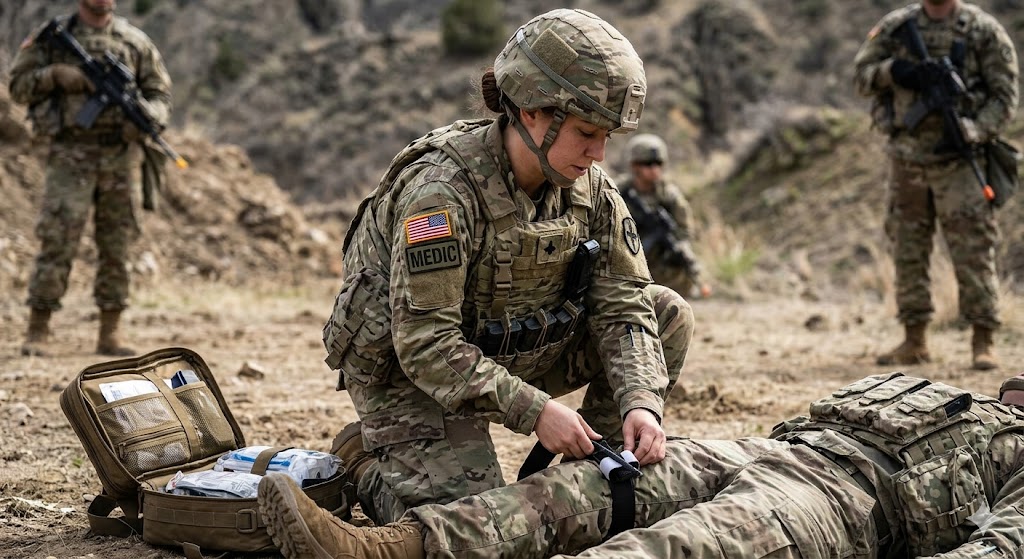
Additional Information
What the Course Entails and Exam Details
The Field Craft 1 phase represents the "combat" portion of Combat Medic training, shifting focus from civilian EMS protocols to battlefield trauma management.
The curriculum is rigorous and hands-on, heavily emphasizing the three phases of TCCC: Care Under Fire (CUF), Tactical Field Care (TFC), and Tactical Evacuation Care (TACEVAC).
The course details core skills, including rapid primary surveys using the MARCH algorithm (Massive Hemorrhage, Airway, Respiration, Circulation, Hypothermia/Head).
Soldiers learn advanced hemorrhage control using junctional and limb tourniquets, hemostatic dressings, and pressure dressings.
The syllabus also covers surgical airway management, needle decompression for tension pneumothorax, and established intravenous (IV) or intraosseous (IO) access.
Beyond individual skills, the course demands proficiency in triage, dynamic patient movement, and preparing casualties for medical evacuation in tactical environments.
What to Expect in the Final Exam
The final assessment for Field Craft 1 is a comprehensive, two-part evaluation consisting of a written examination and a practical hands-on evaluation.
The written portion is a multiple-choice exam that tests theoretical knowledge of anatomy, physiology, pharmacology, and TCCC protocols.
Following the written test, soldiers must pass a high-intensity, scenario-based practical exam, often referred to as "trauma lanes."
During the practical evaluation, candidates must manage multiple simulated casualties while navigating a complex tactical scenario under stressful conditions.
Evaluators score candidates on their adherence to proper TCCC sequencing, technical proficiency in performing interventions, and ability to prioritize care correctly.
A failing score on either the written or practical component usually requires retraining and re-testing.
Complete focus, physical stamina, and the ability to think critically under duress are mandatory requirements for passing.
How to Study and Exam Centers
The most effective way to study for the 68W Field Craft 1 exam is to merge active recall with physical practice.
Candidates must memorize the TCCC guidelines and the MARCH algorithm until they are instinctive reactions.
Use official study guides, Ranger Medic Handbooks, and TCCC skill sheets, as these are the exact standards you will be graded against.
For the practical, practice your physical skills constantly: practice applying tourniquets one-handed, on yourself and others, in low-light environments.
Simulate trauma scenarios with Battle Buddies, forcing each other to voice the MARCH algorithm and perform interventions sequentially.
The Field Craft 1 exam is not taken at civilian testing centers; it is administered exclusively on-site at authorized U.S. Army training locations.
These primary testing locations are located at the Medical Center of Excellence (MEDCoE) at Joint Base San Antonio-Fort Sam Houston, Texas.
Job Opportunities from the Course
Graduating from the 68W AIT pipeline and passing the Field Craft 1 phase unlocks diverse and rewarding career paths within the military.
The primary role unlocked is that of a Combat Medic (68W).
In this role, medics deploy with infantry and armored units, providing immediate point-of-injury care on the battlefield.
Opportunities also exist as a Flight Medic (F2), providing critical care during rotary-wing medical evacuations.
Medics may serve in Army Hospitals or Clinics, working in emergency rooms or specialized departments.
Furthermore, this certification serves as a prerequisite for specialized assignments, such as Special Operations Combat Medic (SOCM) support roles.
Successful 68W training also provides a strong foundation for future civilian medical careers, such as Paramedic or Physician Assistant.
Frequently Asked Questions
Reviews
5.0
Based on 0 reviews
Leave a Review
No reviews yet. Be the first to review!