
Combat Medic ALC Phase 3 Practice Test
$69.00
- Buy to unlock unlimited access to all Quiz questions and Answers in this Quiz.
- After purchase you can print a PDF of the whole quiz at any point. The PDF will contain the questions and the correct answers.
About this Exam
The Combat Medic Advanced Leader Course (ALC) Phase 3 is the culmination of the Army’s 68W leadership training pipeline.
This intensive, resident phase is specifically designed for Sergeants and Staff Sergeants transitioning from tactical medics into medical leaders.
It builds upon the foundational skills of a Combat Medic, shifting the focus from individual technical proficiency to platoon-level medical operations, mission planning, and high-stress clinical validation.
Completing Phase 3 is not just an educational milestone; it is a critical regulatory requirement for NCOs seeking promotion to Staff Sergeant (E-6) and selection for Platoon Sergeant positions.
This certification validates that a leader is capable of managing medical assets, ensuring squad proficiency, and making complex medical decisions under duress in both garrison and operational environments.
Ready to test your knowledge?
Buy Now to Access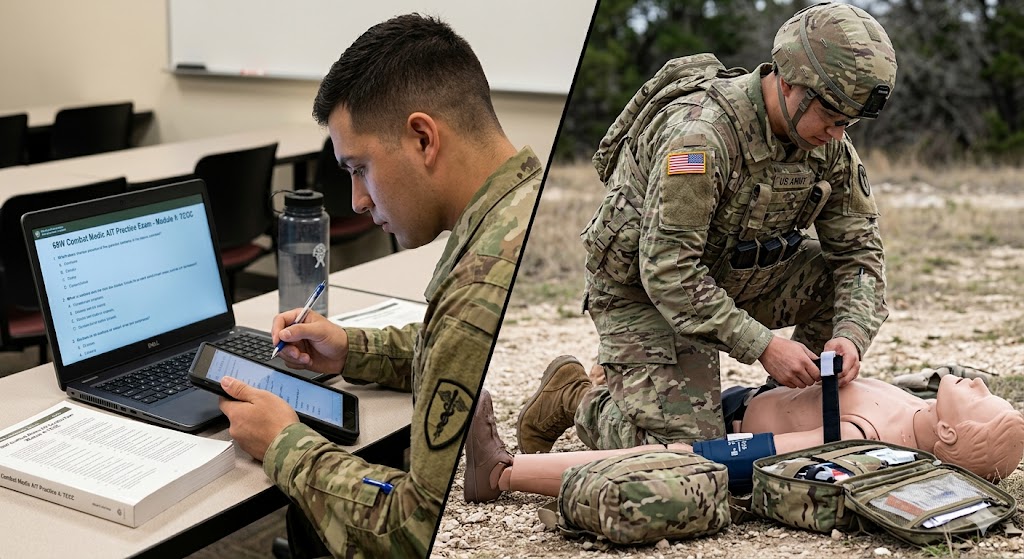
Additional Information
What the Course Entails and Exam Details
Combat Medic ALC Phase 3 focuses heavily on the application of the Tactical Combat Casualty Care (TCCC) guidelines at the leadership level.
The syllabus moves beyond basic interventions, requiring students to master complex medical logistics, mass casualty triage, and prolonged field care scenarios.
A primary core skill emphasized during this phase is operational planning. NCOs must learn to develop the medical Annex (Annex F) for a larger operational order (OPORD), ensuring that medical assets support the maneuver commander’s intent effectively.
The course covers the logistics of medical supplies, evacuation protocols, and the training management cycle of subordinate medics.
Furthermore, students are trained in advanced clinical reasoning, analyzing injury patterns to forecast necessary treatments and resource allocation during a mission.
What to Expect in the Final Exam
The Combat Medic ALC Phase 3 comprehensive examination evaluates both cognitive understanding and practical application.
The final evaluation is composed of a rigorous written exam and several intense practical validations (often referred to as 'lanes').
The written component is a comprehensive multiple-choice test. It focuses heavily on scenario-based questions rather than simple recall. Expect complex questions regarding medical management (MDMP), triage categorization in Mass Casualty (MASCAL) situations, and interpretation of current TCCC guidelines. The time limit is typically strict, demanding rapid but accurate critical thinking.
The practical validations are the hallmark of Phase 3. These "hands-on" exams are high-stress, timed scenarios where the candidate must function as a Medical Squad Leader or Platoon Sergeant during a simulated attack. Evaluators look for command presence, clear communication, the correct application of medical algorithms, and the efficient management of subordinate medics under realistic, duress conditions (noise, smoke, and dynamic casualty statuses). A passing score is mandatory in both the written and practical components to successfully complete the course.
How to Study and Exam Centers
Preparation for the Combat Medic ALC Phase 3 Exam requires a shift from studying manuals to dynamic problem-solving.
Your primary study materials are the current TCCC guidelines, ATP 4-02.2 (Medical Evacuation), and the specific NCO Academy course materials provided upon arrival.
The most effective study strategy is practicing the medical decision-making process (MDMP) with your peers. Practice writing Annex F based on different hypothetical operation orders. For the practical lanes, focus on command presence; practice directing others rather than doing all the treatments yourself, as this is the primary evaluative focus for a leader. Utilize online portals like Army Knowledge Online (AKO) to find study guides, but emphasize collaborative, stress-inoculated training.
This course is conducted exclusively at designated U.S. Army NCO Academies (NCOA). The primary location for 68W ALC is the Joint Base San Antonio (JBSA) Fort Sam Houston NCO Academy, known as the "Home of the Army Medic." Depending on Army requirements, other authorized regional training centers or specific National Guard/Reserve NCO Academies may also host the course. It is not an exam taken at a commercial testing center like Pearson VUE.
Job Opportunities from the Course
Completing Combat Medic ALC Phase 3 directly unlocks significant leadership roles within the U.S. Army medical structure.
It is the primary educational requirement for promotion from Sergeant (E-5) to Staff Sergeant (E-6), a crucial step for long-term military career advancement.
The certification makes the NCO eligible for critical leadership positions that demand operational planning and team management, including:
Medical Platoon Sergeant: Managing the readiness, training, and operational employment of all medics within a maneuver battalion.
Medical Squad Leader: Leading a specific team of medics during tactical deployments or humanitarian missions.
Medical Operations NCO: Working in staff positions at the Battalion or Brigade level, focusing on the planning and logistics of medical support (often referred to as the S-3 or S-4 sections).
Instructor/TCCC SME (Subject Matter Expert): Validating the NCO’s depth of knowledge and leading to roles teaching advanced medicine at various Army training sites.
Frequently Asked Questions
Reviews
5.0
Based on 0 reviews
Leave a Review
No reviews yet. Be the first to review!