
Combat Systems Operational Sequencing System (CSOSS) Technician Practice Test
$69.00
- Buy to unlock unlimited access to all Quiz questions and Answers in this Quiz.
- After purchase you can print a PDF of the whole quiz at any point. The PDF will contain the questions and the correct answers.
About this Exam
Welcome to your definitive preparation hub for the Combat Systems Operational Sequencing System (CSOSS) Technician qualification. This certification is the operational backbone for naval personnel tasked with managing the complexity of shipboard combat systems. It is specifically designed for Navy Technicians, Operators, and aspiring Combat Systems Officers of the Watch (CSOOW) who must ensure maximum combat readiness in all conditions. The CSOSS framework provides the precise, sequential procedures necessary for the safe light-off, operation, configuration control, and casualty response of integrated weapons, sensors, and communications suites. Achieving this qualification proves your mastery over tactical engineering processes, demonstrating that you can maintain system integrity under high-pressure scenarios to ensure the ship can fight and survive.
Ready to test your knowledge?
Buy Now to Access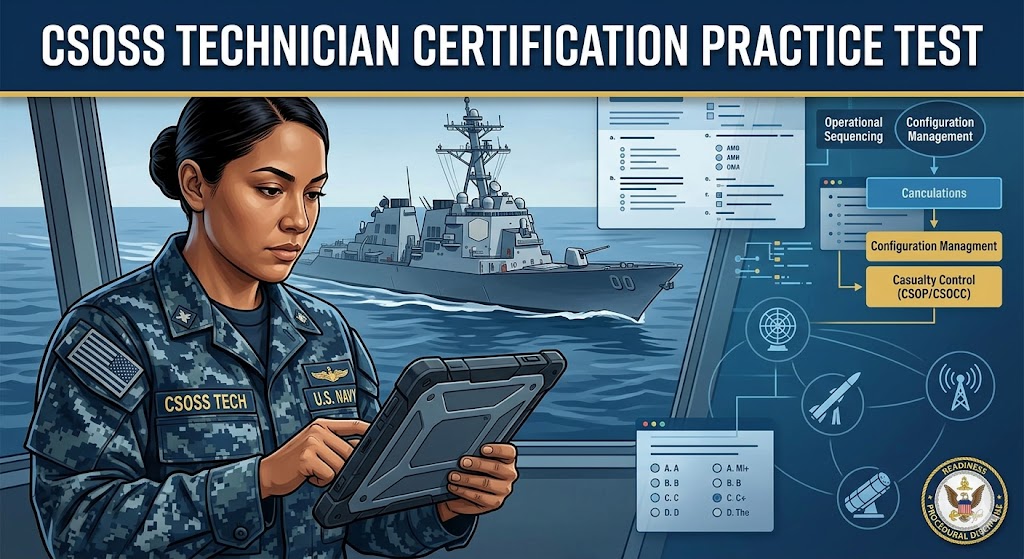
Additional Information
What the Course Entails and Exam Details
This qualification program and the subsequent exam cover an extensive syllabus centered on procedural discipline within the naval combat systems environment. Candidates must demonstrate proficiency across several core domains.
First, you will need a complete understanding of the CSOSS Organization. This includes the hierarchy of personnel, from the Technician at the equipment level to the Combat Systems Officer of the Watch (CSOOW) and the Combat Systems Coordinator (CSC) who manage the system-wide tactical picture.
Second, the curriculum focuses heavily on CSOSS Documentation. You will learn the exact structure, format, and purpose of every document type. This includes Master Procedures (MPs) for system-level coordinating, operational procedures (OPs) for specific equipment families, component procedures (CPs) for individual hardware actions, and system diagrams (SDs) that outline power and air dependencies.
Third, a major portion of the course detail is dedicated to the Combat System Operational Casualty Control (CSOCC) procedures. This is the practical application of troubleshooting, where you are tested on your ability to respond to emergencies—such as power loss, fire, or equipment failure—using standardized steps to restore operational capability rapidly and safely.
What to Expect in the Final Exam
The final qualifying exam for a CSOSS Technician is rigorous and multifaceted, designed to mirror the demands of actual shipboard operations. It typically consists of two distinct parts that evaluate both theoretical knowledge and practical competence.
The first portion is a written, standardized examination, often presented in a multiple-choice format. This section will challenge your recollection of Navy instructions, specifically the COMNAVSURFPAC/COMNAVSURFLANTINST 4790.9 series, which dictates how CSOSS must be implemented and maintained.
The second, and perhaps most critical portion, is the practical application or "walkthrough." This is often a timed evolution administered by qualified seniors or members of the Combat Systems Training Team (CSTT). During this practical phase, you will be required to physically locate equipment and demonstrate, using the official CSOSS documentation, how to execute major non-casualty evolutions (like a complete system light-off) or respond to simulated casualty scenarios.
A high passing score is required, usually 80% or better for the written portion, combined with a mandatory "pass" on all practical evolutions. Failure to adhere strictly to the sequence of procedures or violating safety tags during the practical assessment is an immediate failure.
How to Study and Exam Centers
Preparation is paramount for this qualification, and utilizing a designated CSOSS Technician Practice Test is a highly effective primary strategy. Practice testing helps you identify gaps in your knowledge and get comfortable with the language and procedural logic used in Navy documentation.
You must study your source material directly. Review the COMNAVSURFPACINST 4790.9 instructions and your specific ship’s CSOSS user guide until you understand the structure. Do not just memorize procedures; understand the "why" behind the sequencing, particularly the dependencies between power, cooling, and hardware.
Practical "on-the-job" training is indispensable. Spend time in combat spaces with the actual CSOSS books in hand. Physically trace systems and practice "ghosting" procedures to familiarize yourself with the equipment layout. Collaborate with your CSTT and ask qualified technicians to drill you on casualty response steps.
The location for taking the CSOSS Technician exam is typically controlled by your command. Examinations are administered through authorized Navy training centers, such as the Surface Combat Systems Training Command (SCSTC) or designated, secure testing spaces aboard your vessel, supervised by qualified personnel.
Job Opportunities from the Course
Earning your CSOSS Technician qualification is not just a command requirement; it is a vital milestone that unlocks significant advancement opportunities within the technical community. It provides the necessary foundation for several leadership roles and technical specializations.
This certification is a mandatory stepping stone for advancing to critical shipboard positions. Key operational roles include CSOSS Area Supervisor, where you manage technical operations for a specific warfare area, and ultimately, the Combat Systems Officer of the Watch (CSOOW), who serves as the central hub of technical-to-tactical coordination.
Within maintenance-focused career paths, this qualification is essential for Fire Controlmen (FC), Fire Controlmen Aegis (FCA), Electronics Technicians (ET), and Operations Specialists (OS) looking to qualify as Maintenance Techs, Work Center Supervisors (WCS), or Combat Systems Maintenance Managers (CSMM). Beyond the military, this qualification is highly coveted by defense contractors who provide engineering, training, and technical support for naval combat systems.
Frequently Asked Questions
Reviews
5.0
Based on 0 reviews
Leave a Review
No reviews yet. Be the first to review!