
Combustion Appliances Safety Test (CAST) Practice Test
$69.00
- Buy to unlock unlimited access to all Quiz questions and Answers in this Quiz.
- After purchase you can print a PDF of the whole quiz at any point. The PDF will contain the questions and the correct answers.
About this Exam
The Combustion Appliances Safety Test (CAST) is a critical certification designed for HVAC technicians, energy auditors, and home inspectors. This exam validates a professional's ability to safely install, maintain, and assess gas and oil-fired combustion appliances (such as furnaces, boilers, and water heaters). The CAST certification ensures a foundational understanding of building science principles, pressure dynamics, and, most importantly, the detection of life-threatening carbon monoxide (CO). By focusing on "safety first," this test provides an essential credential for anyone responsible for the safety of residential and light-commercial heating systems.
Ready to test your knowledge?
Buy Now to Access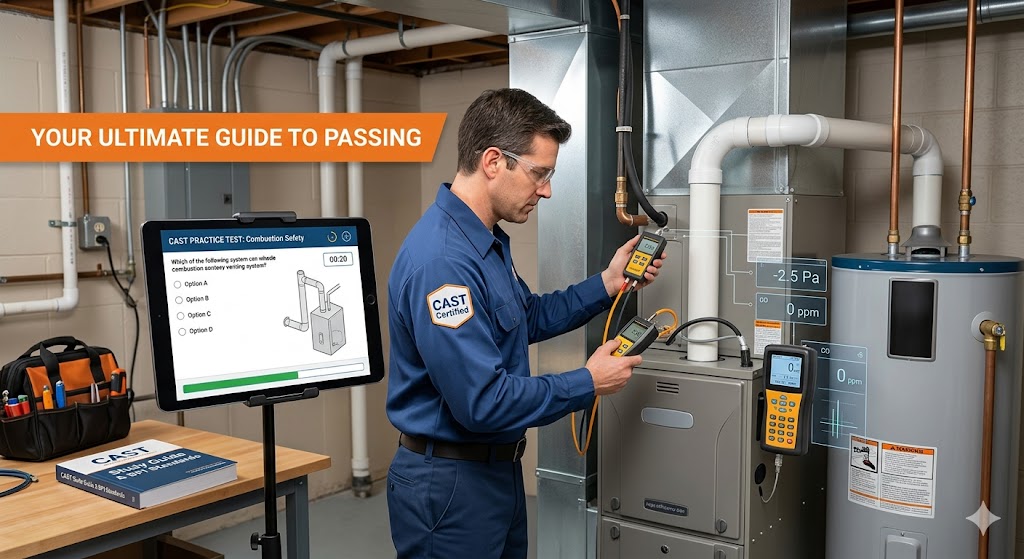
Additional Information
What the Course Entails and Exam Details
This comprehensive course, which preparing for the CAST exam involves, will equip you with a deep understanding of combustion science and practical testing methodologies.
Core topics covered in a standard CAST prep curriculum and on the exam include:
Combustion Science Fundamentals: Understanding the combustion process, fuel types, air requirements, and combustion byproducts (CO, CO2, NOx).
Carbon Monoxide (CO) Monitoring: Best practices for ambient CO testing and flue gas analysis, including how to read a combustion analyzer and understand critical action levels (e.g., when to shut down an appliance).
Venting Systems: Identifying and assessing natural draft, fan-assisted, and direct-vent systems. Recognizing the causes of venting failures and spillage.
Draft Measurements: Learning how to use a manometer to measure draft and pressure, ensuring appliances are properly venting under all conditions.
Combustion Appliance Zone (CAZ) Depressurization Test: The crucial practical skill of calculating CAZ depressurization and testing for draft under worst-case scenarios, such as when exhaust fans and the air handler are running.
Gas Leakage Detection: Safe and effective methods for locating fuel gas leaks in piping and connections.
What to Expect in the Final Exam
While the exact structure can vary depending on the certifying body, the final CAST exam typically consists of two distinct components: a knowledge exam and a field-based practical test.
The Written Knowledge Exam:
Format: Multiple-choice questions.
Time Limit: Usually 1 to 2 hours.
Number of Questions: 50–100 questions.
Content: This section will test your knowledge of combustion theory, fuel types, safety standards, venting rules, and testing procedures. You must demonstrate a clear understanding of critical thresholds for CO, draft, and pressure.
The Practical Field Exam:
Format: A hands-on test in a controlled lab or field setting.
Requirements: Under the observation of an evaluator, you must successfully perform a complete "Combustion Appliance Safety Inspection" (CAS). This will include setting up worst-case depressurization scenarios, measuring draft, checking for spillage, and analyzing flue gases on real or simulated appliances.
Passing Score: Both the written and practical components usually require a minimum score of 70% to 80% to pass.
How to Study and Exam Centers
Preparation is paramount for the CAST exam, as the test is as demanding as it is detailed. Here are actionable study strategies:
Master the Core Documents: Most CAST exams are based on the latest industry standards, such as those from the Building Performance Institute (BPI) (specifically the BPI-1200 Standard) and the National Fuel Gas Code (NFPA 54). Get familiar with these standards.
Take Practice Tests: Utilizing a high-quality "Combustion Appliances Safety Test (CAST) Practice Test" is one of the most effective ways to build your confidence and identify knowledge gaps. This familiarizes you with the phrasing and format of the questions you will face on exam day.
Hands-on Training: Practical skills are the foundation of this certification. Seek out authorized training providers who offer hands-on practice in a specialized lab. Getting comfortable with tools like manometers and combustion analyzers is essential for passing the field exam.
Exam Centers:
You can typically take the CAST exam in two main ways:
Authorized Training Centers: Many technical schools and energy auditing firms are authorized to provide both the pre-exam training and the practical/written tests on-site.
Online Testing Portals/Proctoring: For the written component of the exam, some certifying bodies offer the option of an online, proctored exam. You will take the exam from your own computer, monitored by a live, remote proctor.
To find your nearest testing center, check the website of the specific certifying body you are pursuing.
Job Opportunities from the Course
Earning the CAST certification opens a clear pathway into multiple high-demand career fields. This essential credential is a requirement or a massive asset for job titles such as:
HVAC Installer: Ensuring that new heating systems are installed safely and meet all local codes.
HVAC Service Technician: Diagnosing and repairing advanced issues related to combustion, venting, and carbon monoxide.
Energy Auditor (Building Analyst): Conducting comprehensive home energy assessments, which always include a full combustion safety verification.
Home Inspector: Providing invaluable safety reports on a home's mechanical systems for potential buyers.
Weatherization Specialist: Implementing energy-saving measures, while ensuring the home's "air-tightening" does not create new safety hazards with existing appliances.
Facility Manager: Overseeing the maintenance and safety of a portfolio of properties.
With this certification, you demonstrate that you are a "safety-first" professional, making you highly competitive in the workforce.
Frequently Asked Questions
Reviews
5.0
Based on 0 reviews
Leave a Review
No reviews yet. Be the first to review!