
Comfort Examination and Assessment Questionnaire (EAQ) Practice Exam
$69.00
- Buy to unlock unlimited access to all Quiz questions and Answers in this Quiz.
- After purchase you can print a PDF of the whole quiz at any point. The PDF will contain the questions and the correct answers.
About this Exam
The Comfort Examination and Assessment Questionnaire (EAQ) is a specialized assessment tool designed to evaluate the holistic comfort of individuals in various care settings. This examination assesses a candidate’s understanding of the multidimensional nature of comfort—encompassing physical, psychospiritual, environmental, and social dimensions—and their ability to apply the EAQ tool effectively. This certification is primarily designed for healthcare professionals, including Registered Nurses (RNs), Licensed Practical Nurses (LPNs/LVNs), Nurse Practitioners (NPs), patient care technicians, and clinical researchers who are dedicated to improving patient outcomes and satisfaction through rigorous comfort management.
Ready to test your knowledge?
Buy Now to Access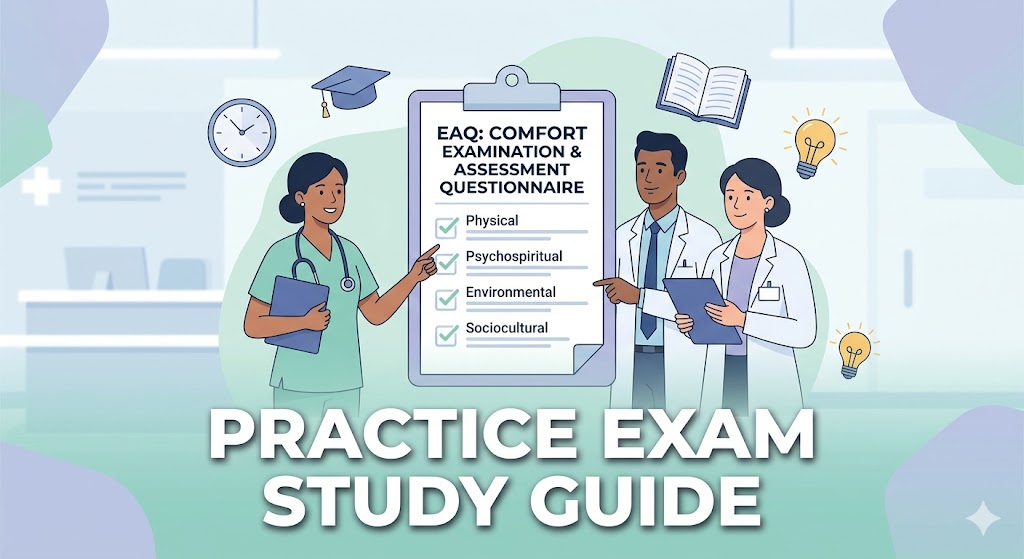
Additional Information
What the Course Entails and Exam Details
Preparing for the Comfort EAQ Examination involves a deep dive into the theoretical framework of comfort care and the practical application of the assessment questionnaire. The core curriculum generally entails the following areas:
Foundations of Comfort Theory: Understanding the history, definitions, and taxonomic structure of comfort (Relief, Ease, and Transcendence).
Multidimensional Assessment: Learning to identify and score comfort across the four contexts: Physical, Psychospiritual, Sociocultural, and Environmental.
The EAQ Tool: Mastering the specific structure, items, and scoring methodology of the Comfort Examination and Assessment Questionnaire itself.
Interpreting Data: Analyzing EAQ scores to identify specific areas of discomfort and tracking comfort levels over time.
Care Planning: Utilizing EAQ findings to develop and implement targeted, evidence-based interventions to enhance patient comfort.
What to Expect in the Final Exam
The Final Comfort EAQ Examination is a standardized assessment meant to verify your clinical competency in comfort assessment. While specific formats may vary by issuing body, candidates should generally expect the following:
Exam Format: The exam usually consists of 60 to 100 multiple-choice questions.
Content Split: Approximately 40% covers theoretical concepts of comfort, and 60% focuses on practical scenario-based application of the EAQ tool.
Scenario Questions: A significant portion of the exam uses detailed patient vignettes, requiring you to determine the appropriate EAQ scoring or the next clinical step based on a provided EAQ profile.
Time Limit: Candidates are typically allotted 90 to 120 minutes to complete the exam.
Passing Score: A minimum score of 75% is standard for passing and receiving certification.
Rules: The exam is closed-book and requires proctoring, whether taken in-person or online.
How to Study and Exam Centers
Success on the Comfort EAQ Exam requires a blend of theoretical study and practical familiarity with the assessment tool. We recommend the following actionable strategies:
Utilize Official Study Guides: Begin by thoroughly reading the core text on Comfort Theory and the official manual for the EAQ tool.
Take Mock Exams: Consistent practice with a Comfort EAQ Practice Exam is crucial. This helps familiarize you with the wording of scenario-based questions and improves your pacing.
Create Flashcards: Memorize the different types of comfort (Relief, Ease, Transcendence) and the four contexts of experience using flashcards for quick recall.
Apply the Tool Clinically: If possible, practice using the EAQ during your clinical rotations or current practice (with appropriate permissions) to become comfortable with real-world application.
Candidates can take the Comfort EAQ Examination through several authorized channels. It is frequently offered via secure online proctoring portals, allowing you to take the exam from home. Physical testing is also available at authorized Pearson VUE testing centers worldwide, as well as specific physical testing centers located within authorized nursing schools or teaching hospitals.
Job Opportunities from the Course
Earning a certification in the Comfort Examination and Assessment Questionnaire validates a specialized skill set that is highly valued in modern, patient-centered healthcare environments. This credential can unlock various advanced career paths and job titles, including:
Comfort Care Specialist: A dedicated role focusing on assessing and managing complex comfort needs, often within palliative or pain management teams.
Palliative Care Nurse: Utilizing specialized assessment skills to improve the quality of life for patients with serious illnesses.
Hospice Nurse: Applying the EAQ to ensure maximum comfort for patients in the end stages of life.
Patient Experience Coordinator: Leading administrative efforts to improve hospital-wide patient satisfaction scores based on comfort data.
Clinical Research Coordinator: Using the EAQ as a standardized metric in clinical trials focusing on pain management or supportive care interventions.
Geriatric Care Manager: Specializing in the holistic comfort and well-being of older adults in long-term care or residential settings.
Frequently Asked Questions
Reviews
5.0
Based on 0 reviews
Leave a Review
No reviews yet. Be the first to review!