
Commercial ACS Practice Exam
$69.00
- Buy to unlock unlimited access to all Quiz questions and Answers in this Quiz.
- After purchase you can print a PDF of the whole quiz at any point. The PDF will contain the questions and the correct answers.
About this Exam
The Commercial ACS (Accredited Certification Scheme) assessment is the essential gateway for any gas operative wishing to work legally within non-domestic, commercial environments in the United Kingdom. This rigorous certification validates an individual’s competence to work safely on large-scale gas systems found in settings like factories, office blocks, hospitals, schools, and restaurants. It is designed for experienced domestic gas engineers looking to expand their scope of work, as well as new entrants to the industry who have completed their initial Managed Learning Programme (MLP). Successfully passing the Commercial ACS assessment is a prerequisite for registering with the Gas Safe Register under commercial categories, proving you possess the specialized knowledge and practical skills to handle complex, high-pressure, and high-volume gas installations.
Ready to test your knowledge?
Buy Now to Access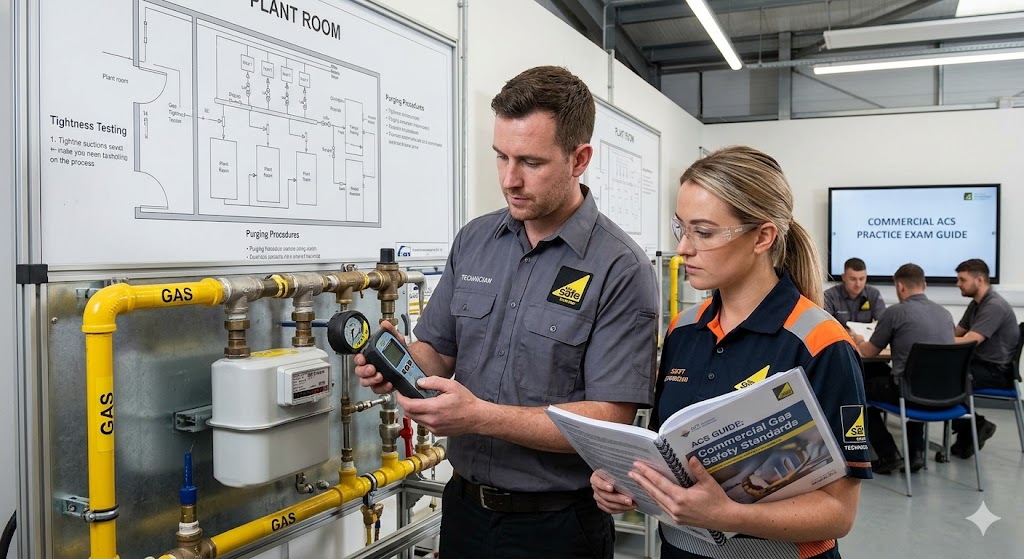
Additional Information
What the Course Entails and Exam Details
This examination does not follow a single syllabus but consists of multiple modules tailored to specific commercial applications. The core component most candidates undertake is the Core Commercial Natural Gas Safety (COCN1) assessment, or its changeover equivalent (CODNCO1) for those already holding domestic qualifications. The course content covering these assessments is comprehensive, delving deep into the theory and regulation of commercial gas work.
You will master the specifics of legislation and British Standards unique to the commercial sector, which differ significantly from domestic regulations. The core topics included in the training and assessment are: Tightness testing and purging of large-diameter pipework, installation of commercial pipework and fittings, combustion performance analysis of commercial appliances, ventilation requirements for large plant rooms, and the operation of emergency control valves and safety systems. Furthermore, beyond the core module, you can undertake specialized "appliance" assessments covering areas such as Commercial Catering (CODC1/COCATA1), Commercial Laundry (COCC1), and Non-Domestic Heating (CIGA1/CORT1).
What to Expect in the Final Exam
You must understand that the Commercial ACS is not a simple written test; it is a comprehensive, multi-day competency assessment. It combines theoretical knowledge testing with rigorous practical demonstrations performed under the watchful eye of an accredited assessor.
The theory component typically utilizes a mix of multiple-choice questions and short-answer questions. Many sections of the theoretical test are "open book," allowing you to reference official legislative documents, British Standards, and technical manuals, simulating real-world working conditions where a technician must know how to find accurate information quickly.
The practical component is where you must demonstrate your hands-on skill. You will be required to perform specific tasks on live or simulated commercial gas equipment within a workshop setting. These tasks often include setting up and testing commercial boilers, diagnosing faults, performing strength and tightness tests on large pipework, and correctly installing safety components. The pass mark is extremely high—often demanding 100% competency in safety-critical elements—as there is no room for error when dealing with commercial gas safety. The total duration of the assessment varies based on the number of modules you are taking, typically lasting between two and four days.
How to Study and Exam Centers
Effective preparation is the single biggest factor in passing your Commercial ACS assessment. Because this is a competency-based test, you cannot rely solely on memorization.
We highly recommend enrolling in a dedicated ACS training course prior to your assessment days. These courses are designed not only to teach you the theoretical principles but also to give you hands-on experience with the types of commercial rigs and equipment you will be tested on.
Your study strategy must combine standard review with active practical simulation: First, meticulously study the primary reference materials, specifically the current British Standards (BS 6891, BS 7624, etc.) and IGEM documents. Second, utilize online Commercial ACS Practice Exam tools to familiarize yourself with the style and complexity of the theory questions. Third, and most importantly, practice your practical procedures. If you have access to commercial settings, shadow experienced engineers and practice tightness testing and purging. If not, maximize your time in the training workshop to build muscle memory and confidence in fault-finding and installation tasks.
You cannot take the Commercial ACS assessment online. It must be completed at an accredited ACS assessment centre. These centres are approved by awarding bodies such as BPEC, LCL Awards, or EAL and are audited to ensure they meet the national standard. You can locate your nearest accredited centre through these awarding body websites or by searching the official Gas Safe Register training provider list.
Job Opportunities from the Course
Gaining your Commercial ACS certification dramatically expands your career horizons within the gas and heating industry, unlocking access to larger contracts and specialized, higher-paying roles.
The specific job titles and career paths this certification unlocks include:
Commercial Gas Engineer (Service and Maintenance)
Industrial Gas Engineer
Commercial Catering Engineer
Commercial Heating and Ventilation (HVAC) Engineer
Building Services Manager
Gas Safe Inspector (Commercial Scope)
Gas Training Assessor or Tutor
Self-Employed Commercial Gas Contractor
Plant Room Installation Specialist
Facilities Maintenance Technician (Gas Specialism)
Frequently Asked Questions
Reviews
5.0
Based on 0 reviews
Leave a Review
No reviews yet. Be the first to review!