
Commercial Appraisal Practice Exam
$69.00
- Buy to unlock unlimited access to all Quiz questions and Answers in this Quiz.
- After purchase you can print a PDF of the whole quiz at any point. The PDF will contain the questions and the correct answers.
About this Exam
The Commercial Appraisal Practice Exam is a critical milestone designed for aspiring professionals aiming to specialize in the valuation of non-residential properties. This comprehensive examination is the national standard required to achieve the prestigious Certified General Appraiser classification. It is specifically tailored for individuals who intend to appraise all types of real property, ranging from small office buildings and retail centers to complex industrial complexes, multi-family housing, and agricultural land. Passing this exam demonstrates an applicant's mastery of advanced valuation principles, market analysis techniques, and ethical standards required to provide credible results in the dynamic commercial real estate sector. It is a necessary step for anyone seeking the highest level of state licensing and professional recognition in the field of real estate appraisal.
Ready to test your knowledge?
Buy Now to Access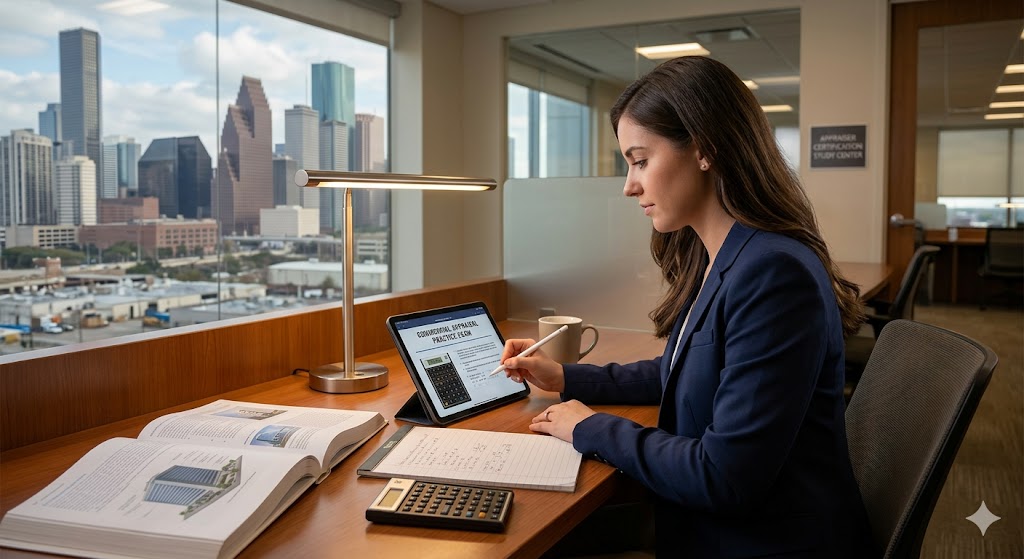
Additional Information
What the Course Entails and Exam Details
This examination is not derived from a single course but rather serves as a cumulative assessment of the 300+ hours of qualifying education mandated by the Appraiser Qualifications Board (AQB). The core content of the qualifying education, which this exam rigorously tests, is structured around several complex pillars. Students will be required to demonstrate proficiency in advanced valuation theory. This includes an in-depth understanding of market analysis, highest and best use analysis, and the derivation and application of capitalization rates. A significant portion of the syllabus is dedicated to the application of the Three Approaches to Value, with a particular focus on the Income Capitalization Approach, which is dominant in commercial valuation. Candidates will learn how to build and analyze various cash flow models. They must also master the Cost Approach, requiring detailed knowledge of construction cost estimation and depreciation analysis, and the Sales Comparison Approach, necessitating the ability to identify, verify, and adjust comparable property data. Furthermore, the coursework includes crucial studies on real estate finance, statistics, valuation modeling, and the Uniform Standards of Professional Appraisal Practice (USPAP), ensuring ethical compliance in all assignments.
What to Expect in the Final Exam
The Commercial Appraisal Practice Exam is known for its rigor and comprehensive nature. It is a national-level, computer-based test administered through authorized testing providers. The examination primarily consists of multiple-choice questions designed to assess both theoretical knowledge and the ability to solve practical, real-world valuation problems. A typical exam will have a total of around 120 to 135 questions. This includes several unscored pre-test questions used for future test development. The time limit for the examination is substantial, usually between four to six hours, reflecting the complexity of the problems. The minimum passing score is generally around 75 percent, which is often reported as a scaled score rather than a raw percentage. Candidates are required to bring and know how to use an approved financial calculator, such as the HP 12c or HP 17bII+, as a significant number of questions involve complex financial calculations, including mortgage-equity analysis and yield capitalization. The exam format is strictly monitored, with no access permitted to personal items or standard reference materials during the test period.
How to Study and Exam Centers
Preparation for the Commercial Appraisal Practice Exam requires a disciplined and thorough study plan. To succeed, you should take as many full-length, simulated practice exams as possible. This builds stamina and familiarizes you with the computerized format and question style. Focus your energy on mastering the concepts within the Income Capitalization Approach. This section is often the largest and most challenging portion of the test, requiring complete comfort with both direct capitalization and discounted cash flow analysis. Utilize active recall methods, such as flashcards, for learning thousands of specific commercial appraisal terms, equations, and rules from USPAP. We highly recommend joining online study forums or groups of fellow examinees. Discussing complex case studies is one of the best ways to reinforce your understanding. Many educational providers offer specific pre-exam cram courses. We suggest you attend one a week or two before your scheduled date. Once you are prepared, you must register for the exam through your state’s licensed administrator, often a national testing company like Pearson VUE. The exams are typically administered at their dedicated computer testing centers, which are located in major cities throughout all fifty states, ensuring accessibility for all candidates.
Job Opportunities from the Course
Earning the designation that this exam validates opens the door to the most lucrative and high-impact career paths within the real estate valuation industry. As a Certified General Appraiser, you are legally authorized to appraise every type of real property, from a single-family home to a landmark skyscraper.
Key job opportunities unlocked by this certification include:
Certified General Real Property Appraiser
Commercial Real Estate Analyst
Review Appraiser for Lending Institutions and Banks
Valuation Consultant for Investment Firms
Eminent Domain and Condemnation Appraiser for Government Agencies
Asset Manager for Real Estate Investment Trusts (REITs)
Corporate Real Estate Valuation Manager
Commercial Fee Appraiser at Regional or National Firms
Real Estate Litigation Support Specialist and Expert Witness
Frequently Asked Questions
Reviews
5.0
Based on 0 reviews
Leave a Review
No reviews yet. Be the first to review!