
Commercial Checkride Practice Test
$69.00
- Buy to unlock unlimited access to all Quiz questions and Answers in this Quiz.
- After purchase you can print a PDF of the whole quiz at any point. The PDF will contain the questions and the correct answers.
About this Exam
The Commercial Checkride, officially known as the FAA Commercial Pilot Practical Test, is the final defining hurdle for pilots seeking to transition from recreational flying to a professional career in aviation. This rigorous evaluation is designed for certificated Private Pilots who have met the substantial aeronautical experience requirements necessary to command aircraft for compensation or hire. Obtaining your Commercial Pilot Certificate is a milestone achievement, validating not just your precise flying skills, but also your judgment, decision-making ability, and command-level understanding of complex aviation regulations and systems. If you aspire to get paid for doing what you love—flying—this is the test that unlocks the door to your professional life in the skies.
Ready to test your knowledge?
Buy Now to Access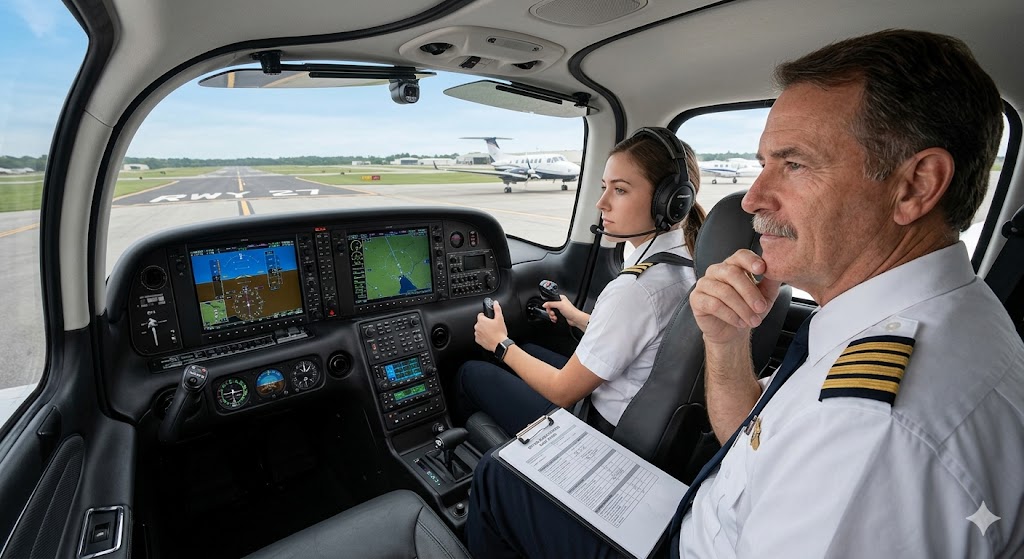
Additional Information
What the Course Entails and Exam Details
While there isn’t a single "course" that covers the checkride, your entire training curriculum for the Commercial Pilot Certificate is focused on mastering the specific standards outlined in the current FAA Airman Certification Standards (ACS).
A thorough study program will entail a deep dive into advanced aerodynamic concepts, sophisticated cross-country flight planning, high-performance aircraft systems (including retractable landing gear and constant-speed propellers), and the extensive regulatory framework of 14 CFR Part 61 and Part 91 governing commercial operations. You will refine your skills in performing flight maneuvers with exceptional precision, handling emergency procedures with calmness and accuracy, and demonstrating the level of Aeronautical Decision Making (ADM) expected of a professional pilot in charge of passengers or cargo. Key syllabus areas include: Masterful Performance of Commercial-Level Maneuvers, Deep Regulation Knowledge, Multi-engine or Complex Aircraft Systems, and Scenario-Based Management.
What to Expect in the Final Exam
It is critical to understand that the Commercial Checkride is not a written, computer-based exam. That is the Commercial Pilot Knowledge Test, which must be passed before you can take this practical test.
The Checkride itself is a comprehensive, one-on-one evaluation conducted in person by an FAA Designated Pilot Examiner (DPE). It consists of two distinct parts: the Ground Oral Exam and the Flight Practical Test.
During the Ground Oral Exam, which typically lasts several hours, the DPE will question you on any topic listed in the ACS, often using realistic scenarios to test your depth of understanding regarding privileges and limitations, weather analysis, aircraft performance, navigation, and systems knowledge. There is no numerical passing score; you must demonstrate understanding to the satisfaction of the examiner based on the ACS task elements.
Following the successful completion of the ground portion, you will proceed to the Flight Practical Test. During this phase, you will act as Pilot in Command (PIC) and perform a predetermined set of maneuvers within the strict tolerances defined by the ACS. The examiner will evaluate your smoothness, accuracy, situational awareness, and crew resource management (CRM). Any failure to meet a standard, violation of a regulation, or demonstration of unsafe operation can result in a dynamic disapproval of the entire test. You must provide a technically advanced or complex aircraft suitable for the test.
How to Study and Exam Centers
Preparation for the Commercial Checkride demands a different approach than previous certificates, focusing heavily on application rather than simple recall.
Actionable Study Strategies:
Make the ACS Your Bible: Download the current Commercial Pilot Airman Certification Standards (ACS) immediately. This document tells you exactly what the examiner must test, the knowledge elements required, the risk management factors, and the flight tolerances you must maintain. Study every single line.
Utilize Oral Exam Guides: Purchase a dedicated Commercial Oral Exam Guide. These books formulate knowledge into the type of scenario-based questions examiners use, helping you practice delivering concise, accurate, and professional answers.
Record Mock Orals: Schedule multiple full-length mock ground exams with your Certified Flight Instructor (CFI). Record these sessions so you can critique your own performance, identify weak areas, and practice verbalizing your knowledge.
Practice to Standards, Not Just "Good Enough": Every training flight must focus on the precise tolerances defined by the ACS (e.g., ±100 feet altitude, ±10 knots airspeed). Practice until you are consistently well within those standards, even when you are tired or stressed.
Verbalize Everything: During your practical flying practice, get in the habit of narrating your actions and thought processes out loud. This demonstrates to the DPE that you are actively managing the flight and making conscious decisions.
Exam Centers:
You do not take the Commercial Checkride at a computer testing center like Pearson VUE. The Practical Test is scheduled directly with a Designated Pilot Examiner (DPE). Your CFI will help you locate an authorized DPE in your region, often through the FAA’s Integrated Airman Certification and Rating Application (IACRA) system. The checkride will take place at a mutually agreed-upon airport, typically where you or the examiner are based.
Job Opportunities from the Course
Earning your Commercial Pilot Certificate is the essential prerequisite for almost every paid position in aviation. It transitions you from a student to a professional. Below is a list of job titles and career paths that this certificate unlocks:
Certified Flight Instructor (CFI/CFII)
Corporate or Business Aviation Pilot
Charter Pilot (Part 135 Operations)
Regional Airline First Officer (leads to ATP certificate)
Agricultural Pilot (Crop Dusting)
Aerial Photography Pilot
Banner Towing Pilot
Pipeline or Powerline Patrol Pilot
Emergency Medical Services (EMS) Pilot
Aerial Firefighting Pilot
Contract Government or Military Pilot (Non-Military Status)
Skydiving Pilot
Frequently Asked Questions
Reviews
5.0
Based on 0 reviews
Leave a Review
No reviews yet. Be the first to review!