
Commercial Comprehensive 2 Practice Exam
$69.00
- Buy to unlock unlimited access to all Quiz questions and Answers in this Quiz.
- After purchase you can print a PDF of the whole quiz at any point. The PDF will contain the questions and the correct answers.
About this Exam
The Commercial Comprehensive 2 qualification is a sought-after standard designed for individuals looking to solidify and expand their competence in commercial gas installations. It serves as an essential milestone for professionals already holding foundational commercial gas certificates (such as the Commercial Core assessment). This qualification validates that an engineer possesses the advanced knowledge and practical skills required to safely and efficiently install, service, maintain, and fault-find complex, large-scale commercial gas appliances and ventilation systems.
This standard is primarily designed for existing Commercial Gas Engineers, Heating Engineers, and technicians who operate in non-domestic environments such as schools, hospitals, hotels, large office blocks, and industrial units. Achieving this competence demonstrates a commitment to safety, adherence to legal regulations (like the Gas Safety Regulations), and high-quality workmanship in the diverse and challenging commercial gas sector.
Ready to test your knowledge?
Buy Now to Access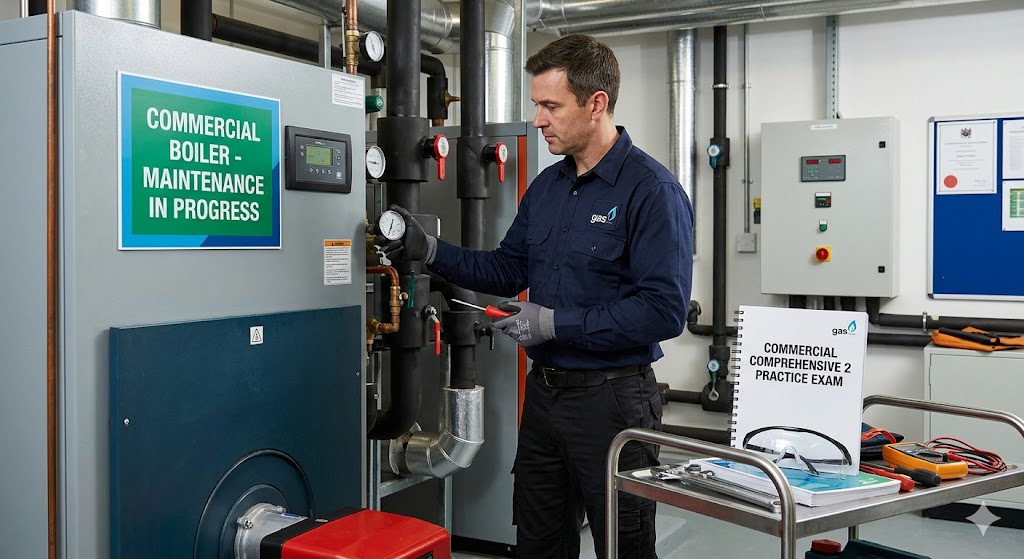
Additional Information
What the Course Entails and Exam Details
The path to the Commercial Comprehensive 2 qualification involves both structured learning (which may be a formal course or equivalent field experience) and a robust assessment process. The focus is strictly commercial and does not cover domestic scenarios. The curriculum or required knowledge base generally covers several key areas vital for large-scale commercial operations:
Commercial Ventilation Systems: Designing, checking, and assessing ventilation requirements for various commercial appliance types, ensuring adequate fresh air for combustion and the safe removal of combustion products.
Commercial Appliance Installation & Maintenance: In-depth procedures for installing, commissioning, servicing, and repairing different categories of commercial boilers, radiant plaques/tubes, forced draught burners, and water heaters.
Chimney & Flue Systems (Commercial): Comprehensive knowledge of commercial flue configurations, including materials, sizing, testing for spillage, and chimney design criteria for large-scale operations.
Commercial Gas Tightness Testing & Purging: Rigorous standards and methodologies for ensuring the integrity of large-diameter commercial gas installations and purging gas supplies safely (usually up to 1m³ volume/40mbar MOP).
Gas Safety (Commercial) Regulations: Staying current with and understanding the application of statutory regulations, standards, and safety critical requirements in the commercial sector.
The formal assessment process validates understanding across all these domains. This process typically requires prerequisite training or experience, as well as holding the standard Commercial Core gas safety certification.
What to Expect in the Final Exam
The actual Commercial Comprehensive 2 assessment is rigorous and strictly controlled. It is designed to simulate real-world challenges and test both practical competence and regulatory knowledge. It usually consists of two distinct parts:
Written Assessments (Multiple Choice or Short Answer): This component evaluates your understanding of key gas safety regulations, British Standards, appliance theories, calculations (e.g., for ventilation or flue sizing), and fault-finding principles. These tests are typically closed-book and time-limited.
Practical Assessments: In this hands-old portion, you must demonstrate competence under observation in a simulated environment or workshop. You will be required to perform critical tasks, such as installing or servicing a commercial boiler, carrying out a comprehensive flue-gas analysis, testing commercial ventilation systems, or performing a detailed commercial tightness test and purge. Assessments are based on strictly adhering to correct procedures and achieving safe outcomes.
Passing Score Requirements: Candidates must pass all practical tasks perfectly (zero safety deviations) and meet a high threshold in the written examinations (typically 80% or higher).
Time Limits: Assessments vary depending on the specific tasks, but expect to allocate 1–2 days for the full assessment process.
How to Study and Exam Centers
Effective preparation for the Commercial Comprehensive 2 assessment requires combining theoretical study with extensive practical experience. Consider the following actionable strategies:
Official Study Materials: Invest in the authorized industry workbooks, standards documents (like BS 6644 for boilers, BS 5440-2 for ventilation, or IGEM standards), and study guides specifically recommended for this qualification.
Engage in Structured Training: While not always strictly mandatory, enrolling in a dedicated training course provided by an accredited college or private training center is highly beneficial. These courses offer structured guidance, clarify complex topics, and provide structured practical practice in safe workshop environments.
Practical Practice (Crucial): Maximize your field exposure. Actively seek opportunities to install, commission, and maintain the specific types of large-scale commercial appliances that are assessed. The practical examination is often the most challenging part, so hands-on practice is vital to build confidence and muscle memory for safe procedures.
Utilize Practice Exams: Practice tests, such as the one described in the title, are excellent for identifying knowledge gaps, becoming familiar with the types of written assessment questions, and practicing answering within time limits. Look for practice exams developed by trusted sources or recognized training providers.
Exam Centers: The assessments for Commercial Comprehensive 2 can only be undertaken at approved and accredited Gas Assessment Centers. These centers are authorized by recognized bodies (such as BPEC, LCL, or others) and possess the necessary resources, equipment, and certified assessors to deliver the qualifications robustly. They operate across the UK (and potentially internationally depending on the qualification's recognition). You must register with an approved center directly or through your training provider to schedule your assessments. These centers have dedicated workshops and testing booths to simulate actual commercial scenarios for your practical evaluation.
Job Opportunities from the Course
A Commercial Comprehensive 2 qualification is highly sought after within the building services engineering and gas industries. Holding this competence validates your ability to operate safely at an advanced level in the commercial sector, significantly boosting your employability.
The qualification unlocks a clear path to diverse and lucrative job opportunities, including:
Commercial Gas Engineer (Advanced Specialist)
Heating & Ventilation (H&V) Engineer (Commercial Focus)
Building Services Engineering Technician
Service Manager/Field Supervisor (for commercial gas teams)
Gas Safety Inspector/Compliance Officer (within organizations managing non-domestic properties)
Independent Commercial Gas Contractor (Working for schools, offices, factories, and public buildings)
Plant Room Maintenance Technician
Successfully achieving this qualification demonstrates to employers that you possess both the high-level practical skills and the regulatory knowledge to manage and maintain complex commercial gas installations safely and effectively.
Frequently Asked Questions
Reviews
5.0
Based on 0 reviews
Leave a Review
No reviews yet. Be the first to review!