
Commercial Driver’s License (CDL) Practice Exam
$69.00
- Buy to unlock unlimited access to all Quiz questions and Answers in this Quiz.
- After purchase you can print a PDF of the whole quiz at any point. The PDF will contain the questions and the correct answers.
About this Exam
The Commercial Driver’s License (CDL) Class B practice test is an essential preparatory tool for aspiring professional drivers.
This certification is designed for individuals looking to operate heavy straight vehicles that do not have a trailer (such as dump trucks or large delivery trucks) or large passenger buses.
Earning this license is the key required to unlock stable and profitable local or regional driving careers.
Ready to test your knowledge?
Buy Now to Access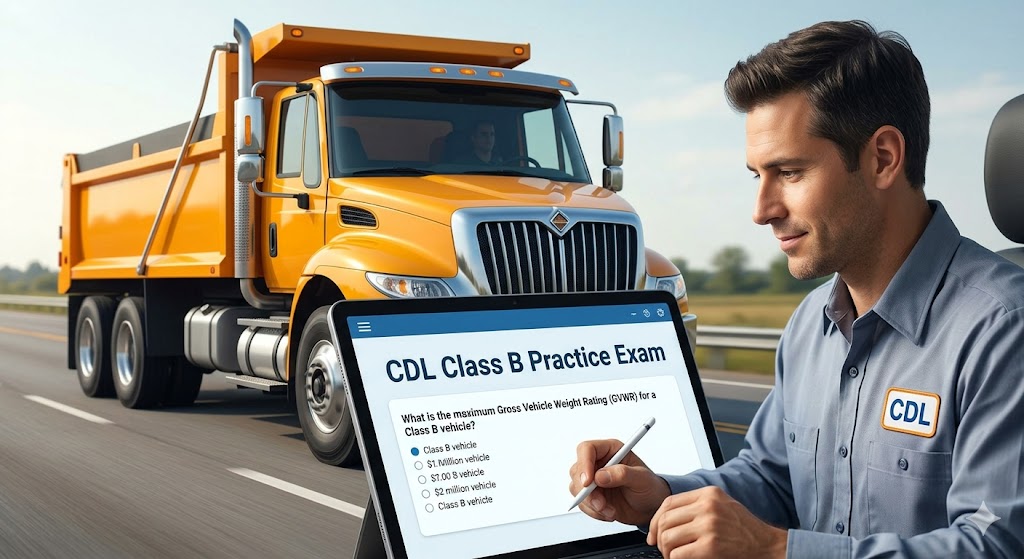
Additional Information
What the Course Entails and Exam Details
Preparation for the CDL Class B exam covers specific vehicle operational skills and safety regulations.
The primary knowledge base revolves around operating "straight trucks" with a Gross Vehicle Weight Rating (GVWR) exceeding 26,001 pounds.
Core topics include vehicle inspection procedures, the critical function of air brake systems (which most Class B vehicles possess), basic control skills, and safe driving principles.
If the driver intends to operate passenger buses, a "Passenger" (P) endorsement is also necessary and often integrated into the preparation.
What to Expect in the Final Exam
The final licensing process is typically divided into two main components: the written knowledge test and the practical skills test.
The written exam is comprised of multiple-choice questions focusing on general knowledge and specialized topics (like air brakes).
While the number of questions varies by state, applicants usually need to achieve a score of at least 80% to pass the written portion.
It is crucial to verify specific time limits and procedures with your local Department of Motor Vehicles (DMV) or equivalent licensing agency, as these can differ significantly by jurisdiction.
How to Study and Exam Centers
The foundation of your study plan must be the official CDL Manual provided by your state's Department of Motor Vehicles.
Do not skim this manual; read it thoroughly, highlighting key facts regarding vehicle specs and safety regulations.
The most effective method for preparing is taking repeated online practice tests.
These practice tests familiarize you with the multiple-choice structure and help pinpoint topics where you need improvement.
The final written exam must usually be taken in person at a designated state DMV testing facility.
The subsequent practical skills test might be scheduled at the DMV or through a state-authorized third-party commercial driving school.
Job Opportunities from the Course
Obtaining a Class B CDL opens doors to diverse and stable job opportunities that keep local economies moving.
This license qualifies you for specific roles and career paths.
Job opportunities unlocked by this certification include:
Heavy Straight Truck Driver
Dump Truck Operator
City or Public Transit Bus Driver
School Bus Driver (requires 'S' endorsement)
Local Delivery Driver for large goods
Concrete Mixer Truck Driver
Waste Disposal Vehicle Operator
CDL Class B Practice Exam
1. Description
The Commercial Driver’s License (CDL) Class B practice test is an essential preparatory tool for aspiring professional drivers.
This certification is designed for individuals looking to operate heavy straight vehicles that do not have a trailer (such as dump trucks or large delivery trucks) or large passenger buses.
Earning this license is the key required to unlock stable and profitable local or regional driving careers.
2. What the Course Entails and Exam Details
Preparation for the CDL Class B exam covers specific vehicle operational skills and safety regulations.
The primary knowledge base revolves around operating "straight trucks" with a Gross Vehicle Weight Rating (GVWR) exceeding 26,001 pounds.
Core topics include vehicle inspection procedures, the critical function of air brake systems (which most Class B vehicles possess), basic control skills, and safe driving principles.
If the driver intends to operate passenger buses, a "Passenger" (P) endorsement is also necessary and often integrated into the preparation.
3. What to Expect in the Final Exam
The final licensing process is typically divided into two main components: the written knowledge test and the practical skills test.
The written exam is comprised of multiple-choice questions focusing on general knowledge and specialized topics (like air brakes).
While the number of questions varies by state, applicants usually need to achieve a score of at least 80% to pass the written portion.
It is crucial to verify specific time limits and procedures with your local Department of Motor Vehicles (DMV) or equivalent licensing agency, as these can differ significantly by jurisdiction.
4. How to Study and Exam Centers
The foundation of your study plan must be the official CDL Manual provided by your state's Department of Motor Vehicles.
Do not skim this manual; read it thoroughly, highlighting key facts regarding vehicle specs and safety regulations.
The most effective method for preparing is taking repeated online practice tests.
These practice tests familiarize you with the multiple-choice structure and help pinpoint topics where you need improvement.
The final written exam must usually be taken in person at a designated state DMV testing facility.
The subsequent practical skills test might be scheduled at the DMV or through a state-authorized third-party commercial driving school.
5. Job Opportunities from the Course
Obtaining a Class B CDL opens doors to diverse and stable job opportunities that keep local economies moving.
This license qualifies you for specific roles and career paths.
Job opportunities unlocked by this certification include:
Heavy Straight Truck Driver
Dump Truck Operator
City or Public Transit Bus Driver
School Bus Driver (requires 'S' endorsement)
Local Delivery Driver for large goods
Concrete Mixer Truck Driver
Waste Disposal Vehicle Operator
Frequently Asked Questions
Reviews
5.0
Based on 0 reviews
Leave a Review
No reviews yet. Be the first to review!