
Commercial Food Equipment Service Association (CFESA) Refrigeration Certification Practice Test
$69.00
- Buy to unlock unlimited access to all Quiz questions and Answers in this Quiz.
- After purchase you can print a PDF of the whole quiz at any point. The PDF will contain the questions and the correct answers.
About this Exam
The Commercial Food Equipment Service Association (CFESA) Refrigeration Certification is a highly respected credential within the commercial foodservice industry. This certification is specifically designed for service technicians who install, maintain, and repair commercial refrigeration equipment found in restaurants, hotels, hospitals, and other foodservice facilities. Earning this certification validates a technician’s expertise in refrigeration theory, system diagnostics, and safety procedures, signaling competence to employers and customers. The practice exam serves as a critical preparatory tool, helping candidates gauge their readiness and identify areas needing further study before taking the official certification exam.
Ready to test your knowledge?
Buy Now to Access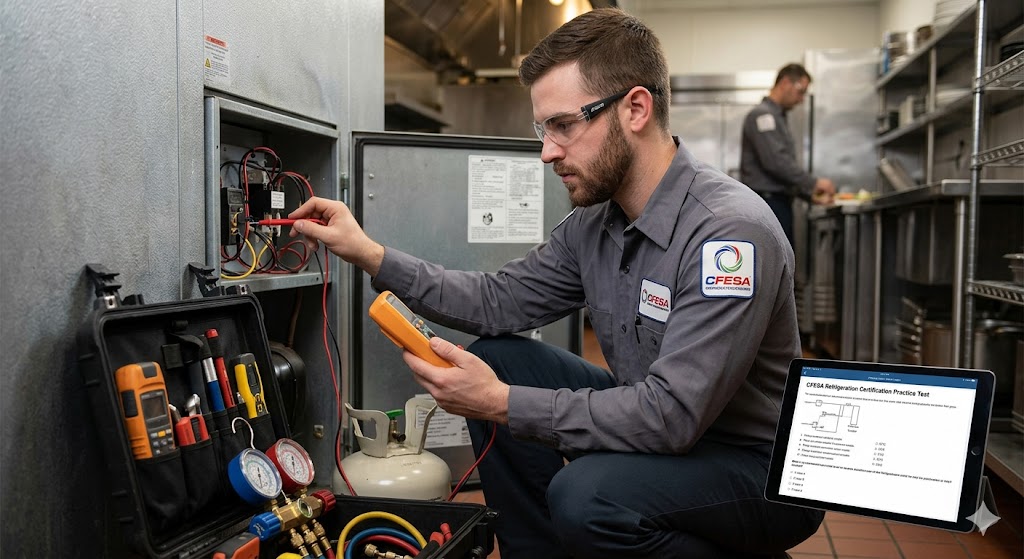
Additional Information
What the Course Entails and Exam Details
The path to CFESA Refrigeration Certification involves a comprehensive understanding of both theoretical concepts and practical applications. The core topics and skills covered include:
Thermodynamics and the Refrigeration Cycle: Master the principles of heat transfer, pressure-temperature relationships, and the step-by-step function of the mechanical refrigeration cycle.
System Components: In-depth knowledge of essential components, including compressors (reciprocating, scroll, rotary), condensers (air-cooled and water-cooled), evaporators, metering devices (TXVs, capillary tubes), and specialized controls.
Refrigerants and Regulations: Understanding the properties of various refrigerants (CFCs, HCFCs, HFCs, and natural refrigerants like R-290 and R-744), leak detection methods, proper recovery/recycling practices, and crucial environmental regulations (including EPA Section 608 requirements).
Electrical Systems and Controls: Mastery of reading wiring diagrams, troubleshooting electrical circuits, testing motors, capacitors, relays, and operating electronic controllers specific to refrigeration equipment.
System Diagnostics and Troubleshooting: Developing systematic approaches to diagnose common issues, such as low cooling performance, component failures, and electrical problems.
Commercial Equipment Specifics: Training on specific types of commercial equipment, including ice machines, reach-in coolers and freezers, walk-in units, and display cases.
Safety Procedures: Emphasizing proper safety protocols when working with high pressures, electricity, and various refrigerants.
What to Expect in the Final Exam
The official CFESA Refrigeration Certification exam is a rigorous assessment designed to test a technician’s comprehensive knowledge. While specific details can sometimes vary slightly, here is what candidates can typically expect:
Format: The exam is primarily a computer-based test featuring multiple-choice questions. It is designed to be closed-book, meaning no outside references or manuals are allowed.
Time Limit: Candidates are usually allotted a specific time window to complete the exam, often around 2 to 3 hours. Efficiency and managing your time per question are important.
Questions: The exam contains a significant number of questions, often ranging from 75 to 100+, covering the broad spectrum of refrigeration topics mentioned above.
Passing Score: To earn the certification, candidates must achieve a minimum passing score, typically 75% or higher.
Focus: Expect a strong emphasis on practical scenarios, troubleshooting diagnostics, regulation compliance, and electrical system analysis, rather than just abstract theory.
How to Study and Exam Centers
Preparation is key to succeeding on the CFESA Refrigeration Certification exam. Here are actionable study strategies and information on where to take the test:
How to Study:
Utilize CFESA Training Materials: The most effective study resource is the official training material provided by CFESA, including manuals and study guides designed specifically for this certification.
Take Practice Exams: Leverage resources like the CFESA Refrigeration Certification Practice Test. This is crucial for familiarizing yourself with the types of questions, the exam format, and identifying weak points in your knowledge base.
Focus on Fundamentals: Ensure you have a rock-solid understanding of the basic refrigeration cycle, thermodynamics, and electricity before moving to advanced topics.
Review Regulations: Study the EPA Section 608 regulations thoroughly, as these are critical and frequently tested.
Hands-on Experience: Combine theoretical study with practical application. Apply concepts you learn to the real-world equipment you service daily. Practice troubleshooting simulated problems.
Form Study Groups: Collaborating with colleagues who are also preparing can provide new perspectives and motivation.
Exam Centers:
The CFESA certification exams are standardized and administered through official channels:
CFESA Headquarters: Exams are often proctored directly at CFESA training facilities.
Authorized Testing Sites: CFESA utilizes a network of authorized testing centers throughout North America. These may include specific vocational schools, community colleges, or dedicated testing organizations that partner with CFESA.
Online Proctoring: CFESA also offers online proctored exam options, allowing technicians to take the certification test conveniently from their own location, provided they meet specific technical and proctoring requirements.
Scheduling: Candidates must register for the exam in advance through the CFESA website. This process involves selecting your preferred testing date and location (physical center or online proctoring).
Job Opportunities from the Course
Earning a CFESA Refrigeration Certification significantly boosts a technician’s credibility and marketability in the commercial foodservice industry. This certification unlocks several specific career paths and job opportunities, including:
Commercial Refrigeration Technician: Specialist focused specifically on repairing, installing, and maintaining commercial coolers, freezers, and ice machines in foodservice environments.
Foodservice Equipment Technician (Generalist): Technicians who service a wide array of commercial kitchen equipment, including hot-side (ovens, ranges) and cold-side (refrigeration) units.
HVAC/R Service Technician: Technicians with broader skills covering heating, ventilation, air conditioning, and refrigeration, often working on both commercial comfort cooling and specialized foodservice systems.
Refrigeration Preventive Maintenance Specialist: Focusing primarily on scheduled maintenance tasks for large commercial refrigeration systems to ensure peak efficiency and minimize downtime.
Facilities Maintenance Technician (Hospitality/Foodservice): In-house technician responsible for maintaining all mechanical systems, including critical refrigeration, within a large facility like a hotel, hospital, or university campus.
Lead Service Technician or Service Manager: The advanced knowledge validated by CFESA certification often qualifies technicians for leadership roles, supervising other service personnel.
Frequently Asked Questions
Reviews
5.0
Based on 0 reviews
Leave a Review
No reviews yet. Be the first to review!