
Commercial Ground – Weather Practice Exam
$69.00
- Buy to unlock unlimited access to all Quiz questions and Answers in this Quiz.
- After purchase you can print a PDF of the whole quiz at any point. The PDF will contain the questions and the correct answers.
About this Exam
Embark on a crucial step towards your aviation career with the Commercial Ground – Weather Practice Exam. This comprehensive assessment is meticulously crafted to prepare aspiring commercial pilots for the intricate nuances of aviation meteorology. It serves as an invaluable resource for individuals seeking to enhance their understanding of weather patterns, phenomena, and their critical impact on safe flight operations. Whether you're a student pilot aiming for a commercial license or an experienced aviator brushing up on essential concepts, this practice exam offers a practical and effective way to evaluate your knowledge and build confidence.
Ready to test your knowledge?
Buy Now to Access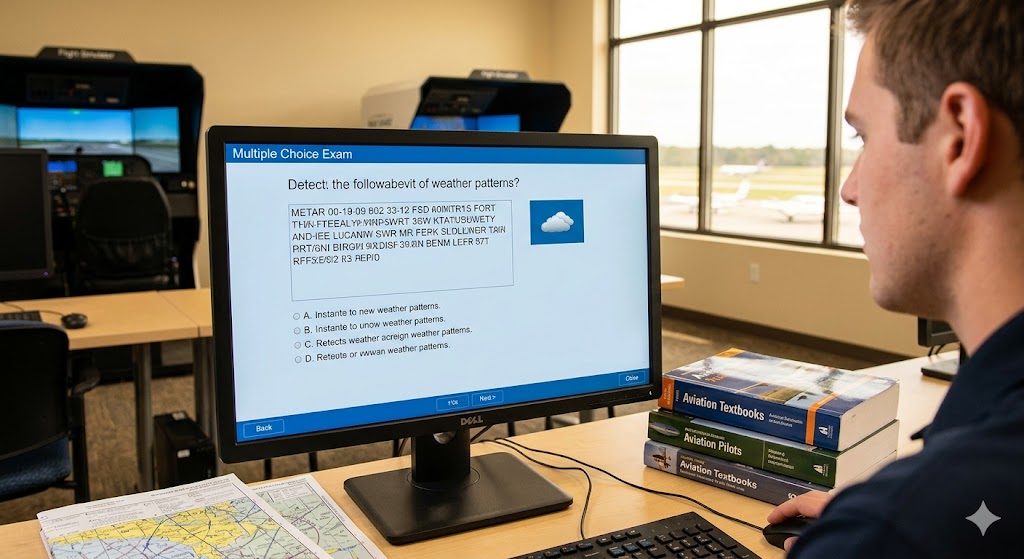
Additional Information
What the Course Entails and Exam Details
This practice exam delves deep into the core meteorology principles vital for commercial aviation. Expect to encountered a wide array of topics including:
Atmospheric Fundamentals: Structure, composition, heat exchange, pressure systems, and altimetry.
Weather Systems: Fronts, air masses, cyclones, and anticyclones, understanding their formation and effects.
Aviation Hazards: Significant weather phenomena such as turbulence, icing, thunderstorms, fog, and low visibility.
Weather Information Services: Interpreting METARs, TAFs, PIREPs, GAFAs, and other essential weather charts and briefings.
Weather and Flight Operations: Analyzing the impact of weather on aircraft performance, route planning, and decision-making.
Upper-Air Meteorology: Understanding jet streams, tropopause, and their relevance to long-distance flights.
The exam structure closely mimics the format encountered in official commercial pilot knowledge tests. Typically consisting of multiple-choice questions, it assesses your ability to apply theoretical knowledge to practical scenarios. Time limits are usually implemented to reflect the fast-paced environment pilots operate within, demanding efficient analysis and accurate interpretation of weather data. While passing scores may vary depending on the specific regulatory body (e.g., FAA, EASA), a thorough understanding of all topics covered is essential for success.
What to Expect in the Final Exam
Upon completion of the Commercial Ground – Weather course, you'll be well-prepared to face the official knowledge test mandated by aviation authorities. This exam typically consists of a predetermined number of multiple-choice questions, designed to comprehensively evaluate your grasp of the subject matter. Questions are often scenario-based, requiring you to analyze weather data, interpret charts, and make informed decisions regarding flight safety.
It is crucial to be familiar with the specific requirements of your licensing authority. This includes knowing the precise number of questions, the allocated time limit, and the minimum score required to pass. While specific details can differ slightly between jurisdictions, the core principles of aviation meteorology remain consistent globally.
How to Study and Exam Centers
Preparation is key to succeeding in any aviation examination. For the Commercial Ground – Weather topic, a multi-faceted approach is most effective:
Thorough Study of Textbooks and Manuals: Utilize recommended aviation meteorology textbooks and official handbooks from organizations like the FAA (e.g., Pilot's Handbook of Aeronautical Knowledge, Aviation Weather).
Interactive Courses and Online Resources: Engage with online courses, webinars, and educational videos that provide visual explanations and interactive learning experiences.
Practice Exams like this one: Consistently taking practice tests is invaluable. They help identify areas where you need further study, familiarize you with the question format, and improve time management skills.
Interpretation Practice: Regularly analyze real-world METARs, TAFs, and other weather charts. Practice making go/no-go decisions based on specific scenarios.
Join Study Groups: Collaborating with other student pilots can provide different perspectives and help clarify complex concepts.
Official commercial pilot knowledge tests are typically administered at authorized testing centers. These centers include dedicated facilities like Pearson VUE or authorized locations within flight schools and aviation academies. You will need to register for the exam in advance through the appropriate regulatory body or testing service provider. Ensure you check the specific requirements and locations available in your region well before your desired exam date.
Job Opportunities from the Course
A strong understanding of aviation meteorology, as demonstrated by passing the commercial ground knowledge test, is a fundamental requirement for numerous exciting career paths within the aviation industry. While passing the weather portion itself doesn't guarantee a job, it is a critical stepping stone towards obtaining your commercial pilot license. Once you have earned your commercial certificate, various job opportunities become accessible, including:
Commercial Pilot (Airlines, Charter, Cargo)
Flight Instructor (sharing your knowledge with aspiring pilots)
Aerial Photographer / Surveyor
Pipeline Patrol Pilot
Air Ambulance / Medevac Pilot
Corporate / Business Aviation Pilot
Test Pilot (with advanced experience)
Drone Operator (often requiring similar airspace and weather knowledge)
Dispatcher (crucial for flight planning and weather monitoring)
By dedicating yourself to mastering Commercial Ground – Weather, you lay a solid foundation for a successful and rewarding career as a professional pilot, contributing to safer skies and more efficient aviation operations worldwide. Keep practicing and keep striving for excellence!
Frequently Asked Questions
Reviews
5.0
Based on 0 reviews
Leave a Review
No reviews yet. Be the first to review!