
Commercial Pilot Airplane (CAX) Calculations Practice Exam
$69.00
- Buy to unlock unlimited access to all Quiz questions and Answers in this Quiz.
- After purchase you can print a PDF of the whole quiz at any point. The PDF will contain the questions and the correct answers.
About this Exam
The Commercial Pilot Airplane (CAX) Knowledge Test is a vital milestone for aspiring professional pilots. This exam is designed for aviators who have already mastered the fundamentals of flight and are seeking the Commercial Pilot Certificate, which allows them to fly for compensation or hire. The "CAX Calculations Practice Exam" is a dedicated resource for mastering the complex arithmetic and performance planning problems that constitute a significant and often challenging portion of the main Knowledge Test. If you are aiming to transition from a private pilot to a commercial career, mastering these calculations is non-negotiable for success.
Ready to test your knowledge?
Buy Now to Access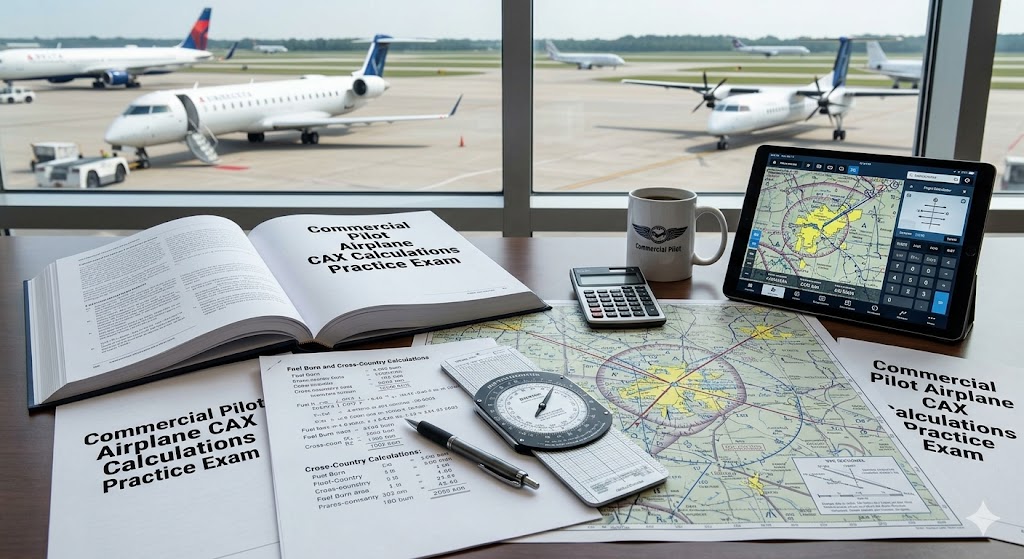
Additional Information
What the Course Entails and Exam Details
This practice exam focuses specifically on the quantitative skills required of a commercial pilot. It isolates and provides extensive practice for the complex calculation-based questions found on the actual FAA CAX Knowledge Test. The core topics covered include:
Advanced Flight Planning: Calculating fuel burn, time, and distance for multi-leg cross-country flights using performance charts.
Aircraft Performance: Interpreting complex graphs and tables for takeoff distance, landing distance, rate of climb, and cruise performance, often accounting for non-standard temperatures and pressure altitudes.
Weight and Balance: Solving intricate problems involving shifts in cargo, passengers, or fuel, and ensuring the aircraft remains within its operational envelope (Center of Gravity) throughout the flight.
Aeronautical Chart Calculations: Computing headings, groundspeeds, and wind correction angles using VFR and IFR charts and a flight computer (E6B).
Weather Data Interpretation: Analyzing Terminal Aerodrome Forecasts (TAFs) and Aviation Area Forecasts (FAs) to calculate conditions that affect flight safety and performance.
Aviation Regulations (Calculation-Based): Applying the definitions of regulations to specific logistical problems, such as crew duty day calculations and minimum fuel reserves.
What to Expect in the Final Exam
While this practice exam is focused on calculations, it prepares you for a significant component of the full CAX Knowledge Test. The actual FAA exam structure you are preparing for is as follows:
Exam Format: Multiple-choice.
Number of Questions: 100 questions.
Time Limit: 3 hours (180 minutes).
Passing Score: 70%.
Calculation Focus: Historically, 15-20% of the questions on the CAX Knowledge Test involve complex, multi-step calculations similar to those found in this practice material.
Materials Allowed: You will be provided with the Airman Knowledge Testing Supplement (which contains the charts you must reference), a standard E6B flight computer, and a basic, non-programmable calculator. Scratch paper is provided, and you are expected to show (to yourself, during practice) the logic of your steps.
How to Study and Exam Centers
Successfully navigating the CAX calculations requires a strategy that goes beyond simple rote memorization. The best approach is rigorous application:
Isolate the Topics: Do not try to solve every problem at once. Dedicate specific study sessions purely to Weight and Balance, followed by sessions purely for Performance Chart interpretation.
Use the Correct Materials: Always practice using the official Airman Knowledge Testing Supplement. Getting familiar with the specific layout and scale of the FAA's charts is crucial.
The "Slow is Smooth, Smooth is Fast" Method: Initially, do not worry about the time limit. Focus on getting the exact right answer. Work through the steps meticulously. Speed will naturally develop as your precision increases.
Practice on both E6B and Calculator: The actual exam allows both. For complex wind or fuel problems, the E6B is often faster and less prone to user error if you know how to use it. For purely numerical divisions or additions, the calculator is superior. Know when to use each tool.
Review the Learning Statement Codes: For any question you get wrong, immediately find the FAA Learning Statement Code (LSC) associated with it. The LSC will pinpoint the specific regulation, chart, or concept you need to restudy in the Pilot's Handbook of Aeronautical Knowledge (PHAK).
Taking the Final Exam:
The FAA does not offer the knowledge test directly. You must register and take it through an authorized testing vendor.
PSI Services: PSI is the sole contracted vendor for all FAA knowledge tests.
Finding a Testing Center: You must create an account on the PSI True Talent website to locate a nearby physical testing center. These centers are often located at flight schools, FBOs (Fixed Base Operators), or general professional testing facilities (like many Pearson VUE centers that also host PSI).
FAA Tracking Number (FTN): Before registering with PSI, you must have an FAA Tracking Number (FTN), which you get by registering in the Integrated Airman Certification and Rating Application (IACRA) system.
Job Opportunities from the Course
Successfully passing the CAX Knowledge Test (of which calculations are a vital part) and obtaining your Commercial Pilot Certificate is the essential prerequisite for almost all professional flying positions. This certification is the "gateway" to a career, unlocking opportunities such as:
Commercial Airline Pilot (First Officer): Operating for regional airlines as a crucial step toward major carriers.
Charter Pilot (Part 135): Flying passengers or cargo in private jets, turboprops, or piston aircraft for non-scheduled operations.
Corporate/Business Aviation Pilot: Flying executives or personnel for a specific corporation or private owner.
Flight Instructor (CFI): This certification allows you to teach others to fly (after obtaining the CFI rating), which is often the primary method for newly commercial pilots to build their flight hours.
Cargo/Freight Pilot: Flying essential goods for organizations like FedEx, UPS, or regional cargo feeders.
Aerial Photographer: Flying precisely planned grids for cartography or marketing.
Agricultural Pilot (Crop Duster): Applying fertilizers and pesticides via precise flight over farmland.
Pipeline and Powerline Patrol Pilot: Visually inspecting infrastructure from low altitudes.
Tour Pilot: Conducting aerial sightseeing tours over scenic areas.
Frequently Asked Questions
Reviews
5.0
Based on 0 reviews
Leave a Review
No reviews yet. Be the first to review!