
Commercial Pilot Airplane (CAX) Performance Practice Exam
$69.00
- Buy to unlock unlimited access to all Quiz questions and Answers in this Quiz.
- After purchase you can print a PDF of the whole quiz at any point. The PDF will contain the questions and the correct answers.
About this Exam
The Commercial Pilot — Airplane (CAX) Knowledge Test is a pivotal hurdle for pilots seeking to transition from a private pilot to a professional aviation career. This exam, administered by the Federal Aviation Administration (FAA), is designed to test an applicant's comprehension of advanced aviation concepts and regulations necessary to act as pilot in command of an aircraft carrying passengers or property for compensation or hire. It is the standard written requirement for anyone aiming to fly professionally in an airplane category. This guide is specifically tailored to help you master the material required to pass the CAX exam and move one step closer to your commercial certificate.
Ready to test your knowledge?
Buy Now to Access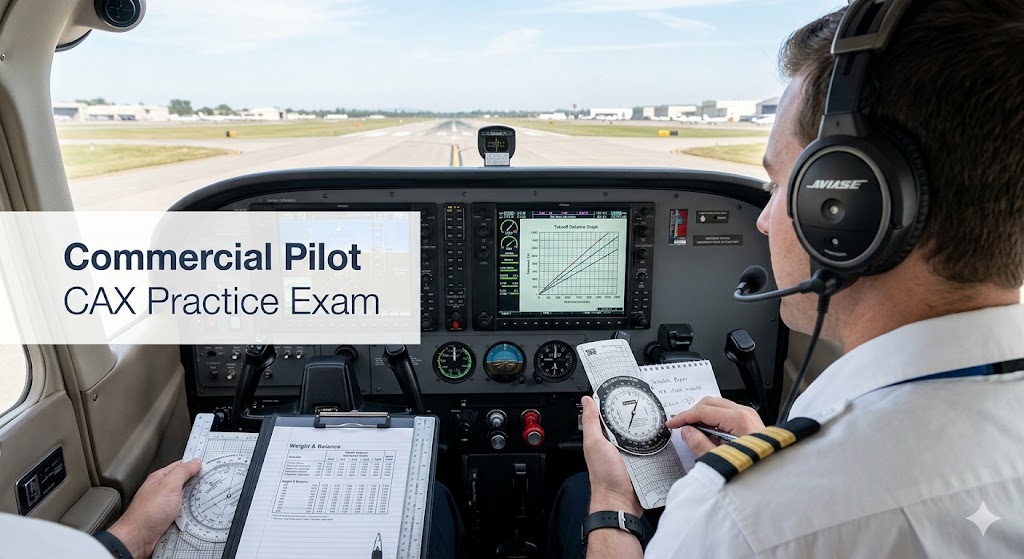
Additional Information
What the Course Entails and Exam Details
This comprehensive course of study covers a wide range of aeronautical knowledge areas defined by the FAA. Candidates must demonstrate deep understanding, not just memorization, of subjects including:
Aerodynamics and Principles of Flight: Understanding how aircraft operate under various configurations and flight conditions.
Aircraft Systems: Advanced details on engines, electrical systems, flight controls, and environmental systems of complex and high-performance airplanes.
Federal Aviation Regulations (FARs): Specific regulations governing commercial operations (e.g., Part 61, 91, and an introduction to Parts 119, 121, and 135).
Performance: This critical section covers calculating takeoff and landing distances, climb performance, density altitude effects, and understanding Aircraft Flight Manuals (AFM).
Weight and Balance: Complex calculations to ensure the aircraft remains within safe operating limits during all phases of flight.
Weather and Aviation Weather Services: Interpretation of advanced weather reports, forecasts, and understanding meteorological phenomena that affect commercial flight safety.
Navigation: Advanced use of navigation systems, including GPS/GNSS, VOR, and interpreting complex aeronautical charts and publications.
Flight Operations: Commercial maneuvers, air traffic control procedures, nighttime operations, and high-altitude operations.
Aeromedical Factors & Aeronautical Decision Making (ADM): Understanding human factors, physiological limitations, and the risk management process crucial for commercial operations.
What to Expect in the Final Exam
The FAA Commercial Pilot Airplane (CAX) Knowledge Test is a computer-administered exam. Knowing what to expect on test day can significantly reduce anxiety and improve your performance.
Format: The exam consists of 100 multiple-choice questions.
Time Limit: You are allotted 3 hours (180 minutes) to complete the entire exam.
Passing Score: The minimum passing score is 70%.
Question Types: The questions are designed to be objective and require you to apply your knowledge to specific scenarios. Many questions, especially in the performance and weight & balance sections, will require you to refer to a provided Computer Testing Supplement (which contains charts, graphs, and diagrams) to find the correct answer. You will need to make precise calculations and interpret graphical data.
Test Aids: You will typically be provided with scratch paper, pencils, a basic four-function calculator, and the official Computer Testing Supplement. You may bring your own approved electronic or manual flight computer (like an E6B) if it meets the FAA’s guidelines (e.g., no pre-programmed course materials or communication capabilities).
Authorized Persons: You must have a proper authorization (usually a logbook endorsement from an authorized ground or flight instructor) certifying that you have completed the required home-study course or ground training and are prepared to take the test.
How to Study and Exam Centers
Preparation is the key to success on the CAX exam. Here are actionable study strategies:
Study Strategies:
Use a Structured Ground School: Enroll in an FAA-approved (Part 141) ground school or utilize a reputable online home-study course. These programs provide a logical flow of information and ensure all tested areas are covered.
Master the FAA Supplements: Obtain a copy of the actual Computer Testing Supplement for Commercial Pilot (FAA-CT-8080-2H or the latest version). Practice every problem involving performance charts, weight & balance graphs, and navigation plotters until you can do them quickly and accurately. This is often where students lose the most time.
Take Practice Exams: Utilize reliable practice exam software and question banks. These tools simulate the actual testing environment and help you identify weak areas. Don't just seek the correct answers; read the explanations to understand why an answer is correct.
Review Core FAA Publications: The Pilot’s Handbook of Aeronautical Knowledge (FAA-H-8083-25) and the Airplane Flying Handbook (FAA-H-8083-3) are the primary sources for the exam questions. Pay close attention to the chapters on performance, weather, and regulations.
Focus on Weak Areas: Use your practice exam results to focus your study time on the topics where you struggle most.
Exam Centers:
The CAX exam is administered by authorized Airman Knowledge Testing (AKT) Centers. The FAA has designated knowledge testing organization designation authorization (ODA) holders to manage these centers across the United States.
How to Register: You cannot usually register for an exam directly at the physical testing center. You must register online through the official vendor portal. Currently, PSI Services LLC is the primary vendor handling FAA knowledge tests.
Requirements for Registration: Before you can schedule your exam, you must have an FAA Tracking Number (FTN). You obtain an FTN by registering in the FAA's Integrated Airman Certification and Rating Application (IACRA) system.
Locating a Center: When registering through the PSI portal, you can search for authorized testing centers near you by entering your zip code. These centers are often located within flight schools, universities, or dedicated testing facilities.
Day of the Test: Arrive at the testing center early with valid government-issued photo identification that includes your current physical address, your FTN, and your required instructor endorsement or authorization.
Job Opportunities from the Course
Earning your Commercial Pilot Certificate unlocks a wide range of exciting and challenging career opportunities. This certificate is the foundational requirement for getting paid to fly. Below are some specific job titles and career paths available to commercial pilots:
Flight Instructor (CFI/CFII/MEI) - Requires additional flight instructor certificates
Charter Pilot (Part 135 Operations)
Corporate or Business Aviation Pilot
Regional Airline First Officer - Typically requires ATP certification, which the commercial pilot certificate is a prerequisite for
Cargo or Freight Pilot
Aerial Photographer/Survey Pilot
Agricultural Pilot (Crop Dusting)
Pipeline or Powerline Patrol Pilot
Sightseeing or Air Tour Pilot
Air Ambulance/Medevac Pilot
Ferry Pilot (Delivering new or used aircraft)
Skydive Pilot
Frequently Asked Questions
Reviews
5.0
Based on 0 reviews
Leave a Review
No reviews yet. Be the first to review!