
Commercial Pilot Licence Aeroplane (CPAER) Meteorology Practice Test
$69.00
- Buy to unlock unlimited access to all Quiz questions and Answers in this Quiz.
- After purchase you can print a PDF of the whole quiz at any point. The PDF will contain the questions and the correct answers.
About this Exam
The Commercial Pilot Licence Aeroplane (CPAER) written examination is a rigorous gateway certification administered by civil aviation authorities such as Transport Canada for aviators stepping up from recreational flying to a professional career.
Within this comprehensive examination, Meteorology stands out as one of the most vital and academically demanding core subjects.
This specific practice exam and study track are designed for ambitious student pilots who hold a Private Pilot Licence (PPL) and are preparing to earn their commercial wings.
By mastering aviation meteorology, candidates not only ensure they can pass the CPAER examination on their first attempt, but they also acquire the essential decision-making skills needed to command commercial aircraft safely through unpredictable and complex atmospheric conditions.
Ready to test your knowledge?
Buy Now to Access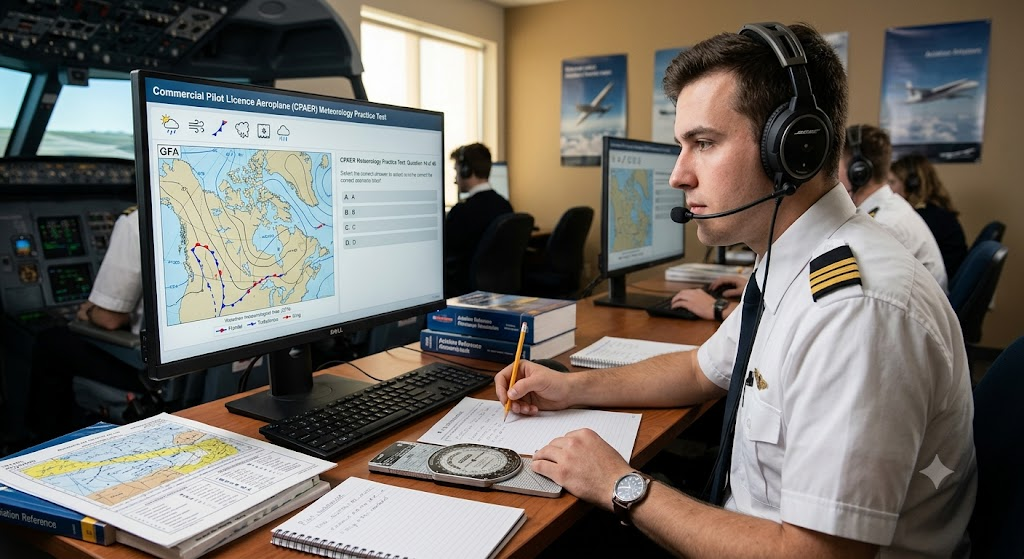
Additional Information
What the Course Entails and Exam Details
A comprehensive CPAER Meteorology course covers both advanced atmospheric theory and practical, real-world interpretation of aviation weather products.
Students delve deeply into the foundational mechanics of the atmosphere, including heating and cooling processes, atmospheric pressure systems, altimetry, and the principles of atmospheric stability.
The syllabus provides extensive training on cloud classification, air mass characteristics, and the life cycles of frontal systems that govern continental weather patterns.
Critical aviation weather hazards receive intense focus, requiring pilots to thoroughly understand the formation and avoidance of severe thunderstorms, clear air turbulence (CAT), wind shear, and structural aircraft icing.
Additionally, the course trains candidates to decode and interpret meteorological reports and forecasts with pinpoint accuracy.
This includes mastering METARs, TAFs, Graphic Area Forecasts (GFAs), Upper Wind and Temperature Forecasts (FDs), Pilot Reports (PIREPs), and urgent hazard advisories like SIGMETs and AIRMETs.
What to Expect in the Final Exam
The official Transport Canada CPAER written examination is a comprehensive 100-question, multiple-choice test encompassing four mandatory subject areas: Air Law, Navigation, Meteorology, and General Knowledge.
Meteorology constitutes a dedicated section of the test, generally comprising between 20 and 25 questions that challenge both theoretical recall and practical chart interpretation.
To achieve a passing grade, candidates must secure an overall score of at least 60 percent across the entire 100-question exam while also attaining a mandatory minimum score of 60 percent specifically within the Meteorology section.
Candidates are allotted a total time limit of 3.5 hours (210 minutes) to complete the full CPAER examination, meaning efficient time management and swift weather interpretation are essential.
The test is strictly closed-book, though students are permitted to bring approved, non-programmable electronic flight computers or manual E6B navigation computers, along with basic rulers and protractors provided or authorized by the testing center.
How to Study and Exam Centers
Achieving mastery in commercial meteorology requires shifting from rote memorization to a conceptual understanding of how dynamic weather systems interact.
A highly effective study strategy begins with utilizing authoritative ground school manuals, such as the Air Command Weather Manual, alongside interactive online ground school modules.
Candidates should practice decoding complex METARs, TAFs, and GFA charts daily until reading them becomes second nature.
Completing timed, realistic CPAER practice exams is crucial for identifying knowledge gaps and building test-day stamina under simulated exam conditions.
When you are endorsed by your Flight Training Unit (FTU) and ready to test, the CPAER examination is administered in person at official Transport Canada regional offices or authorized computer-based examination centers located within certified flight schools.
Appointments must be scheduled in advance through your local aviation examination portal, and candidates must present valid government-issued photo identification, a medical certificate, and proof of required ground school and flight experience hours.
Job Opportunities from the Course
Successfully clearing the CPAER examination and obtaining your Commercial Pilot Licence unlocks a wide array of paid aviation careers, moving you out of the student phase and into professional flight operations.
Charter and Air Taxi Pilot Fly passengers and time-sensitive cargo on scheduled or unscheduled routes, often navigating into remote aerodromes where advanced meteorological interpretation is critical.
Certified Flight Instructor (CFI) Build your pilot-in-command flight hours while teaching the next generation of aviators how to fly safely and navigate atmospheric complexities.
Aerial Survey and Mapping Pilot Operate specialized aircraft equipped with LiDAR and photographic equipment, requiring high precision and clear-weather window planning.
Agricultural Pilot (Crop Duster) Conduct low-level flight operations to treat farmland, a role that demands exceptional mastery of local wind, temperature inversions, and microclimates.
Pipeline and Powerline Patrol Pilot Inspect critical energy infrastructure from the air across vast distances, monitoring weather systems along linear flight paths.
Corporate and Executive Charter Co-Pilot Join multi-crew turbine or jet operations flying business executives on optimized routes around hazardous weather systems.
Regional Airline First Officer Take the final stepping stone into multi-engine commercial airline operations, utilizing advanced weather radar and dispatch briefings to ensure passenger comfort and safety.
Frequently Asked Questions
Reviews
5.0
Based on 0 reviews
Leave a Review
No reviews yet. Be the first to review!