
Commodity Fumigation License Practice Exam
$69.00
- Buy to unlock unlimited access to all Quiz questions and Answers in this Quiz.
- After purchase you can print a PDF of the whole quiz at any point. The PDF will contain the questions and the correct answers.
About this Exam
The Commodity Fumigation License is a crucial specialized certification for pest control professionals who work primarily within the agricultural, logistics, and storage industries. This license authorizes individuals to safely use highly restricted gaseous pesticides (fumigants) to treat stored products and raw materials—such as grain, tobacco, dried fruit, wood products, and processed food—against devastating insect and rodent infestations. It is designed for dedicated pest control technicians, grain elevator managers, warehouse supervisors, shipping and logistics personnel, and food processing quality control specialists. Achieving this licensure proves that an applicator possesses the advanced technical expertise and unwavering commitment to safety required to handle volatile chemicals without risking public health or damaging the food supply.
Ready to test your knowledge?
Buy Now to Access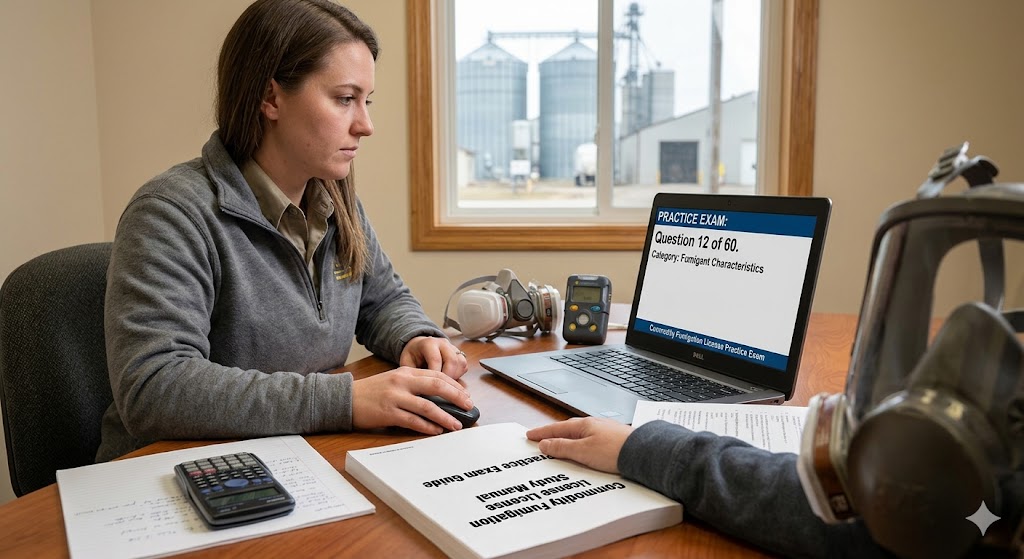
Additional Information
What the Course Entails and Exam Details
A comprehensive preparation course for the Commodity Fumigation License equips students with the specialized knowledge required by federal and state regulatory agencies. The curriculum is centered heavily on the chemistry and physics of common fumigants, including Phosphine (Aluminum/Magnesium Phosphide) and Sulfuryl Fluoride, covering their characteristics, formulations, and precise application methods.
Core syllabus topics include:
Accurate pest identification of common stored-product insects, such as weevils, beetles, and moths, and their life cycles.
Fumigation principles for various scenarios, including tarp, vehicle (railcar/truck), chamber, and structural fumigation of storage facilities.
Advanced safety protocols, featuring mandatory respiration protection requirements, gas detection device usage, and critical emergency response plans.
Rigorous environmental protection strategies and Integrated Pest Management (IPM) principles designed to use fumigation only when necessary.
Mathematical calculations for determining accurate dosages, volumes of fumigation sites, and aeration times.
Comprehensive understanding of state and federal pesticide laws, record-keeping mandates, and restricted-use pesticide (RUP) regulations.
What to Expect in the Final Exam
The final licensing exam is a rigorous test of both your theoretical knowledge and your ability to apply safety principles to practical scenarios. The examination is primarily administered in a written, multiple-choice format, though some states may include short-answer questions or requires a secondary practical demonstration. The questions are designed to challenge your understanding of fumigant biology, safety protocols, law compliance, and mathematical calculations.
Candidates are typically required to achieve a passing score of at least 70% or 75% to be granted the license. The exam is always proctored and strictly timed, often allowing between 90 minutes to two hours for completion. You will be forbidden from bringing outside resources into the exam, but standard calculators are often allowed, and reference materials specific to label interpretation may be provided by the testing center.
How to Study and Exam Centers
The key to passing this exam lies in mastering the technical study manuals provided by your state’s Department of Agriculture or authorized university extension services. You must develop a strong grasp of chemical labels, as label interpretation is a heavy component of the test. Dedicate significant time to practicing dosage calculations to ensure speed and accuracy. One of the most effective study methods is consistently taking a Commodity Fumigation License Practice Exam to familiarize yourself with the question phrasing, manage your time, and pinpoint specific areas where you need further review.
Regarding examination centers, these exams are typically managed at the state level. They may be administered directly at physical Department of Agriculture offices or through recognized third-party proctoring services, such as Pearson VUE. In many cases, authorized environmental training schools or county extension offices also serve as designated testing sites. You must check with your specific state lead pesticide agency for their specific registration processes and location list.
Job Opportunities from the Course
Earning your Commodity Fumigation License signals a high level of specialization that is in demand across multiple lucrative sectors. This certification unlocks several specific career paths, including:
Certified Commodity Fumigation Specialist
Restricted-Use Pesticide Applicator
Specialized Pest Control Technician
Grain Elevator Manager or Supervisor
Agricultural Warehouse Sanitation Coordinator
Logistics and Shipping Port Fumigator
Food Processing Facility Quality Control Inspector
Import/Export Quarantine Officer
Frequently Asked Questions
Reviews
5.0
Based on 0 reviews
Leave a Review
No reviews yet. Be the first to review!