
Common Safety Orientation (CSO) Practice Test
$69.00
- Buy to unlock unlimited access to all Quiz questions and Answers in this Quiz.
- After purchase you can print a PDF of the whole quiz at any point. The PDF will contain the questions and the correct answers.
About this Exam
The Common Safety Orientation (CSO) is a foundational safety certification designed specifically for individuals entering the energy, oil, and gas industries. Developed by industry experts, this orientation introduces new workers to essential health and safety concepts necessary for safe performance on work sites. Its primary goal is to establish a standardized level of safety knowledge across the sector, eliminating the need for redundant general safety training when moving between different employer sites. This certification is crucial for anyone looking to start a career in these high-stakes industrial environments.
Ready to test your knowledge?
Buy Now to Access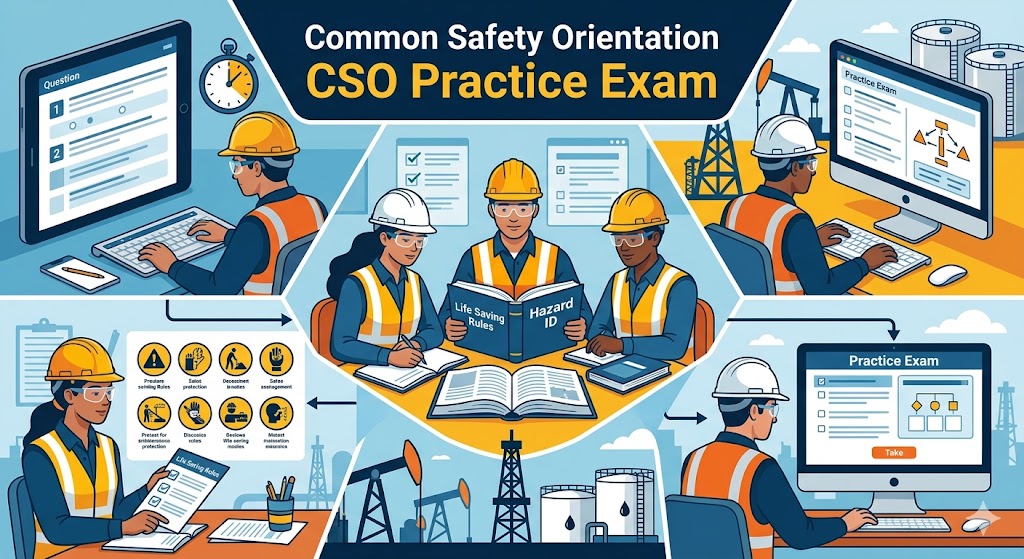
Additional Information
What the Course Entails and Exam Details
The CSO course covers a comprehensive range of core safety topics. Participants are introduced to personal accountability for safety, arriving fit for duty, and understanding their legal rights and responsibilities under Occupational Health and Safety (OHS) legislation. The curriculum delves deeply into hazard assessment and control, teaching workers how to identify common workplace hazards and apply the Hierarchy of Controls.
A significant portion of the course is dedicated to the 10 Life-Saving Rules, which are critical behaviors designed to prevent serious injuries and fatalities. Other essential subjects include emergency preparedness and response procedures, proper incident and near-miss reporting, and recognizing standard safety signage and communication protocols used in industrial settings.
What to Expect in the Final Exam
The final exam for the Common Safety Orientation is typically administered online and serves as a proctored, knowledge-based assessment. Candidates should expect a series of multiple-choice questions that test their understanding of all the concepts covered in the orientation modules. The exam is closed-book, meaning you cannot reference materials during the test.
To receive the certification, a high passing score is required, commonly set at 80% or higher. There is generally a time limit to complete the exam, often ranging from 60 to 90 minutes. Upon successful completion, a permanent certificate is usually issued, which does not expire, although some industry sectors may require periodic refreshers.
How to Study and Exam Centers
Effective study strategies for the CSO exam involve engaging thoroughly with the course material. While practical, hands-on skills are vital in the field, this exam focuses on theoretical knowledge. We highly recommend reviewing all modules of the official CSO course carefully, taking detailed notes on the Life-Saving Rules and hazard assessment techniques. Utilizing practice exams is an excellent method to familiarize yourself with the question format and identify areas needing further study. Focus on understanding the why behind safety regulations, not just memorizing them.
The course and final exam are most frequently accessed online through authorized safety training providers and the official portal of Energy Safety Canada. This online format allows for flexibility, letting you complete the training and test from a computer with a webcam and reliable internet access. In some cases, authorized physical testing centers or designated schools may offer facilitated sessions for those who prefer an in-person environment.
Job Opportunities from the Course
Obtaining the CSO certification is often a mandatory prerequisite for many roles within the energy sector, serving as a key that unlocks numerous career paths. This certification demonstrates to employers that you possess the essential safety mindset required to work on their sites. Here is a list of job titles and career paths that a CSO certification can help you access:
Leasehand / Floorhand in Drilling
Roustabout
General Labourer in Oil & Gas
Field Technician Assistant
Maintenance Worker (Entry-Level)
Construction Craft Worker (Industrial)
Well Servicing Worker
Pipeline Labourer
Warehouse Worker (Industrial)
Driver/Operator Assistant
Frequently Asked Questions
Reviews
5.0
Based on 0 reviews
Leave a Review
No reviews yet. Be the first to review!