
Community and Public Health Nursing Practice Test
$69.00
- Buy to unlock unlimited access to all Quiz questions and Answers in this Quiz.
- After purchase you can print a PDF of the whole quiz at any point. The PDF will contain the questions and the correct answers.
About this Exam
The Community Public Health Nursing Practice Exam is an essential tool for registered nurses aiming to achieve certification in the vital field of public health. This comprehensive resource is designed to mimic the rigor and content of official board exams, such as the Public Health Nursing-Board Certified (PHN-BC™) credential. The primary goal of these final exams is to validate a nurse’s entry-level clinical knowledge and skills in the specialty, confirming their ability to promote and protect the health of entire populations. It is ideal for dedicated nurses holding a Bachelor of Science in Nursing (BSN) who have gathered significant clinical experience and wish to formalize their expertise. Achieving this certification demonstrates your dedication to mastering epidemiological concepts, community assessment, and evidence-based interventions for diverse communities.
Ready to test your knowledge?
Buy Now to Access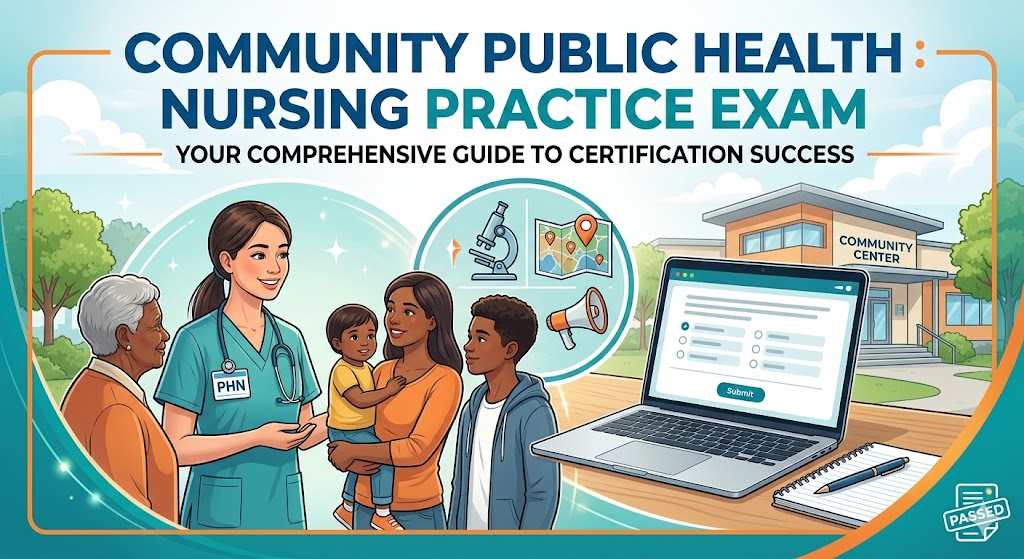
Additional Information
What the Course Entails and Exam Details
The ultimate certification exam focuses on the core competencies and knowledge domains essential for effective public health nursing. While it is an assessment rather than a traditional course, preparing for it requires mastery of several critical areas. The exam tests your ability to apply nursing processes to population-based care, analyze health data, and manage complex social and health issues.
Key topics covered within the final exam typically include:
Community Health Assessment: Techniques for gathering and interpreting population health data and community assets.
Epidemiology and Communicable Disease Control: Principles of disease tracking, outbreak investigation, and prevention strategies.
Health Promotion and Disease Prevention: Implementing programs across the lifespan for individuals, families, and groups.
Policy and Advocacy: Understanding the nurse's role in shaping health policy and advocating for social justice and health equity.
Program Planning and Evaluation: Designing, implementing, and assessing the effectiveness of community health initiatives.
Environmental Health: Identifying and managing environmental factors that affect community well-being.
What to Expect in the Final Exam
The final board certification exam, such as the ANCC PHN-BC, is a rigorous, computer-based assessment. Candidates must be prepared for a standardized environment with specific rules to ensure fairness and integrity. You will not receive standard multiple-choice questions only; modern exams often include alternative item formats to better test critical thinking.
Essential details to keep in mind for your final testing day are:
Exam Format: The test consists primarily of multiple-choice questions, but may also include alternative item types like drag-and-drop, hot spot, and multiple responses.
Total Questions: You can expect approximately 150 questions in total, with around 125 being scored items and 25 being pretest, or pilot, items that do not affect your score.
Time Limit: Candidates are generally allotted 3 hours to complete the examination.
Passing Score: The ANCC reports scores on a scale from 0 to 500. To pass, you must achieve a scaled score of 350 or higher.
Scoring Method: This is a criterion-referenced test, meaning your performance is measured against a fixed standard of competence, not against other test-takers.
Specific Rules: Personal items are not allowed in the testing room, and you must present a government-issued photo ID upon arrival.
How to Study and Exam Centers
To maximize your chances of success on the final board exam, you must adopt a structured and multifaceted study approach. The Community Public Health Nursing Practice Test is your cornerstone resource, offering realistic simulation and immediate feedback to guide your review. When you utilize the practice test, treat it as a diagnostical tool to identify weak areas rather than just a memory aid.
Actionable study strategies include:
Analyze Your Practice Test: After taking the practice test, carefully review the rationales for both correct and incorrect answers to understand the underlying principles.
Review Official Scope and Standards: Thoroughly study the ANA's Public Health Nursing: Scope and Standards of Practice as it forms the basis of the exam blueprint.
Use Multiple Resources: Supplement your study with reliable textbooks on epidemiology, community health nursing, and health policy.
Form Study Groups: Collaborating with peers allows for discussion and deeper processing of complex topics.
Create Concept Maps: Visualize relationships between different public health concepts, diseases, and nursing interventions.
The final certification exams are not taken within a standard course portal but at secure, authorized testing centers worldwide. You must schedule your exam in advance through the official accrediting body’s testing partner. For ANCC exams, this is typically done via the Prometric website after your eligibility has been confirmed. Prometric has a vast network of physical testing centers, ensuring you can find a convenient location to take your high-stakes assessment in a controlled environment.
Job Opportunities from the Course
Achieving Board Certification in Public Health Nursing unlocks a wide range of rewarding career paths. Employers in government agencies, non-profits, and educational systems highly value the validation of specialized knowledge that this credential provides.
Graduates of this preparation and the subsequent final certification are qualified for roles such as:
Public Health Nurse (County, State, or Federal)
Community Health Educator
School Nurse (Pre-K through 12)
Occupational Health Nurse
Nurse Case Manager (Public Health Sector)
Infectious Disease or Epidemiology Nurse
Maternal and Child Health Nurse (Home Visiting)
Home Health Nurse
Community Clinic Manager
Health Policy Analyst/Advocate
Frequently Asked Questions
Reviews
5.0
Based on 0 reviews
Leave a Review
No reviews yet. Be the first to review!