
Community Health Nursing Practice Exam
$69.00
- Buy to unlock unlimited access to all Quiz questions and Answers in this Quiz.
- After purchase you can print a PDF of the whole quiz at any point. The PDF will contain the questions and the correct answers.
About this Exam
The Community Health Nursing Practice Exam is a vital assessment tool for registered nurses (RNs) and licensed practical/vocational nurses (LPNs/LVNs) aiming to specialize in population-focused healthcare. This practice exam is designed to help dedicated nursing professionals evaluate their readiness for final certification or comprehensive academic exams in community and public health nursing. It is an ideal resource for those who want to transition from acute care settings into impactful roles within communities, schools, occupational settings, and government agencies. By taking this practice exam, students can identify critical knowledge gaps and build the confidence necessary to succeed in promoting wellness and preventing disease on a broad scale.
Ready to test your knowledge?
Buy Now to Access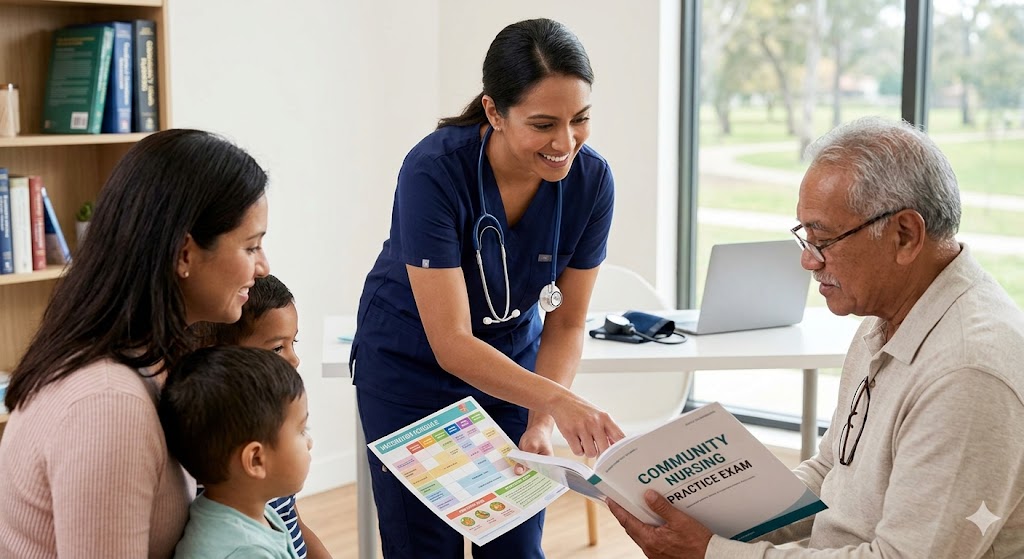
Additional Information
What the Course Entails and Exam Details
This specialized practice exam focuses on the unique skills required to care for communities and distinct population groups rather than individual patients in a clinical setting. The core curriculum, reflected in the exam questions, covers essential principles of public health, focusing on the synthesis of nursing practice and public health tenets.
The syllabus primarily entails the following domains:
Concepts of Community Health: Understanding the philosophy, goals, and history of community health nursing practice.
Health Promotion and Disease Prevention: Strategies for the primary, secondary, and tertiary levels of prevention within diverse populations.
Epidemiology and Demography: Basic concepts of epidemiology, understanding disease transmission, vital statistics, and demographic cycles.
Community Assessment and Diagnosis: Methods for assessing a community’s health needs, assets, and identifying prevailing health problems.
Care of Vulnerable Populations: Specialized nursing care strategies for specific groups such as the elderly, homeless, maternal-child groups, and those with chronic illnesses.
Environmental Health: Identifying environmental risk factors, sanitation principles, and the nurse's role in advocating for healthy environments.
Emergency Preparedness and Disaster Management: The nurse's role in planning for, responding to, and recovering from community emergencies or natural disasters.
Ethical and Legal Considerations: Applying ethical frameworks to population-based care and understanding the relevant health laws and policies.
What to Expect in the Final Exam
While the exact structure can vary depending on the specific certifying body or academic institution, students should generally expect a rigorous, comprehensive assessment that challenges their critical thinking skills. The format is overwhelmingly multiple-choice, with questions often based on realistic, complex community scenarios.
Typically, a full-length final exam may contain between 100 and 150 items. The time limit allocated is usually between 2 and 3 hours, requiring efficient time management. A passing score generally ranges from 70% to 75%, reflecting a requirement for a high level of competency in the material. Some exams may also include alternative item formats, such as multiple-response or drag-and-drop questions, requiring comprehensive knowledge rather than simple recall.
How to Study and Exam Centers
Preparation for this exam requires a structured approach that emphasizes application over rote memorization. Successful students are encouraged to create a detailed study plan that covers all the core domains outlined in section two.
Actionable study strategies include:
Use Practice Exams Extensively: Do not just take the test; analyze the rationales for both correct and incorrect answers to understand the "why" behind public health decisions.
Focus on Health Promotion Levels: Ensure you can clearly differentiate primary, secondary, and tertiary prevention scenarios, as this is a heavily tested concept.
Master Key Epidemiology Terms: You must be fluent in terms like incidence, prevalence, morbidity, and mortality, and understand how they are calculated and applied.
Review Scenario-Based Questions: Practice solving problems where you are given data about a community and must determine the priority nursing diagnosis or intervention.
The final official examination is typically administered through authorized professional testing organizations, such as Pearson VUE, at their dedicated computer-based testing centers worldwide. Depending on the specific program, online proctored options may also be available through secure portals. Students must register for the exam through their respective certifying agency or university academic department.
Job Opportunities from the Course
A strong performance on the final exam leads to certification or academic credit that significantly unlocks diverse and rewarding career paths outside the traditional hospital environment. Professionals with expertise in community health nursing are highly sought after by various organizations.
This certification or focus opens doors to the following specific job titles and career paths:
Frequently Asked Questions
Reviews
5.0
Based on 0 reviews
Leave a Review
No reviews yet. Be the first to review!