
Community Paramedic Practice Test
$69.00
- Buy to unlock unlimited access to all Quiz questions and Answers in this Quiz.
- After purchase you can print a PDF of the whole quiz at any point. The PDF will contain the questions and the correct answers.
About this Exam
The Certified Community Paramedic (CP-C) designation represents a significant evolution in pre-hospital care. This specialization is designed for experienced paramedics who are ready to expand their role beyond traditional emergency response and transport.
Community Paramedicine focuses on mobile integrated healthcare (MIH), filling crucial gaps in the local health system by providing preventive care, chronic disease management, and post-discharge follow-up directly in patients' homes. This certification validates a paramedic's competence in operating within this broader public health framework, coordinating care with physicians, and addressing the social determinants of health to improve patient outcomes and reduce unnecessary hospital readmissions.
Ready to test your knowledge?
Buy Now to Access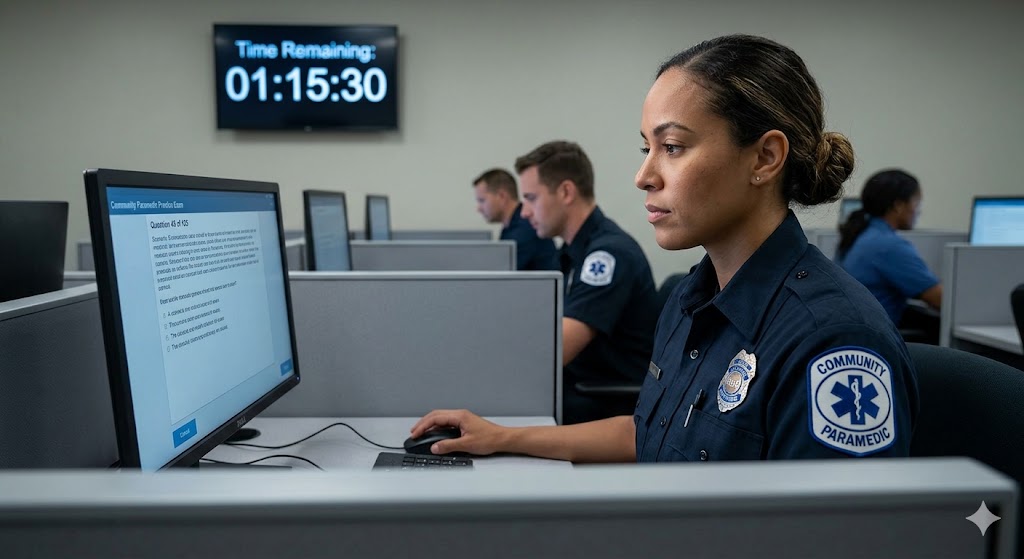
Additional Information
What the Course Entails and Exam Details
Preparing for this exam requires a deep understanding of primary care principles that aren't always covered in standard paramedic training. The curriculum and the exam cover several core domains essential for community practice.
You must be proficient in community health needs assessment, understanding how to identify gaps in care within a specific population. A massive component is chronic disease management, focusing on the long-term care of conditions such as congestive heart failure (CHF), COPD, diabetes, and hypertension, including medication reconciliation and adherence counseling.
The exam also entails knowledge of social determinants of health (SDOH), navigating public health and social service systems, and performing safety assessments within the home environment. Furthermore, candidates must master behavioral health interventions, motivational interviewing techniques, and the ethical responsibilities unique to longitudinal, patient-centered care.
What to Expect in the Final Exam
The Certified Community Paramedic examination is a rigorous assessment administered by the International Board of Specialty Certification (IBSC). The exam is a computer-based test consisting of 135 multiple-choice questions.
Of these 135 items, 110 are scored, while 25 are unscored "beta" questions used for future test validation. Candidates are provided with a strictly enforced 2.5-hour time limit to complete the entire examination. The questions are significantly scenario-based, requiring you to apply your knowledge to realistic community health situations rather than just recalling facts.
The passing score is determined using a criterion-referenced approach, meaning your score is scaled against a predetermined standard of competence, rather than a curved grade. This is not an entry-level test; it is designed to validate the advanced competency required for this specialized role.
How to Study and Exam Centers
Successfully passing the CP-C exam requires dedicated preparation beyond your field experience. Your study strategy should prioritize scenario-based practice.
Start by obtaining the official IBSC CP-C Exam Content Outline to focus your efforts. Study core texts such as "Community Health Paramedicine" (AAOS) and review guidelines on MIH models from organizations like NAEMT. Many paramedics find that taking a formal Certified Community Paramedic review course—offered by many community colleges and specialized training agencies—is highly beneficial. Utilize practice exams to familiarize yourself with the cadence of scenario-based multiple-choice questions and to identify your weak points in chronic disease management or public health systems.
When you are ready to take the final exam, you will need to register through the IBSC portal. The exam is administered at authorized professional testing centers, most commonly Pearson VUE locations available globally. After registering and paying the examination fee, you will receive an Authorization to Test (ATT) which allows you to schedule your specific time slot at a convenient testing center. Ensure you bring proper government-issued identification on test day.
Job Opportunities from the Course
Earning your Community Paramedic certification unlocks specialized, in-demand career paths that differ significantly from traditional 911 response. This certification signals to employers that you possess the advanced clinical and public health knowledge required for integrated care models.
Specific job titles and pathways include:
Community Paramedic (CP)
Mobile Integrated Healthcare (MIH) Provider
Chronic Disease Management Coordinator
Post-Discharge Follow-up Specialist
Hospital-at-Home Paramedic
Public Health Paramedicine Liaison
Care Navigator
Rural Health Paramedic Specialist
These roles are found within various organizations, including hospital systems looking to reduce readmissions, private EMS agencies partnering with insurance providers, municipal fire departments expanding their public health outreach, and standalone community health programs.
Frequently Asked Questions
Reviews
5.0
Based on 0 reviews
Leave a Review
No reviews yet. Be the first to review!