
Complete Nurse Aide Practice Exam Study Guide
$69.00
- Buy to unlock unlimited access to all Quiz questions and Answers in this Quiz.
- After purchase you can print a PDF of the whole quiz at any point. The PDF will contain the questions and the correct answers.
About this Exam
The Nurse Aide certification is a foundational credential for those passionate about entering the healthcare field and providing essential, direct care to patients. It is designed for individuals who want to work under the supervision of licensed nurses, assisting with the daily activities and well-being of residents in various settings. This certification validates the crucial knowledge and practical skills required to deliver safe, effective, and compassionate care. Our comprehensive Nurse Aide Practice Exam and guide are specifically created to help you, as a student, prepare effectively, build confidence, and successfully achieve this important professional milestone.
Ready to test your knowledge?
Buy Now to Access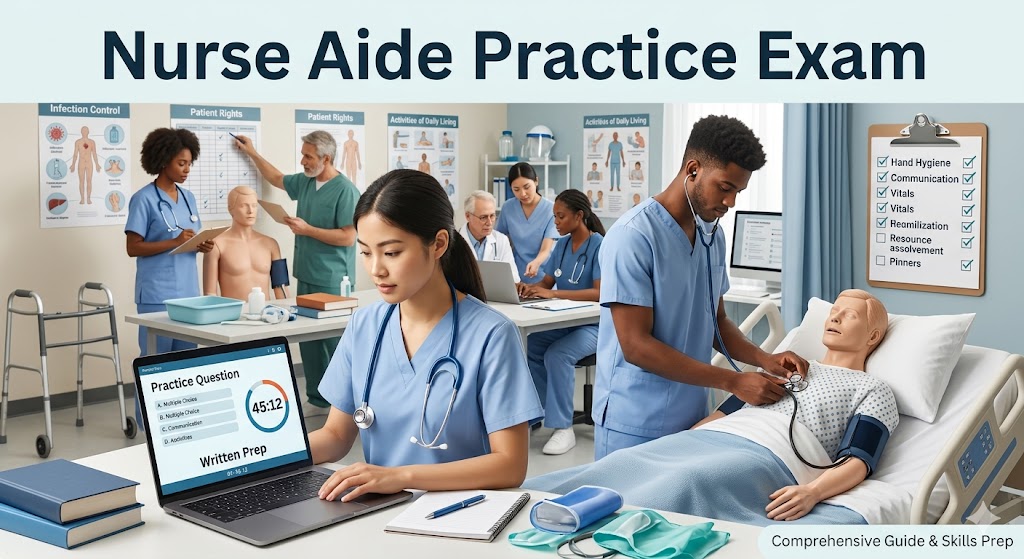
Additional Information
What the Course Entails and Exam Details
A typical Nurse Aide training course equips you with a wide array of fundamental caregiving skills and theoretical knowledge. Topics commonly covered include understanding resident rights, infection control practices, safety procedures, and communication techniques. You will also learn practical skills like measuring vital signs (temperature, pulse, respiration, and blood pressure), assisting with personal hygiene, feeding, and positioning. Furthermore, courses delve into restorative care, basic nursing skills, and the ethical/legal aspects of the role.
The actual certification process generally consists of two main parts: a written (or oral) multiple-choice exam and a practical skills evaluation. Our practice exam is a valuable tool designed to simulate the types of questions and concepts you will encounter in the theoretical portion, allowing you to assess your readiness and identify areas that need more focus. While not a course itself, utilizing this guide and practice exam significantly enhances your preparation for the final test day.
What to Expect in the Final Exam
On the day of your official Nurse Aide certification exam, you can expect a comprehensive assessment of your capabilities. The written exam typically involves answering approximately 60 to 70 multiple-choice questions within a set time limit, often around 90 to 120 minutes. These questions will cover the diverse topics learned in your training, testing your understanding of procedures, safety guidelines, and patient interactions. In some instances, a portion of these questions may be non-scored, pretest items.
The practical skills evaluation is equally crucial, where you will perform a selection of essential nurse aide skills, usually between 5 and 7 tasks, in front of an evaluator. Hand hygiene is almost always one of the evaluated skills, alongside others randomly chosen from a standard list, such as transferring a resident, measuring vital signs, or providing personal care. You will be observed on your adherence to safety, infection control, and resident rights throughout each skill. Effective time management is essential, as there is often a time limit for completing all the designated skills, typically 25 to 35 minutes.
How to Study and Exam Centers
Effective preparation is key to success on the Nurse Aide certification exam. We encourage you to use our realistic practice exam extensively. Take it multiple times, treat it like a timed simulation, and thoroughly review the explanations for both correct and incorrect answers to deepen your understanding. Beyond the practice test, study methods should include reviewing your training materials, textbooks, and notes. Creating flashcards for terminology, vital sign ranges, and key procedures can be highly beneficial.
For the written exam, ensure you practice under timed conditions to get used to the pace required. For the practical skills evaluation, consistent hands-on practice is indispensable. Practice the skills on friends, family members, or even a mannequin, meticulously following the step-by-step checklists you were taught. Pay close attention to infection control, safety steps, and patient communication. Forming a study group with classmates can provide excellent opportunities for practicing skills together and explaining concepts to one another.
When you are ready, you will register for and take the actual certification exam at an authorized testing center. These centers can be located in diverse locations, including dedicated professional testing facilities like Pearson VUE or Prometric centers, state-approved educational institutions, or sometimes even within the facility where you completed your training. Your state's nurse aide registry or the approved testing agency will provide specific details on how to schedule your exam and a list of available testing locations near you. Many written exams may also offer an online, remotely proctored option through specific portals.
Job Opportunities from the Course
Earning your Nurse Aide certification opens doors to several rewarding career paths and entry-level positions within the healthcare sector. Potential job titles and roles include:
Certified Nursing Assistant (CNA)
Nurse Aide
Patient Care Assistant (PCA)
Nursing Home Aide
Home Health Aide (though specific requirements can vary by state and agency)
Patient Care Technician (PCT - sometimes requires additional training)
Hospital Attendant
Resident Care Aide
Frequently Asked Questions
Reviews
5.0
Based on 0 reviews
Leave a Review
No reviews yet. Be the first to review!