
Compounded Sterile Preparation Technician (CSPT) Practice Exam
$69.00
- Buy to unlock unlimited access to all Quiz questions and Answers in this Quiz.
- After purchase you can print a PDF of the whole quiz at any point. The PDF will contain the questions and the correct answers.
About this Exam
The Certified Compounded Sterile Preparation Technician (CSPT) certification is a specialized credential offered by the Pharmacy Technician Certification Board (PTCB). It validates a pharmacy technician's advanced knowledge and skill in the critical area of preparing compounded sterile preparations (CSPs).
This certification is designed specifically for active Certified Pharmacy Technicians (CPhTs) who wish to formalize their expertise and advance their careers in hospital systems, home infusion pharmacies, and other sterile compounding environments. It demonstrates a commitment to patient safety through mastery of aseptic techniques and compliance with stringent quality standards.
Ready to test your knowledge?
Buy Now to Access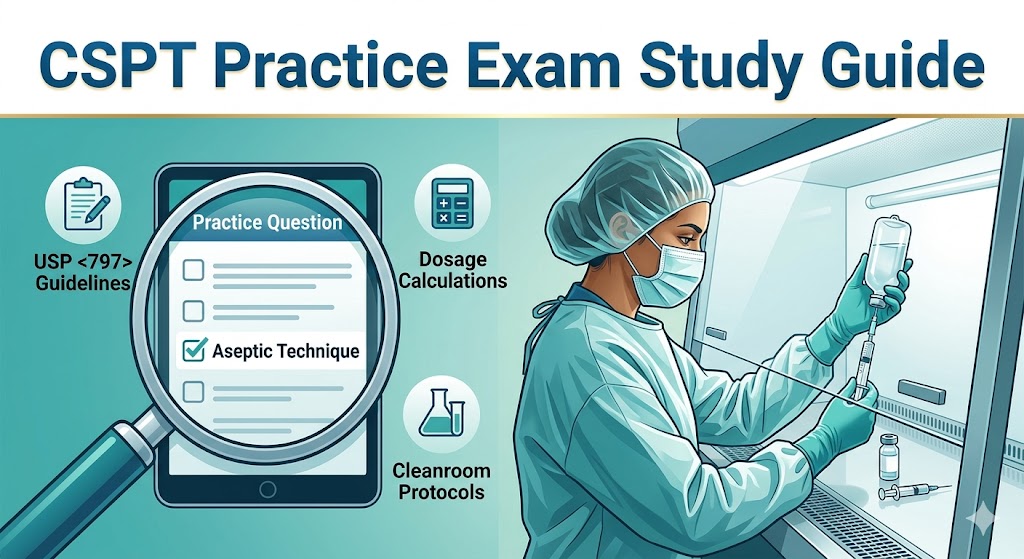
Additional Information
What the Course Entails and Exam Details
Preparing for the CSPT exam requires a deep understanding of the regulatory standards governing sterile compounding, particularly USP Chapters <797> and <800>. While not a "course" itself, candidates often complete recognized training programs or gain extensive on-the-job experience.
The CSPT exam syllabus is organized into four major knowledge domains, weighted as follows:
Medications and Components (17%): Covers therapeutic classifications, indications, standard dosages, physical characteristics, and the proper handling of CSP components, including specialized medications.
Facilities and Equipment (22%): Focuses on cleanroom engineering controls (ISO classes), laminar flow hoods, biological safety cabinets, barrier isolators, and the stringent protocols for cleaning, sanitizing, and monitoring these environments.
Sterile Compounding Procedures (53%): The core section covering aseptic handwashing, garbing sequences, sterile field maintenance, rigorous aseptic technique for standard IVs, piggybacks, hazardous drug preparations, and sterilization methods.
Handling, Packaging, Storage, and Disposal (8%): Detailes proper labeling requirements, beyond-use date determination based on risk levels, specialized storage, transport of CSPs, and the legal protocols for hazardous waste disposal.
What to Expect in the Final Exam
Knowing the exam format is vital for managing test-day anxiety. The CSPT final exam is a computer-based, standardized test.
Question Count: There are a total of 75 multiple-choice questions on the exam.
Scored vs. Unscored: Of the 75 questions, only 60 are scored. The remaining 15 are pretest questions used to gather data for future exams and are randomly distributed; you will not know which questions are which.
Time Limit: Candidates are given a total of 2 hours (120 minutes) to complete the exam. This time includes a tutorial and a post-exam survey. The actual exam time is 1 hour and 50 minutes.
Passing Score: PTCB uses a scaled score range from 1,000 to 1,600. The passing score is 1,400.
Results: Upon completion of the exam, you will receive an immediate, unofficial result (pass/fail) on the screen. Official results are typically available in your PTCB account within two to three weeks.
How to Study and Exam Centers
Successfully challenging the CSPT exam requires a dedicated and structured study plan.
Leverage PTCB Official Resources: Utilize the official PTCB CSPT Exam Content Outline and Medications List as your primary blueprints for study. These documents define exactly what you must know.
Deep Dive into USP <797> and <800>: These chapters form the regulatory backbone of the exam. Do not just skim them; understand the rationale behind every rule. Create comparison tables for cleanroom classifications, garbing steps, and beyond-use dating.
Relentless Calculation Practice: Math is a cornerstone of sterile compounding. Practice dosage calculations, concentration problems, alligation methods, and flow rate equations daily until they become second nature.
Utilize High-Quality Practice Exams: Simulate the actual test environment by taking CSPT practice exams. These are essential for gauging your knowledge gaps, understanding the phrasing of PTCB questions, and practicing your time management skills under pressure. Look for resources that provide explanations for correct and incorrect answers.
Build Specialized Flashcards: Use flashcards for drug classifications, storage requirements, required PPE for different compounding levels, and decontamination protocols.
Exam Centers: The CSPT exam is administered nationwide through Pearson VUE. Candidates can schedule their exam at a Pearson VUE professional test center or choose the online proctored testing option to take the exam from their own computer, provided they meet the strict technical requirements. After approval, you will receive an "authorization to schedule" email with a 90-day window to complete the exam.
Job Opportunities from the Course
Earning the CSPT credential signals to employers that you have achieved a high level of proficiency and specialized knowledge that is directly linked to enhanced patient safety. This specialty certification is increasingly preferred, and sometimes required, for advanced technician roles.
Specific job titles and career paths this certification can unlock include:
Lead Sterile Compounding Technician
IV Room Supervisor
Chemotherapy/Oncology Technician
Parenteral Nutrition Specialization Technician
Nuclear Pharmacy Technician (may require additional specialized training)
Home Infusion Pharmacy Technician
Pharmacy Quality Assurance/Compliance Coordinator
Pharmacy Technician Educator (focused on compounding)
By earning your CSPT certification, you are not just passing a test; you are positioning yourself as a vital specialist on the modern healthcare team. Good luck with your studies!
Frequently Asked Questions
Reviews
5.0
Based on 0 reviews
Leave a Review
No reviews yet. Be the first to review!