
Comprehensive Agriculture and Land Use Practice Test
$69.00
- Buy to unlock unlimited access to all Quiz questions and Answers in this Quiz.
- After purchase you can print a PDF of the whole quiz at any point. The PDF will contain the questions and the correct answers.
About this Exam
The Comprehensive Agriculture and Land Use Certification is an essential milestone for emerging professionals in the agricultural, environmental, and municipal planning sectors. This exam validates a candidate's holistic understanding of sustainable farming practices, environmental stewardship, and the regulatory frameworks governing land allocation. It is designed for aspiring farm managers, agricultural extension agents, environmental consultants, and urban/rural planners who need to demonstrate competence in balancing productive land use with ecological preservation. Candidates are expected to prove their ability to apply theoretical principles to real-world scenarios, making sound decisions regarding resource management, soil health, and legislative compliance.
Ready to test your knowledge?
Buy Now to Access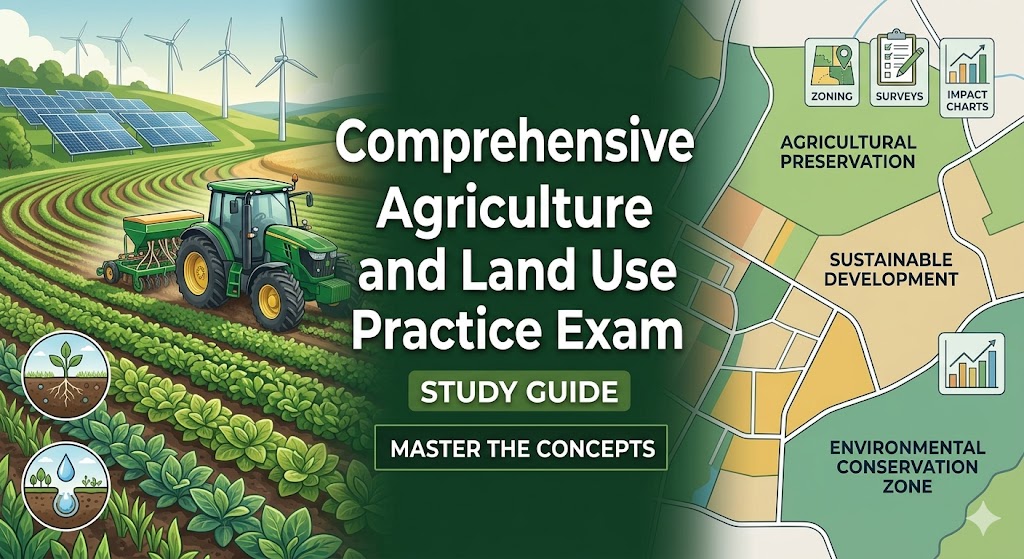
Additional Information
What the Course Entails and Exam Details
This comprehensive examination covers a diverse and interconnected range of critical topics that reflect the modern agricultural landscape. The core syllabus tests proficiency in several key domains. Students must demonstrate deep knowledge of Soil Science and Conservation, including soil classification, fertility management, erosion control, and health restoration techniques. A significant portion focuses on Sustainable Crop and Animal Production Systems, encompassing integrated pest management (IPM), irrigation efficiency, livestock welfare basics, and rotating pasture systems. Environmental Policy and Land Regulation is another critical area, testing understanding of zoning laws, environmental impact assessment protocols, water rights, and conservation easements. Finally, Agribusiness and Resource Economics covers basic financial management of agricultural operations, land valuation, and risk assessment related to land-use changes.
What to Expect in the Final Exam
The Comprehensive Agriculture and Land Use Final Exam is a rigorous, proctored assessment designed to evaluate both theoretical knowledge and practical application. The standard format consists of 100 to 120 multiple-choice questions, which must be completed within a strict three-hour time limit. The passing score requirement is generally set at 70% or higher, reflecting the need for a strong command of the material. Many questions are scenario-based, presenting complex land-use or farming challenges that require candidates to synthesize knowledge from multiple subject areas to choose the most sustainable or compliant course of action. Security is tight, and students may only bring approved, non-programmable calculators; no external study aids are permitted during the session.
How to Study and Exam Centers
Effective preparation requires a structured and multi-faceted study strategy. Begin by thoroughly reviewing the official candidate handbook and syllabus to identify your weak areas. Utilize authoritative textbooks on agronomy, soil science, and environmental planning as your primary resources. We highly recommend creating detailed flashcards for key terminology, legislative acts, and conservation definitions. Taking multiple practice tests, like the one you are preparing for, is crucial for simulating the timed exam environment and identifying gaps in your reasoning. These certifications are often administered globally through recognized professional testing providers, such as Pearson VUE, within their secure physical centers. Alternatively, some authorized agricultural universities, specialized training schools, or government agencies may offer proctored exam sessions.
Job Opportunities from the Course
Earning the Comprehensive Agriculture and Land Use Certification opens doors to diverse and impactful career paths. This credential is highly valued by employers in both the public and private sectors who are looking for validated expertise. The following job titles and career paths are typical for individuals who have successfully mastered this material:
Farm Manager: Supervising agricultural operations with a focus on sustainability and regulatory compliance.
Agricultural Extension Agent: Advising farmers and landowners on best practices for production and conservation.
Land Use Planner (Rural/Regional): Developing municipal or county plans that balance development with agricultural preservation.
Conservation Scientist / Resource Manager: Working with government agencies or NGOs to protect soil and water resources.
Environmental Consultant: Assessing agricultural land for environmental impact or regulatory compliance.
Agribusiness Risk Analyst: Evaluating the viability and safety of agricultural investments and land acquisition.
Frequently Asked Questions
Reviews
5.0
Based on 0 reviews
Leave a Review
No reviews yet. Be the first to review!