
Comprehensive Core Nursing Practice Test
$69.00
- Buy to unlock unlimited access to all Quiz questions and Answers in this Quiz.
- After purchase you can print a PDF of the whole quiz at any point. The PDF will contain the questions and the correct answers.
About this Exam
The Comprehensive Nursing Core Practice Test is an essential, diagnostic evaluation tool designed specifically for final-year nursing students and recent graduates of Registered Nursing (RN) or Practical Nursing (PN) programs. This critical assessment serves as a benchmark to gauge a candidate's readiness for their official, mandatory licensure examinations, such as the NCLEX-RN or NCLEX-PN. It is designed to evaluate whether a student has successfully synthesized the core knowledge and clinical judgment skills required to practice safely and effectively as an entry-level nurse. By taking this practice test, aspiring nurses can identify their academic strengths and weaknesses before taking the high-stakes official exam, significantly boosting their confidence and passing potential.
Ready to test your knowledge?
Buy Now to Access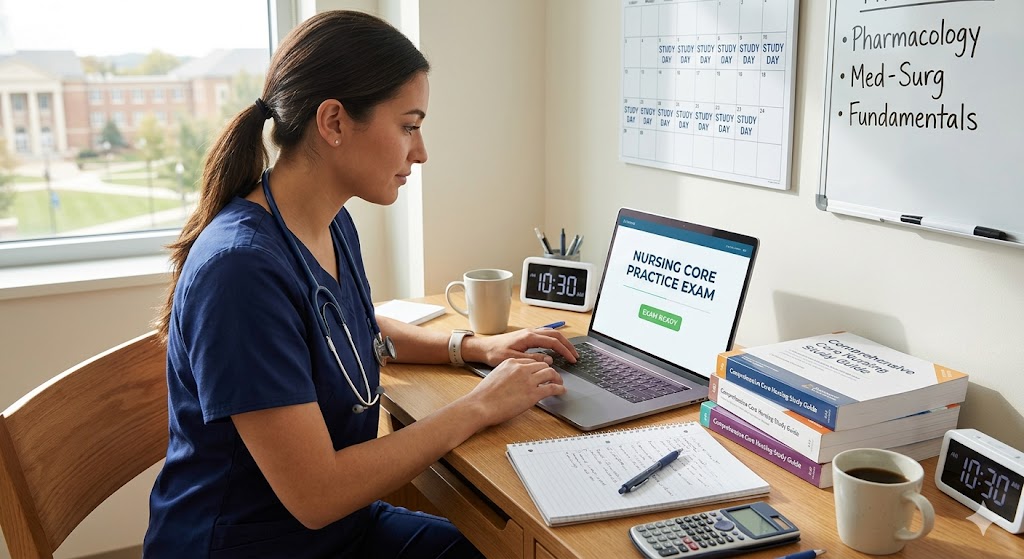
Additional Information
What the Course Entails and Exam Details
This examination is not a single course, but rather a final, cumulative assessment of a student’s entire nursing education journey. It synthesizes knowledge from various foundational and advanced nursing courses. The test plan is typically structured to mimic the Client Needs Categories set by major licensing bodies. The core topics and skills covered in this practice exam include:
Management of Care / Coordinated Care: This covers delegation, prioritization of patient care, ethical practice, legal responsibilities, and advocacy.
Safety and Infection Control: Focusing on accident prevention, standard precautions, handling hazardous materials, and surgical asepsis.
Health Promotion and Maintenance: Includes concepts of aging, antepartum/intrapartum/postpartum care, newborn care, and lifestyle choices.
Psychosocial Integrity: Assessing mental health concepts, coping mechanisms, therapeutic communication, and crisis intervention.
Basic Care and Comfort: Covering nutrition, elimination, mobility, hygiene, and rest.
Pharmacological and Parenteral Therapies: Concentrating on dosage calculation, medication administration, expected effects, and potential adverse reactions.
Reduction of Risk Potential: Including the interpretation of laboratory values, vital signs, and diagnostic test results.
Physiological Adaptation: Covering fluid and electrolyte imbalances, pathophysiology, medical emergencies, and post-operative care.
What to Expect in the Final Exam
When you sit for this practice test, you should expect a computerized adaptive testing (CAT) format or a standardized linear format, depending on the specific provider you choose. This format mirrors the official licensure experience to desensitize you to test-day anxiety.
Exam Format: The primary question format is standard multiple choice. However, to truly reflect modern licensure exams, this test also includes alternate-format questions. These include Select All That Apply (SATA), fill-in-the-blank (often for dosage calculation), hot spot (identifying anatomical locations on an image), and drag-and-drop sequencing.
Time Limit: Candidates are typically allotted a strict time limit, ranging from 3 to 6 hours, matching the actual licensure exam’s duration. This teaches you essential time management skills.
Passing Score Requirements: There is no standard “passing” score, as a practice test is diagnostic. Instead, the test provides a probability score or a detailed readiness report showing your proficiency level in each content category. The goal is to obtain a score that places you in the “highly probable to pass licensure” category according to the test provider’s scoring metrics.
Specific Rules: This exam is usually proctored (even online) to ensure integrity. The use of calculators is strictly forbidden except for the on-screen digital calculator provided within the testing software. You are generally not allowed to access outside resources or personal devices during the active testing window.
How to Study and Exam Centers
Preparation is the key to maximizing the diagnostic benefit of this test. Follow these actionable study strategies:
Use Standardized Review Guides: Utilize reputable study manuals and review books that are specifically aligned with the current licensure test plans. Focus on synthesis rather than rote memorization.
Prioritize Practice Questions: Answer thousands of practice questions. However, do not just answer them; spend significant time reading the rationales for both correct and incorrect answers. This develops your clinical reasoning skills.
Focus on Weakness: Use smaller, focused quizzes to target the specific content areas (e.g., pharmacology or mental health) that you consistently find challenging.
Simulate the Experience: Take at least two full-length practice tests under real exam conditions: quiet room, no breaks, no phone, and with the actual time limit to build endurance.
Practice dosage calculation daily: Calculation errors are common and easily avoidable with consistent practice.
Where to Take the Exam (Exam Centers)
Because this is a preparatory practice test rather than the actual licensure exam, it is highly accessible. You can typically access the exam through two main pathways:
Online Portals: Most students purchase access to this test via authorized third-party nursing education providers. In this case, you can take the exam from the comfort of your own home, provided you have a reliable internet connection and meet the proctoring requirements (which may include using a webcam).
Authorized Schools and Organizations: Many nursing schools purchase these standardized practice tests in bulk as part of their "exit exam" requirements for graduation. In this scenario, you will take the exam in a proctored computer lab at your college or university.
Note: You do not register for this practice test through actual licensure centers like Pearson VUE; those centers are only for the final, official state-board exams.
Job Opportunities from the Course
Successfully utilizing this Comprehensive Core Nursing Practice Test is the vital bridge to passing your official licensure exam. Once you have used this practice to successfully pass your NCLEX-RN or NCLEX-PN and achieved state licensure, a vast landscape of career opportunities becomes available to you. Licensed nursing practitioners are in high demand.
Common job titles and career paths you can unlock include:
Registered Nurse (RN) within a hospital (including ICU, ER, OR, or Med-Surg)
Licensed Practical Nurse / Licensed Vocational Nurse (LPN/LVN)
Home Health Nurse
Pediatric Nurse
Geriatric Nurse / Long-Term Care Nurse
Travel Nurse (RN or LPN)
Occupational Health Nurse
School Nurse
Case Manager Nurse
Hospice and Palliative Care Nurse
Emergency Room Nurse
Operating Room Nurse
Telehealth Nurse
Psychiatric-Mental Health Nurse
Public Health Nurse
Critical Care Nurse (ICU)
Oncology Nurse
Obstetrics and Gynecology Nurse (OB-GYN)
Legal Nurse Consultant (typically after gaining significant experience)
Nursing Educator (after achieving advanced degrees)
Frequently Asked Questions
Reviews
5.0
Based on 0 reviews
Leave a Review
No reviews yet. Be the first to review!