
Comprehensive Guide to Animal Use and Care in Biomedical Research Practice Test
$69.00
- Buy to unlock unlimited access to all Quiz questions and Answers in this Quiz.
- After purchase you can print a PDF of the whole quiz at any point. The PDF will contain the questions and the correct answers.
About this Exam
The Comprehensive Guide to Animal Use and Care in Biomedical Research Practice Test is a valuable educational resource designed for a wide range of professionals involved in laboratory animal science. This includes research scientists, veterinarians, veterinary technicians, laboratory animal technologists, IACUC (Institutional Animal Care and Use Committee) administrators, and compliance officers. The practice test serves as a crucial tool to assess an individual’s knowledge and readiness for actual exams or job roles requiring adherence to high standards of ethical animal care and regulatory compliance in research settings. It helps bridge the gap between theoretical knowledge and practical application, ensuring that ethical considerations and animal welfare remain paramount in biomedical progress.
Ready to test your knowledge?
Buy Now to Access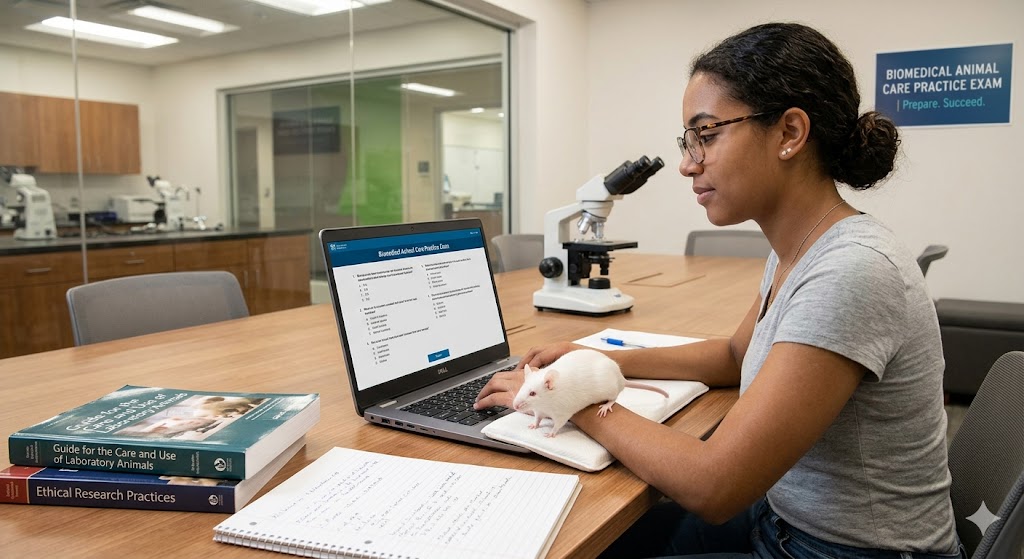
Additional Information
What the Course Entails and Exam Details
This practice exam comprehensively covers the core knowledge areas essential for responsible animal use and care in biomedical research. While not a formal course itself, its content reflects the syllabus of comprehensive training programs and regulatory requirements. Key topics include:
Regulations and Guidelines: In-depth knowledge of the Animal Welfare Act (AWA), Public Health Service (PHS) Policy, the "Guide for the Care and Use of Laboratory Animals," and other relevant international, national, and local standards.
IACUC Function and Oversight: Understanding the role, composition, and responsibilities of the Institutional Animal Care and Use Committee, protocol review processes, and facility inspections.
Ethics and the 3Rs: Thorough understanding of ethical considerations in animal research, including the principles of Replacement, Reduction, and Refinement.
Species-Specific Care and Handling: Knowledge of appropriate housing, nutrition, environmental enrichment, handling, and restraint techniques for common research species (e.g., mice, rats, rabbits, non-human primates).
Pain, Distress, Anesthesia, and Analgesia: Recognition of pain and distress in animals, appropriate use of anesthetics and analgesics, and monitoring requirements.
Surgery and Aseptic Technique: Principles of survival and non-survival surgery, aseptic procedures, and post-operative care.
Health Monitoring and Disease Control: Identification of common diseases, biosecurity measures, and veterinary care protocols.
Occupational Health and Safety: Understanding risks associated with working with laboratory animals, including allergens, zoonoses, and physical hazards.
What to Expect in the Final Exam
The actual exam that this practice test prepares you for typically follows a specific format to assess comprehensive knowledge. Here are common features:
Format: The exam is most often composed of multiple-choice questions. It may include scenario-based questions that test the application of knowledge to real-world situations in a research setting.
Number of Questions: The number of questions can vary, but expect a significant set, perhaps ranging from 100 to 150 questions, covering all major topics.
Time Limit: There is usually a strict time limit, requiring you to complete the exam within a specified duration (e.g., 2 to 3 hours). This tests not just knowledge, but also the ability to process information efficiently.
Passing Score: A minimum passing score is required, often ranging from 70% to 80% or higher. It is essential to aim for mastery rather than just a minimal pass.
Rules: Standard examination rules apply, whether taken online or in person. This includes restrictions on resources (e.g., closed-book exam), rules against cheating, and identification requirements. For online exams, remote proctoring may be used.
How to Study and Exam Centers
Preparation is key to success. Utilize the following strategies and understand where and how to take the actual exam.
Study Guides and Textbooks: Consult authoritative sources such as the latest edition of the "Guide for the Care and Use of Laboratory Animals," textbooks on laboratory animal science, and relevant regulatory publications. Create detailed notes or summaries.
Practice Exams: Utilize the "Comprehensive Guide to Animal Use and Care in Biomedical Research Practice Test" multiple times. Analyze not just your score but the explanation for each correct and incorrect answer to deepen your understanding. This practice is instrumental in identifying knowledge gaps and getting comfortable with the exam style and time constraints.
Flashcards: Create flashcards for key definitions, regulatory bodies, core ethical principles (the 3Rs), and specific care requirements for different species.
Hands-on Experience: If possible, correlate your theoretical knowledge with practical experience in a laboratory setting. This reinforces learning and makes abstract concepts tangible.
Study Groups: Collaborate with colleagues or peers preparing for the same or similar certifications to discuss challenging concepts and quiz each other.
For the actual exam, common administration methods include:
Online Testing Portals: Many professional organizations offer online exams, sometimes with remote proctoring, allowing you to take the test from your location.
Authorized Testing Centers: Independent testing centers, such as Pearson VUE, may be used to deliver the exam in a controlled environment.
Specific Physical Centers: Large institutions, universities, or research centers with authorized testing facilities may conduct exams for their staff or associated personnel.
Specific Physical Schools: Educational institutions offering laboratory animal science programs might serve as testing locations for their students and sometimes external candidates.
Pearson VUE: This large network of testing centers is often utilized for various professional certifications, providing convenient access globally. Be sure to check the specific organization administering your exam for their authorized centers.
Job Opportunities from the Course
A strong performance on an exam like this, often coupled with practical experience, can open doors to numerous rewarding career paths in biomedical research and laboratory animal science. Some specific job opportunities include:
Animal Research Technician
Laboratory Animal Technologist (LAT or LATG)
IACUC Administrator
Veterinary Technician (Research Specialist)
Vivarium Manager
Compliance Officer (Animal Welfare)
Research Scientist/Investigator (using animal models)
Clinical Veterinarian (Laboratory Animal Medicine)
Training Coordinator (Laboratory Animal Science)
Animal Welfare Specialist
Frequently Asked Questions
Reviews
5.0
Based on 0 reviews
Leave a Review
No reviews yet. Be the first to review!