
Comprehensive Guide to Cultural Patterns, Diffusion, and Language in Geography Practice Test
$69.00
- Buy to unlock unlimited access to all Quiz questions and Answers in this Quiz.
- After purchase you can print a PDF of the whole quiz at any point. The PDF will contain the questions and the correct answers.
About this Exam
This comprehensive practice test is specifically designed for students preparing for examinations in introductory human geography, such as the AP Human Geography exam or college-level cultural geography courses.
It serves as a crucial assessment tool for individuals aiming to demonstrate mastery of how culture shapes spaces, how ideas and practices spread globally, and the complex role language plays in human interaction and identity.
Whether you are a high school student striving for college credit or an undergraduate reinforcing foundational concepts, this guide and practice test will help you identify knowledge gaps and build confidence for your final assessment.
Ready to test your knowledge?
Buy Now to Access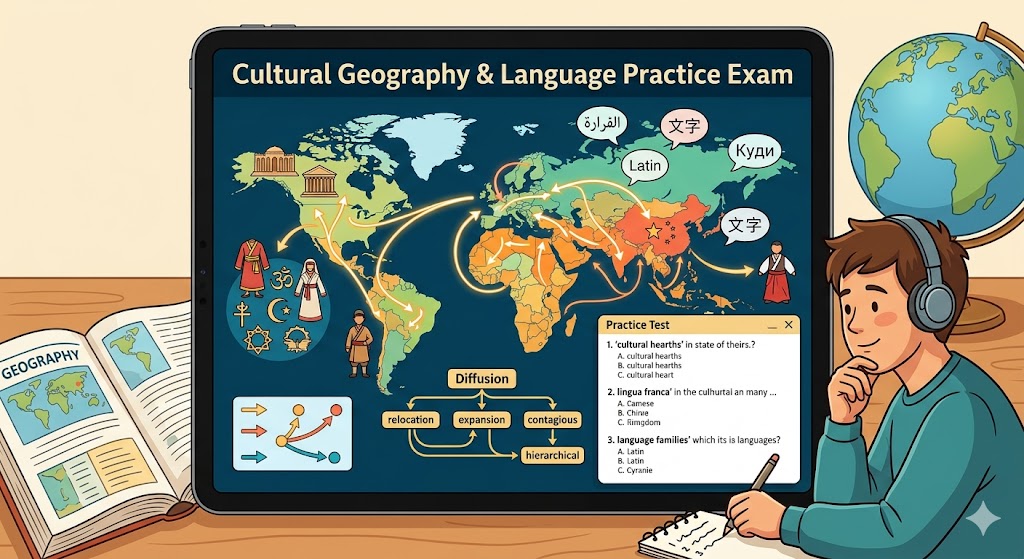
Additional Information
What the Course Entails and Exam Details
The core syllabus covered by this practice exam focuses on the spatial distribution and interaction of cultural traits.
Key topics include defining culture and cultural landscapes, analyzing the multi-faceted processes of cultural diffusion (including relocation, expansion, contagious, hierarchical, and stimulus diffusion), and understanding cultural hearths.
A significant portion of the material is dedicated to the geography of language, covering language families, dialects, lingua francas, and the impact of globalization on language diversity and preservation.
Students will also explore concepts of acculturation, assimilation, and multiculturalism, and how these processes manifest visually on the cultural landscape.
What to Expect in the Final Exam
While this is a practice test, the final exams it prepares you for typically follow a standardized format.
Most commonly, these exams consist of a significant multiple-choice section designed to test broad content knowledge and analytical skills.
Many standardized geography exams, such as the AP exam, also include a free-response or essay section requiring students to apply concepts to real-world scenarios, interpret maps or data, and synthesize information.
You should expect time limits (e.g., 60 minutes for the multiple-choice section) and varying passing score requirements depending on the specific institution or testing body administering the final certification.
How to Study and Exam Centers
Effective study strategies involve a combination of rote memorization of key terms and conceptual understanding.
Utilize flashcards for essential vocabulary like cultural relativism, isogloss, pidgin language, and creolization.
Practice interpreting maps that show the distribution of language families or the historical spread of religions and innovations.
Reviewing case studies of cultural conflicts or successful multicultural societies can also deepen your understanding of how these patterns play out in reality.
For the final standardized exam (such as AP or college finals), testing typically takes place at authorized locations; AP exams are administered at registered high schools, while college exams occur on campus or through authorized online proctoring portals.
Job Opportunities from the Course
Mastery of cultural geography concepts is invaluable for numerous career paths that require an understanding of human diversity and spatial interaction.
Urban and Regional Planner: Utilizing knowledge of cultural landscapes and community dynamics to design inclusive public spaces.
International Relations Specialist: Applying understanding of cultural diffusion and language barriers to navigate global political and social issues.
Market Research Analyst: Analyzing cultural patterns to help businesses understand consumer behavior in different regions.
Geographer: Conducting research on the spatial distribution of cultural traits and the impacts of globalization.
High School Geography Teacher: Educating the next generation on fundamental concepts of human geography and global cultures.
Cultural Resource Manager: Working to preserve and manage tangible and intangible cultural heritage.
Frequently Asked Questions
Reviews
5.0
Based on 0 reviews
Leave a Review
No reviews yet. Be the first to review!